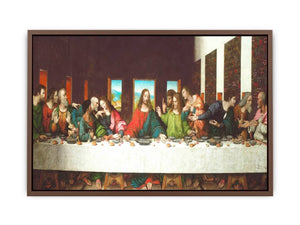
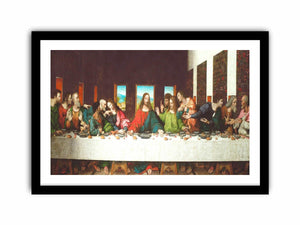
The Last Supper 1498 Painting by Leonardo da Vinci
The Last Supper 1498 Painting by Leonardo da Vinci stands as one of the most intellectually profound and psychologically innovative works in the history of Western art, a painting that transformed a familiar biblical subject into a monumental study of human emotion, moral tension, and compositional intelligence. Completed in 1498 for the refectory of the Dominican convent of Santa Maria delle Grazie in Milan, the work marks a decisive moment in Renaissance painting, redefining how narrative, space, and psychology could be fused into a single, unified vision.
The artist who conceived this revolutionary image, Leonardo da Vinci, approached painting not merely as an act of representation, but as a form of inquiry. Leonardo’s interests in anatomy, optics, geometry, and human behavior converge fully in The Last Supper. Rather than relying on symbolic repetition or devotional formula, he sought to understand how individuals react under emotional strain, how bodies communicate thought, and how space can structure meaning. This painting is not an illustration of scripture; it is an investigation into human response at a moment of moral rupture.
The subject depicts the moment described in the Gospel of John when Christ announces to his disciples that one of them will betray him. Earlier depictions of the Last Supper typically emphasized ritual or hierarchy, presenting the apostles in static arrangements or isolating Judas through overt symbolism. Leonardo rejects this approach. He chooses the precise psychological instant of disclosure, capturing the shockwave of Christ’s words as it ripples across the table. Betrayal is not shown as an act completed, but as a revelation unfolding in real time.
Compositionally, the painting is a masterwork of order and dynamism held in perfect balance. Christ sits at the exact center of the composition, forming a stable triangular shape that anchors the scene both visually and symbolically. The apostles are arranged in four groups of three, each cluster reacting differently to the announcement. This grouping creates rhythmic variation while maintaining structural coherence. Movement flows laterally across the painting, yet all lines—architectural, perspectival, and psychological—ultimately return to Christ.
Perspective is rigorously controlled and philosophically charged. Leonardo employs linear perspective to extend the refectory’s architecture into the painted space, aligning the vanishing point with Christ’s head. This device draws the viewer’s attention inexorably toward him, reinforcing his spiritual centrality without reliance on overt symbolism. The illusion of depth also integrates the painting seamlessly into its architectural setting, dissolving the boundary between sacred image and lived space.
Light plays a crucial role in shaping meaning. Soft illumination enters from the background windows, framing Christ’s silhouette and lending his figure a calm radiance. Unlike later Baroque dramatization, Leonardo’s light is rational and descriptive rather than theatrical. It reveals form, gesture, and expression with clarity, allowing the viewer to read the emotional state of each apostle. Light here serves cognition rather than spectacle.
The color palette is restrained and harmonious. Leonardo uses muted blues, reds, and earth tones to unify the composition and avoid distraction. Christ’s garments, traditionally rendered in red and blue, assert visual calm amid surrounding agitation. The subdued palette supports psychological focus, ensuring that emotional response, not decorative richness, dominates the viewer’s experience.
Leonardo’s technique in The Last Supper was experimental and ambitious. Rather than using true fresco, he applied tempera and oil to dry plaster in order to achieve subtle tonal transitions and painterly detail. This innovation allowed him to model faces and gestures with unprecedented nuance, though it also contributed to the painting’s rapid deterioration. Despite its fragile material condition, the conceptual and visual power of the work has remained undiminished.
Symbolically, the painting operates through gesture and expression rather than conventional iconography. Each apostle reacts according to temperament—some with disbelief, others with anger, sorrow, or confusion. Judas is not isolated physically but psychologically, recoiling into shadow while clutching the money bag, his posture tense and defensive. Leonardo’s insight lies in presenting betrayal as a human action emerging from within the group, not an external intrusion.
Psychologically, The Last Supper is unparalleled. Leonardo treats the apostles as individuals rather than types, each absorbed in personal reaction to collective crisis. Christ alone remains composed, his calm contrasting sharply with the agitation around him. This contrast establishes a profound emotional axis: divine certainty versus human instability. The painting thus becomes a meditation on faith, doubt, and moral choice rather than a static religious image.
Within Leonardo’s oeuvre, The Last Supper represents the fullest realization of his belief that painting could rival philosophy in depth and complexity. While he produced relatively few completed works, this painting alone reshaped the trajectory of Western art. It influenced generations of painters, from Renaissance masters to modern interpreters, establishing new standards for narrative coherence, psychological realism, and spatial integration.
Culturally, the painting occupies a central place in collective imagination. It has transcended its religious origins to become a universal image of trust, betrayal, and human fragility. Its power lies not in dogma, but in empathy. Viewers of all backgrounds recognize the emotional truth of the scene, making The Last Supper perpetually relevant across cultures and eras.
In contemporary interiors across the United States, the United Kingdom, Canada, Australia, and Europe, The Last Supper carries exceptional gravitas and symbolic depth. In dining rooms and formal living spaces, it resonates with themes of gathering, community, and moral reflection. In studies and offices, it conveys intellectual seriousness and historical authority. In galleries and luxury residences, it anchors space with monumental presence, integrating seamlessly into traditional, modern, minimalist, and eclectic décor through its balanced composition and universal subject matter.
The painting remains meaningful today because it addresses the most enduring aspects of human experience: loyalty, doubt, conscience, and consequence. In a world still shaped by trust and betrayal, Leonardo’s vision offers no easy resolution. It presents humanity as it is—complex, emotional, and accountable. The painting does not instruct through doctrine. It reveals through observation.
The Last Supper 1498 Painting by Leonardo da Vinci endures as one of the greatest achievements of human thought rendered in visual form. Through compositional mastery, psychological insight, and intellectual ambition, Leonardo transformed a sacred narrative into a timeless exploration of human nature. The painting does not merely depict history. It examines it.
Buy museum qulaity 400- 450 canvas prints, framed prints, and 100% oil paintings of The Last Supper by Leonardo da Vinci at Alpha Art Gallery, where world-famous masterpieces are recreated with museum-quality detail, refined craftsmanship, and premium materials.
FAQs
What moment does The Last Supper depict?
It depicts the moment Christ announces that one of his disciples will betray him.
Why is Christ placed at the center of the composition?
His central placement reinforces spiritual authority and anchors the entire narrative and perspective.
How does Leonardo portray Judas differently?
Judas is integrated within the group but psychologically isolated through posture, shadow, and gesture.
Why is this painting considered revolutionary?
It introduced unprecedented psychological realism and compositional unity to narrative painting.
What role does perspective play in the work?
Linear perspective directs attention toward Christ and integrates the painting with architectural space.
Why has the painting deteriorated over time?
Leonardo’s experimental technique, using tempera and oil on dry plaster, proved unstable.
Why does The Last Supper remain relevant today?
Its exploration of trust, betrayal, and human reaction transcends religious context.
Where does this artwork work best in interiors?
It is ideal for dining rooms, living rooms, studies, galleries, and spaces emphasizing history and reflection.