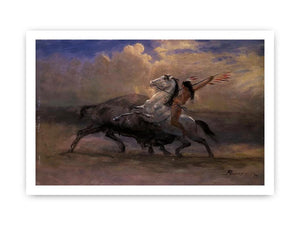
The Last of the Buffalo II Painting by Albert Bierstadt
The Last of the Buffalo II stands as one of Albert Bierstadt’s most solemn and historically charged works, a painting in which the grandeur of the American landscape gives way to a profound meditation on loss, transition, and irrevocable change. Created in the late nineteenth century, the work departs from Bierstadt’s more serenely idealised visions of the West, confronting instead the consequences of expansion and the fragility of natural and cultural systems. In this painting, the wilderness is no longer presented as eternal and untouched; it becomes a stage upon which disappearance unfolds.
Albert Bierstadt was long celebrated for his luminous panoramas of mountains, valleys, and forests that defined the American sublime for nineteenth-century audiences. Yet his engagement with the West was not limited to awe alone. As the century progressed, the realities of westward expansion, industrialisation, and ecological devastation became increasingly visible. The near-extinction of the American buffalo was among the most potent symbols of this transformation. The Last of the Buffalo II emerges from this awareness, offering not a detached observation, but a reflective and mournful response.
The composition is dramatic and charged with movement. A small herd of buffalo is shown under assault, surrounded by hunters on horseback. The animals are rendered with weight and physical presence, their bodies powerful yet vulnerable. The surrounding landscape, though still vast, no longer offers refuge. Open plains stretch outward, exposing the figures rather than sheltering them. Bierstadt uses this openness to intensify the sense of inevitability, as though the land itself can no longer protect what once defined it.
Perspective heightens the painting’s emotional force. The viewer is placed close to the action, drawn into the immediacy of the encounter rather than positioned as a distant observer. This proximity denies comfort. It insists on confrontation. Unlike Bierstadt’s panoramic works that encourage contemplative distance, The Last of the Buffalo II collapses space, forcing the viewer to witness a moment of violent transition. The painting does not allow retreat into scenic admiration.
Light plays a stark and purposeful role. Rather than the radiant, harmonising illumination found in Bierstadt’s idealised landscapes, light here exposes rather than elevates. It reveals dust, motion, and tension, clarifying forms without softening their impact. Shadows deepen the sense of urgency, accentuating the struggle unfolding across the canvas. Light becomes an instrument of truth rather than transcendence.
Colour reinforces the painting’s gravity. Earth tones dominate the palette—browns, ochres, muted greens, and greys—binding figures and land into a single, somber field. These colours lack the luminous optimism characteristic of Bierstadt’s earlier works. Instead, they convey dryness, depletion, and finality. The sky, often a site of spiritual openness in his landscapes, here feels heavy and restrained, mirroring the painting’s emotional weight.
Bierstadt’s technique remains highly refined, yet it serves a different purpose than in his celebratory landscapes. Detail is used to emphasise physical strain and immediacy rather than ideal form. Muscles tense, bodies collide, and motion is arrested at its most critical moment. The artist’s academic precision intensifies realism, making the scene feel unavoidable rather than theatrical. The polish of execution contrasts sharply with the brutality of subject matter, heightening its impact.
Symbolically, The Last of the Buffalo II operates on multiple levels. The buffalo represent not only a species driven to near extinction, but a way of life intrinsically connected to the land and to Indigenous cultures. Their destruction becomes a metaphor for the broader erasure accompanying expansion. Bierstadt does not romanticise the violence, nor does he overtly moralise it. Instead, he presents it as fact—monumental, tragic, and irreversible. The title itself underscores finality, framing the scene as an ending rather than an episode.
Emotionally, the painting is charged with tension and sorrow. There is energy in the movement, yet no sense of triumph. Viewers often experience discomfort alongside admiration, recognising the painting’s technical mastery while grappling with its implications. This emotional complexity distinguishes the work within Bierstadt’s oeuvre. It refuses the reassurance found in his serene landscapes, replacing it with unresolved reflection.
Within Bierstadt’s career, The Last of the Buffalo II represents a critical shift. It reveals an artist increasingly aware of the consequences embedded within the myths of the West. While his earlier works helped shape an image of wilderness as boundless and eternal, this painting acknowledges limits—ecological, cultural, and moral. It complicates Bierstadt’s legacy, demonstrating that his vision of the West could accommodate reckoning as well as reverence.
Culturally, the painting occupies a powerful place in American visual history. The near-extermination of the buffalo became emblematic of unchecked expansion and environmental devastation. By addressing this subject, Bierstadt participated in a broader nineteenth-century recognition that progress carried profound costs. The painting thus functions not only as art, but as historical witness, preserving a moment of irreversible change within collective memory.
In contemporary interiors, The Last of the Buffalo II commands presence through meaning rather than decorative appeal. In living rooms and studies, it functions as a powerful focal point that invites discussion and sustained engagement. In offices and galleries, it communicates intellectual seriousness and historical awareness. Within luxury residences and curated spaces across the United States, United Kingdom, Canada, Australia, and Europe, the painting integrates most effectively within interiors that value depth, narrative, and cultural significance. Its restrained palette and dramatic composition lend it gravity without excess.
The enduring relevance of The Last of the Buffalo II lies in its confrontation with loss. Bierstadt presents a moment when abundance collapses into absence, urging viewers to reckon with the consequences of human action. In an era increasingly defined by environmental concern and historical reassessment, the painting speaks with renewed urgency. It reminds us that landscapes are not only spaces of beauty, but arenas of responsibility, and that what is lost cannot always be recovered. Through this work, Bierstadt extends landscape painting beyond admiration, transforming it into a vehicle for memory, warning, and reflection.
Buy museum qulaity 400- 450 canvas prints, framed prints, and 100% oil paintings of The Last of the Buffalo II by Albert Bierstadt at Alpha Art Gallery, where world-famous masterpieces are recreated with museum-quality detail, refined craftsmanship, and premium materials.
FAQS
What does The Last of the Buffalo II by Albert Bierstadt represent?
It represents the near-extinction of the American buffalo and the broader consequences of westward expansion.
Is this painting based on a historical reality?
Yes, it reflects the real devastation of buffalo populations in the nineteenth century due to overhunting and expansion.
How does this work differ from Bierstadt’s typical landscapes?
It is confrontational and tragic, focusing on loss and conflict rather than serene grandeur and timeless beauty.
What emotional tone does the painting convey?
It conveys tension, sorrow, and inevitability rather than awe or reassurance.
Do the buffalo carry symbolic meaning?
Yes, they symbolise both ecological destruction and the erosion of Indigenous ways of life tied to the land.
Is the painting intended as a moral statement?
It does not overtly moralise, but presents a powerful visual reckoning with irreversible change.
Is The Last of the Buffalo II suitable for contemporary interiors?
Yes, particularly in spaces that value historical depth, narrative strength, and intellectual engagement.
Why does The Last of the Buffalo II remain relevant today?
Its themes of environmental loss and cultural transformation resonate strongly in the modern world.