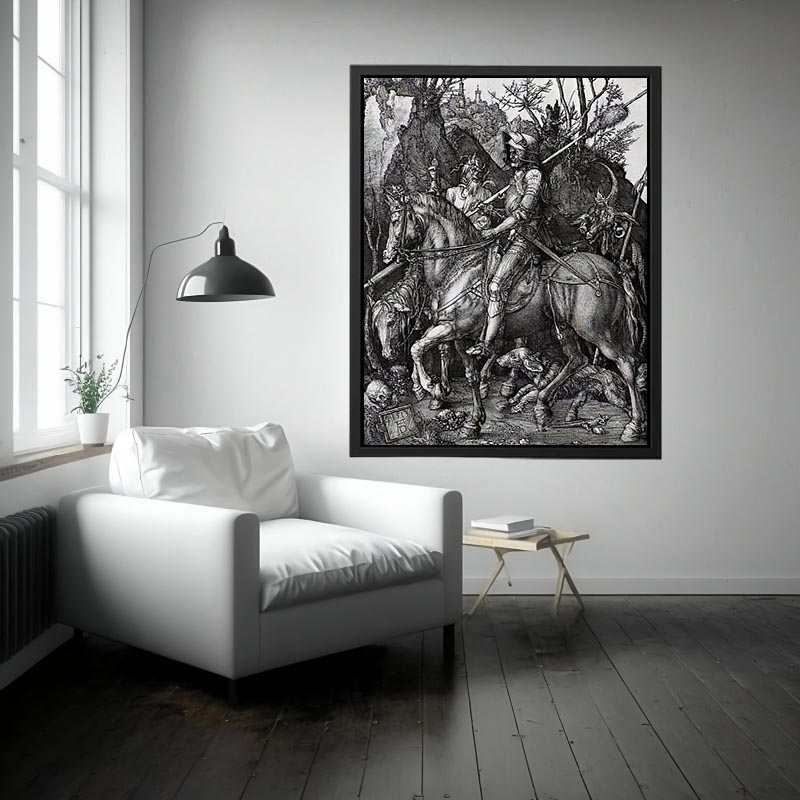
The Knight Death And The Devil Painting by Albrecht Dürer
The Knight, Death and the Devil stands as one of the most intellectually formidable and morally resonant works of the Northern Renaissance, a master engraving in which Albrecht Dürer compressed theology, philosophy, humanist ethics, and psychological intensity into a single, inexorable image. Created in 1513, the work belongs to Dürer’s so-called Meisterstiche, or “master engravings,” a group of works that represent the apex of his technical and conceptual achievement. In this image, the medieval world of moral trial collides with Renaissance ideals of reason, resolve, and individual conscience, producing an artwork that has remained disturbingly relevant for more than five centuries.
Dürer produced The Knight, Death and the Devil during a period of profound intellectual transition in Europe. Humanist philosophy was reshaping conceptions of virtue, individual responsibility, and moral agency, while religious uncertainty and existential anxiety permeated everyday life. Dürer, uniquely positioned as both a devout Christian and a learned humanist, absorbed these tensions into his art. This work does not illustrate a biblical narrative or saintly miracle. Instead, it presents a moral condition: the human journey through a world haunted by mortality and temptation.
The composition is dense, claustrophobic, and relentless. A fully armed knight rides forward through a narrow, rocky pass, his posture upright and unwavering. He does not turn his head. He does not hesitate. His gaze is fixed forward, beyond the pictorial space itself. On either side, embodiments of existential threat press close. Death rides beside him, gaunt and decaying, holding an hourglass as a silent reminder of time’s inevitability. Behind them lurks the Devil, a grotesque hybrid creature bristling with horns, tusks, and bestial features, an incarnation of corruption and moral derailment.
Dürer’s handling of space intensifies the psychological pressure of the scene. The landscape is compressed, jagged, and hostile, offering no refuge or escape. Trees are skeletal, rocks loom sharply, and the path narrows as it recedes. There is no open horizon, no promise of relief. The environment mirrors the moral terrain: progress is possible only through endurance. The knight’s forward motion becomes the central structural force of the composition, cutting through the surrounding threats without engaging them.
The figure of the knight is rendered with extraordinary authority. His armor is meticulously detailed, each plate engraved with precision that borders on obsession. This is not mere technical display. The armor functions symbolically as moral discipline, reason, and self-command. Unlike medieval depictions of saints protected by divine intervention, this knight is protected by his own resolve. He does not brandish his weapon; he carries it as a tool rather than a threat. His strength lies not in aggression, but in steadiness.
Dürer’s use of line is unmatched in its expressive control. Through dense cross-hatching and tonal modulation, he creates an almost sculptural depth, allowing forms to emerge from darkness with tactile clarity. Light does not flood the scene; it carves it. Shadows cling to forms, reinforcing the sense that danger is ever-present, never banished. This mastery of engraving transforms the image into a meditation on endurance itself: every line feels earned, deliberate, and irrevocable.
Symbolism operates at multiple levels. Death’s hourglass is an explicit memento mori, reminding the viewer that time governs all action. The Devil’s grotesque anatomy reflects moral chaos and spiritual distortion, a visual counterpoint to the knight’s geometric order and restraint. The dog running alongside the knight, often overlooked, represents loyalty, faithfulness, and persistence—virtues grounded in action rather than abstraction. Even the horse, powerful and controlled, reinforces the theme of disciplined forward motion.
Emotionally, the work is austere and uncompromising. There is no comfort offered, no assurance of salvation or triumph. The knight’s virtue is not rewarded within the image; it is tested. Viewers are not invited to admire the scene from a safe distance, but to measure themselves against it. The engraving confronts the viewer with a question rather than an answer: how does one proceed when surrounded by inevitability and corruption?
Within Dürer’s career, The Knight, Death and the Devil represents a peak of philosophical maturity. Unlike his earlier religious works, which often emphasise narrative or devotional clarity, this engraving embraces ambiguity and moral complexity. It reflects Dürer’s engagement with contemporary humanist thought, particularly the writings of Erasmus, which emphasised inner virtue, moral constancy, and ethical action in an imperfect world.
Culturally, the image has exerted extraordinary influence. It has been interpreted variously as a Christian allegory, a humanist manifesto, a Stoic ideal, and even a secular ethic of duty. Across centuries, it has been claimed by theologians, philosophers, artists, and political thinkers, each recognising in the knight a reflection of their own moral aspirations or anxieties. Few works of art have sustained such interpretive density without collapsing into symbolism alone.
In contemporary interiors, The Knight, Death and the Devil carries exceptional gravitas. In studies, libraries, and offices, it communicates intellectual seriousness, discipline, and ethical reflection. In living spaces, it functions as a powerful focal point, inviting contemplation rather than decoration. Within galleries and refined residences across the United States, United Kingdom, Canada, Australia, and Europe, the work integrates most effectively into environments that value cultural depth, philosophical engagement, and historical continuity. Its monochromatic intensity complements minimalist and classical interiors alike, anchoring space through meaning rather than colour.
The enduring relevance of The Knight, Death and the Devil lies in its refusal to simplify moral experience. Dürer does not promise redemption, nor does he dramatise despair. He presents existence as it is lived: forward-moving, constrained by time, threatened by corruption, yet shaped by choice. The knight’s power lies not in victory, but in direction. In an age marked by uncertainty, ethical ambiguity, and constant distraction, the image continues to resonate as a profound visual statement on integrity, resolve, and the courage to proceed without reassurance.
Buy museum qulaity 400- 450 canvas prints, framed prints, and 100% oil paintings of The Knight Death And The Devil by Albrecht Durer at Alpha Art Gallery, where world-famous masterpieces are recreated with museum-quality detail, refined craftsmanship, and premium materials.
FAQS
What does The Knight, Death and the Devil by Albrecht Dürer represent?
It represents moral steadfastness and ethical resolve in the face of mortality and corruption.
Is the knight a religious or philosophical figure?
He can be understood as both, embodying Christian virtue and humanist ideals of reason and discipline.
Why does the knight ignore Death and the Devil?
His forward gaze symbolises moral focus and refusal to be distracted by fear or temptation.
What is the significance of Death’s hourglass?
It represents the inevitability of time and mortality governing human life.
Does the image promise salvation or victory?
No, it emphasises endurance rather than reward, presenting virtue as action rather than outcome.
Why is the work considered one of Dürer’s masterpieces?
It combines unparalleled technical skill with profound philosophical and psychological depth.
Is The Knight, Death and the Devil suitable for contemporary interiors?
Yes, especially in spaces that value intellectual seriousness and historical gravitas.
Why does this artwork remain relevant today?
Its exploration of moral resolve amid uncertainty continues to resonate in the modern world.