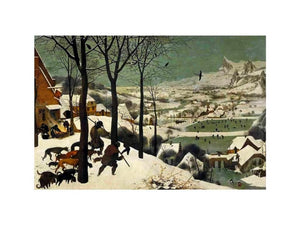
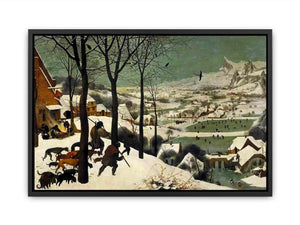
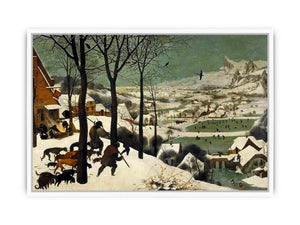
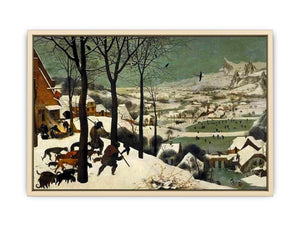
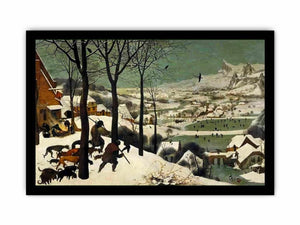
The Hunters in the Snow (Winter) 1565 Painting by Pieter Bruegel the Elder
The Hunters in the Snow (Winter) 1565 Painting by Pieter Bruegel the Elder is one of the most enduring and intellectually profound landscapes of the Northern Renaissance, a work that transforms seasonal hardship into a meditation on human endurance, communal rhythm, and the quiet authority of nature. Painted in 1565 as part of Bruegel’s celebrated cycle of the months, the scene resists anecdote and spectacle, offering instead a panoramic vision in which labor, leisure, and survival are bound together by winter’s uncompromising presence. The painting is neither nostalgic nor dramatic. It is observational, ethical, and astonishingly modern in its balance of empathy and distance.
The artist who conceived this vision, Pieter Bruegel the Elder, stands apart in sixteenth-century art for his insistence that meaning arises from collective life rather than heroic exception. Bruegel’s landscapes are not stages upon which stories are enacted; they are systems within which human activity unfolds. In The Hunters in the Snow, he situates humanity within a vast, cold environment that neither favors nor opposes it, but simply endures. The painting’s authority lies in its refusal to console. Winter is not romanticized; it is acknowledged.
The scene opens with three hunters returning from an unsuccessful hunt, their bodies bent forward by fatigue, their spears bearing little reward. A pack of dogs follows, heads lowered, mirroring their masters’ exhaustion. This procession descends from the left foreground into a wide, frozen valley where village life continues despite scarcity. Below, people skate, play games, carry firewood, tend fires, and gather around inns. The hunters’ quiet struggle contrasts with the dispersed vitality of the village, yet neither is privileged as narrative center. Bruegel presents a world of parallel realities coexisting within the same season.
Compositionally, the painting is masterful in its orchestration of depth and movement. Bruegel employs a high vantage point that allows the eye to travel from the dark, compressed foreground into an expansive middle ground and finally toward distant, icy mountains. This recession is gradual and coherent, guiding the viewer across multiple zones of activity without hierarchy. The diagonal descent of the hunters establishes momentum, while the broad valley opens outward, inviting contemplation rather than focus on a single event.
Perspective functions as a philosophical tool. By placing the viewer slightly above the scene, Bruegel encourages observation rather than immersion. We are made aware of scale—of how small human figures appear against the breadth of land and sky. Yet this distance does not diminish human significance. Instead, it situates it properly, as part of a larger order. Individual effort matters, but it unfolds within forces that exceed it. The painting’s calm authority emerges from this equilibrium.
Light in The Hunters in the Snow is pale, cold, and even. Bruegel avoids dramatic contrasts, bathing the scene in a winter luminosity that clarifies rather than dramatizes. Snow and ice reflect light softly, flattening extremes and reinforcing stillness. This illumination does not celebrate winter’s beauty nor emphasize its cruelty. It records condition. The day is bright but cold, active but restrained—a visual analogue for endurance.
The color palette is restrained and disciplined. Whites, grays, muted greens, and soft browns dominate, punctuated by darker silhouettes of trees, figures, and buildings. Accents of red and warm tones appear sparingly, guiding the eye without disrupting unity. Color here is structural, organizing space and rhythm rather than expressing emotion. The harmony of tones contributes to the painting’s timelessness, allowing it to transcend the specificity of place and date.
Bruegel’s technique is precise yet economical. Figures are rendered with enough detail to convey posture, task, and movement, but never individualized to the point of portraiture. This restraint allows the painting to operate on multiple scales. From a distance, it reads as a unified landscape; up close, it reveals a wealth of small human actions. The artist’s hand serves observation, not display, reinforcing the painting’s ethical clarity.
Symbolism in The Hunters in the Snow is present but understated. The barren trees and empty spears speak quietly of scarcity and effort without reward. The frozen river, alive with skaters, suggests adaptation and resilience—life continuing through altered means. Smoke rising from chimneys introduces warmth without comfort, a reminder that survival is ongoing rather than resolved. Bruegel does not arrange these elements into allegory. He allows them to coexist, trusting the viewer to recognize their implications.
Psychologically, the painting is marked by restraint and empathy. The hunters are not heroicized, nor are they pitied. Their fatigue is acknowledged without sentiment. The villagers below are not idealized; their pleasures are modest, communal, and bound by the same cold that burdens the hunters. Bruegel’s achievement lies in presenting human life as neither tragic nor triumphant, but persistent. Meaning arises from continuity.
Within Bruegel’s broader oeuvre, The Hunters in the Snow represents a culmination of his seasonal landscapes, works that redefined the relationship between humanity and environment. Here, landscape is not backdrop but protagonist—an active force shaping behavior, labor, and social rhythm. This approach would profoundly influence later Northern European painting, establishing winter as a subject of philosophical gravity rather than decorative novelty.
Culturally, the painting reflects a sixteenth-century world acutely aware of nature’s power and unpredictability. Painted during a period of climatic hardship, it captures an attitude of acceptance rather than resistance. There is no promise of relief, no narrative resolution. Winter is endured because it must be. This quiet realism gives the painting enduring relevance, speaking across centuries to societies that continue to negotiate their relationship with environment and labor.
In contemporary interiors across the United States, the United Kingdom, Canada, Australia, and Europe, The Hunters in the Snow brings exceptional depth and narrative richness. In living rooms, it introduces seasonal calm and visual breadth. In studies and offices, it communicates endurance, discipline, and historical intelligence. In galleries and luxury residences, it anchors space with Northern Renaissance authority, integrating seamlessly into traditional, modern, minimalist, and eclectic décor through its balanced composition and subdued palette.
The painting remains meaningful today because it mirrors lived experience without exaggeration. Effort does not always yield reward; communities persist regardless; nature remains indifferent yet beautiful. Bruegel’s vision affirms that dignity lies not in conquest, but in continuity. The Hunters in the Snow does not dramatize winter. It understands it.
The Hunters in the Snow (Winter) 1565 Painting by Pieter Bruegel the Elder endures as one of the most quietly powerful landscapes in Western art. Through compositional breadth, tonal restraint, and ethical clarity, Bruegel transformed a cold day into a timeless meditation on labor, community, and the human condition. The painting does not seek to impress. It endures.
Buy museum qulaity 400- 450 canvas prints, framed prints, and 100% oil paintings of The Hunters in the Snow (Winter) by Pieter Bruegel the Elder at Alpha Art Gallery, where world-famous masterpieces are recreated with museum-quality detail, refined craftsmanship, and premium materials.
FAQs
What does The Hunters in the Snow depict?
It depicts hunters returning from an unsuccessful hunt while village life continues across a frozen winter landscape.
Why are the hunters shown with little game?
Their scarcity emphasizes endurance and effort without reward, a central theme of the painting.
Is this painting part of a larger series?
Yes, it belongs to Bruegel’s cycle of the months, exploring seasonal rhythms of life.
Why is the viewpoint elevated?
The high vantage point encourages observation of collective life rather than focus on a single narrative.
What role does winter play in the painting?
Winter is an active force shaping labor, leisure, and community behavior rather than a mere setting.
Does the painting carry a moral message?
It is observational rather than didactic, presenting endurance and continuity without explicit instruction.
Why does the painting feel calm despite hardship?
Balanced composition, even light, and restrained color create equilibrium while acknowledging difficulty.
Where does this artwork work best in interiors?
It suits living rooms, studies, offices, galleries, and spaces seeking narrative depth, calm authority, and historical presence.