The Horse Fair Painting by Rosa Bonheur
The Horse Fair Painting by Rosa Bonheur stands as one of the most commanding and intellectually rigorous animal paintings of the nineteenth century, a work in which physical power, disciplined observation, and social modernity converge with extraordinary clarity. Completed in 1855, the painting is not merely a depiction of a Parisian horse market; it is a profound statement on movement, control, and the relationship between human will and animal force. Bonheur transforms a bustling urban spectacle into a monumental vision of life in motion, asserting animal painting as a domain capable of epic scale and philosophical depth.
Rosa Bonheur’s position in nineteenth-century art was both exceptional and transformative. At a time when women artists were largely confined to limited subjects and formats, Bonheur claimed authority through mastery rather than provocation. She approached art with scientific seriousness, devoting years to anatomical study, direct observation, and field research. The Horse Fair is the culmination of this commitment. It reflects not a romantic fascination with animals, but a sustained, disciplined engagement with their structure, behavior, and psychological presence.
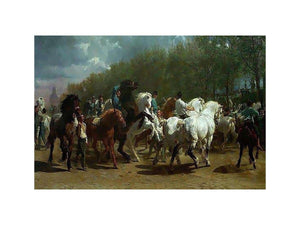
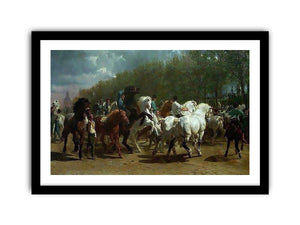
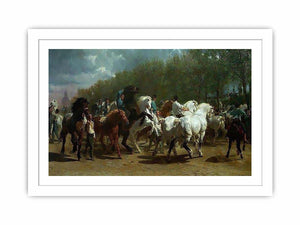
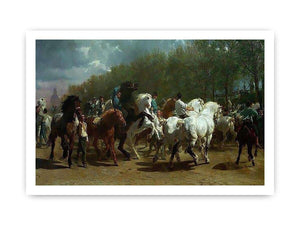
The subject is drawn from the horse market held on the Boulevard de l’Hôpital in Paris, where horses were displayed, tested, and traded. Bonheur does not present this as a picturesque genre scene. Instead, she elevates it to the scale of history painting. The canvas is expansive, the figures life-sized, the action unrelenting. Horses surge across the foreground in a powerful circular motion, their bodies taut with energy, their hooves barely touching the ground. Human handlers strain to control them, forming a counterforce that introduces tension and rhythm.
Compositionally, the painting is a masterwork of controlled chaos. Bonheur organizes the scene through sweeping arcs and counter-curves that guide the eye continuously across the canvas. The horses dominate the composition, their mass and movement creating a centrifugal force that threatens to exceed containment. Yet the composition never collapses. Bonheur’s structural intelligence ensures balance, using repeated forms, directional movement, and carefully placed verticals to anchor the energy. The result is a sense of motion that feels both immediate and eternal.
Perspective plays a critical role in immersing the viewer. Bonheur positions the scene at a level that places the viewer within the action rather than above it. The horses appear close, their scale overwhelming, their power undeniable. This choice eliminates detachment. The viewer does not observe calmly; the viewer experiences proximity, risk, and physical presence. Bonheur’s Paris is not a distant backdrop, but a living environment shaped by labor, commerce, and force.
Colour in The Horse Fair is disciplined and purposeful. Bonheur avoids decorative brightness, instead employing a restrained palette of earth tones, greys, browns, and muted whites. This chromatic restraint allows form and movement to dominate. The horses’ coats are rendered with subtle variation rather than dramatic contrast, emphasizing anatomical truth over visual spectacle. The background architecture recedes in softened tones, ensuring that the kinetic foreground remains paramount.
Light is handled with exceptional control. Illumination is even and naturalistic, revealing muscle, bone, and tension without theatrical exaggeration. Bonheur does not dramatize the scene through chiaroscuro. Instead, light functions as an analytical tool, clarifying form and reinforcing realism. This restraint underscores the painting’s intellectual seriousness. The spectacle arises from reality itself, not from painterly manipulation.
Bonheur’s anatomical mastery is central to the painting’s authority. Every horse is rendered with precision, yet no two are identical. Musculature, gait, posture, and expression vary subtly, conveying individuality within collective movement. This level of differentiation elevates the painting beyond repetition into observation. The horses are not symbols or types; they are living beings captured at the height of exertion. Bonheur’s knowledge was earned through direct study, often in environments inaccessible to women artists of her time, a fact that lends the work additional historical weight.
Emotionally, The Horse Fair conveys power rather than sentiment. There is no romanticization of rural life, no nostalgia for pastoral calm. Instead, the painting confronts the viewer with energy disciplined by human systems. The relationship between humans and animals is presented without moralizing. Control exists, but it is never absolute. The tension between force and restraint defines the scene, reflecting broader nineteenth-century concerns with industry, order, and modernity.
Symbolically, the painting operates on multiple levels. On the surface, it depicts commerce and spectacle. Beneath this lies a meditation on mastery—over nature, over movement, over chaos. The circular motion of the horses suggests cycles of labor and exchange, while the city backdrop situates the scene firmly within modern urban life. Bonheur does not retreat into myth or allegory. Her symbolism is structural and experiential, emerging from action rather than imposed meaning.
Within Bonheur’s career, The Horse Fair represents her most ambitious and defining achievement. It secured her international reputation and permanently altered perceptions of animal painting. No longer confined to minor genres, animal subjects here assume the scale, seriousness, and complexity traditionally reserved for historical or mythological scenes. Bonheur demonstrated that truth, rigor, and observation could rival narrative drama in expressive power.
Culturally, the painting holds lasting significance as an assertion of artistic authority grounded in expertise. It challenges assumptions about gender, genre, and hierarchy within art. Bonheur’s refusal to conform—to subject matter, to scale, to expectation—reshaped the possibilities available to later generations of artists. The Horse Fair is not only a great painting; it is a statement of independence earned through discipline.
In contemporary interiors across the United States, the United Kingdom, Canada, Australia, and Europe, The Horse Fair commands presence and respect. In living rooms, it introduces energy, movement, and visual authority. In studies and offices, it reflects decisiveness, intellectual rigor, and appreciation for nineteenth-century realism. In galleries and luxury residences, it functions as a centerpiece that communicates confidence and cultural depth.
The painting integrates naturally into traditional interiors, where its monumental scale and classical realism align with established aesthetics. At the same time, it works powerfully in modern and minimalist spaces, where its dynamic composition and controlled palette provide contrast and vitality. In eclectic interiors, it acts as an anchor of strength, balancing diverse elements through motion and structure.
The long-term artistic importance of The Horse Fair lies in its refusal to compromise. Bonheur does not soften power, simplify complexity, or sentimentalize labor. She presents the world as she observed it—vigorous, demanding, and alive. This honesty ensures the painting’s continued relevance, as it speaks to enduring questions about control, coexistence, and respect for force beyond ourselves.
Today, The Horse Fair remains profoundly compelling because it does not ask to be admired passively. It demands attention, proximity, and acknowledgment. Through discipline, scale, and uncompromising realism, Rosa Bonheur created a work that redefined animal painting and expanded the language of modern art. The Horse Fair endures as a testament to mastery earned through observation, courage, and unwavering commitment to truth.
Buy museum qulaity 400- 450 canvas prints, framed prints, and 100% oil paintings of The Horse Fair by Rosa Bonheur at Alpha Art Gallery, where world-famous masterpieces are recreated with museum-quality detail, refined craftsmanship, and premium materials.
FAQS
What does The Horse Fair by Rosa Bonheur depict?
It portrays a Parisian horse market, focusing on the power, movement, and control of horses during commercial display.
Why is this painting considered groundbreaking?
It elevated animal painting to monumental scale and seriousness, traditionally reserved for historical subjects.
How did Rosa Bonheur achieve such anatomical accuracy?
She conducted extensive direct study of animals, including field observation and anatomical research.
Is the painting symbolic or purely realistic?
While grounded in realism, it carries symbolic weight through structure and motion rather than overt allegory.
Where does The Horse Fair work best in interior spaces?
It is ideal for living rooms, studies, offices, galleries, and large-scale interiors that can accommodate its visual power.
Is The Horse Fair suitable for modern décor?
Yes, its disciplined palette and dynamic composition integrate effectively into modern, minimalist, and traditional spaces.
Does The Horse Fair have lasting artistic and cultural value?
Its technical mastery, historical importance, and redefinition of genre ensure enduring relevance across generations.