The Headless Horseman Painting by John Quidor
The Headless Horseman Painting by John Quidor stands as one of the most imaginative and psychologically charged interpretations of American literary folklore in nineteenth-century art. Painted in 1858, the work draws its subject from Washington Irving’s The Legend of Sleepy Hollow, yet it transcends illustration to become a visual meditation on fear, superstition, and the porous boundary between reality and imagination. Quidor’s painting does not simply recount a story; it visualizes the collective psyche of early America, where folklore, landscape, and moral anxiety intertwine.
John Quidor occupies a singular position in American art history. Working outside the dominant academic and Hudson River traditions, he pursued subjects rooted in literature, myth, and psychological drama rather than topographical accuracy or heroic history. His paintings often feel dreamlike and theatrical, shaped by emotion rather than realism. In The Headless Horseman, Quidor’s unconventional vision finds its most compelling expression. The painting reflects his fascination with narrative moments charged with ambiguity, where the viewer is invited not to observe passively, but to experience the tension of the scene.
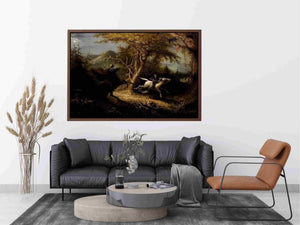
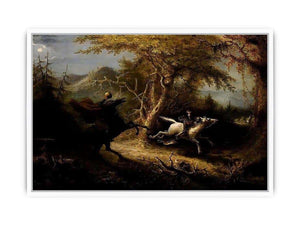
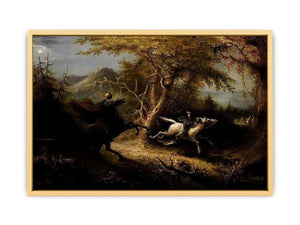
The subject depicts the climactic pursuit from Irving’s tale, in which Ichabod Crane flees through the night, pursued by the terrifying figure of the Headless Horseman. Quidor captures the moment not as a clear-cut supernatural event, but as an unstable psychological encounter. The Horseman looms as both presence and projection, a figure that may be ghostly reality or the embodiment of Ichabod’s terror. This ambiguity is central to the painting’s enduring power.
Compositionally, the painting is deliberately compressed and urgent. The figures surge forward through a narrow, shadowed space, their movement intensified by diagonal thrusts and exaggerated gesture. Quidor places the rider and pursued in close proximity, collapsing distance to heighten fear. The viewer is drawn into the chase, sharing Ichabod’s panic rather than observing from a safe remove. The landscape does not offer orientation or refuge; it encloses and disorients.
The Headless Horseman himself is rendered with striking theatricality. His raised arm, clutching a flaming pumpkin, becomes the focal point of the composition. The absence of a head denies individuality, transforming him into a symbol rather than a character. He appears less human than elemental, a force emerging from darkness and superstition. Quidor’s treatment resists anatomical precision in favor of expressive distortion, reinforcing the Horseman’s uncanny nature.
Ichabod Crane’s figure is equally expressive. His posture conveys desperation and disbelief, his body pitched forward as though propelled by fear alone. Quidor exaggerates gesture and movement to communicate psychological intensity rather than physical realism. Ichabod becomes a study in panic, his individuality dissolving under the weight of terror. This emphasis on emotional truth over naturalistic detail aligns with Quidor’s broader artistic philosophy.
Light plays a crucial role in shaping the painting’s atmosphere. Illumination is selective and dramatic, punctuating darkness rather than dispelling it. The glowing pumpkin casts an unnatural light, isolating figures and fragments of landscape while leaving much of the scene in obscurity. This unstable lighting reinforces uncertainty, suggesting a world where perception is unreliable and fear dictates vision.
Colour is employed sparingly but effectively. Dark browns, deep greens, and inky blacks dominate the background, creating a suffocating nocturnal environment. Against this, the fiery orange of the pumpkin burns with symbolic intensity, acting as both literal light source and emblem of menace. The contrast is not decorative; it is psychological, directing attention and emotion simultaneously.
Quidor’s brushwork contributes to the painting’s sense of immediacy. Strokes are loose and expressive, sometimes bordering on raw. This lack of polish is intentional. It allows the surface to vibrate with energy, mirroring the instability of the scene itself. The painting feels animated, as though the chase might continue beyond the frame.
Symbolically, The Headless Horseman operates on multiple levels. On one level, it visualizes a popular ghost story rooted in colonial-era superstition. On another, it reflects anxieties about reason versus irrationality, education versus folklore. Ichabod, the schoolmaster, represents Enlightenment rationalism confronted by primal fear. The Horseman embodies the persistence of myth and the power of belief. Quidor does not resolve this conflict; he stages it.
Within Quidor’s artistic career, this painting represents a culmination of his literary imagination. While many of his contemporaries sought to define American identity through landscape or history, Quidor turned inward, exploring the nation’s stories and fears. The Headless Horseman exemplifies this alternative vision, asserting that cultural identity is shaped as much by imagination and legend as by geography and politics.
Culturally, the painting holds lasting significance as one of the earliest serious engagements with American folklore in fine art. It helped legitimize literary and supernatural subjects as worthy of painterly exploration. By treating Irving’s story with seriousness rather than parody, Quidor elevated folklore into a vehicle for psychological and cultural inquiry.
In contemporary interiors across the United States, the United Kingdom, Canada, Australia, and Europe, The Headless Horseman functions as a striking narrative centerpiece. In living rooms, it introduces drama, mystery, and conversation. In studies and libraries, it reflects literary sophistication and interest in cultural history. In galleries and curated residences, it signals appreciation for unconventional nineteenth-century American art.
The painting adapts effectively to traditional interiors, where its literary roots and dark palette complement classical furnishings. At the same time, it resonates powerfully in modern and eclectic spaces, where its expressive intensity and narrative ambiguity provide contrast to minimalist surroundings. Its emotional charge ensures presence without reliance on scale alone.
The long-term artistic importance of The Headless Horseman lies in its embrace of uncertainty. Quidor does not clarify whether the terror is real or imagined. He trusts the viewer to inhabit that ambiguity. This openness ensures the painting’s continued relevance, as it speaks to enduring human experiences of fear, belief, and the stories we tell to make sense of the unknown.
Today, The Headless Horseman remains deeply compelling because it captures a moment where imagination overwhelms reason. In doing so, it affirms the power of art to visualize not only what is seen, but what is feared. John Quidor’s painting endures as a rare and vivid example of how American art can engage myth with psychological depth and expressive courage, securing its place as a landmark of narrative imagination.
Buy museum qulaity 400- 450 canvas prints, framed prints, and 100% oil paintings of The Headless Horseman by John Quidor at Alpha Art Gallery, where world-famous masterpieces are recreated with museum-quality detail, refined craftsmanship, and premium materials.
FAQS
What story inspires The Headless Horseman by John Quidor?
The painting is inspired by Washington Irving’s The Legend of Sleepy Hollow, depicting the climactic chase scene.
Is the Horseman portrayed as supernatural or psychological?
Quidor deliberately leaves this ambiguous, allowing the figure to function as both ghostly presence and manifestation of fear.
Why is the painting considered important in American art?
It is one of the earliest serious fine art treatments of American folklore, emphasizing imagination and psychology.
How does Quidor’s style differ from his contemporaries?
He favored expressive distortion and narrative intensity over realism and landscape accuracy.
Where does this painting work best in interior spaces?
It is ideal for studies, libraries, living rooms, galleries, and spaces that value narrative and dramatic art.
Is The Headless Horseman suitable for modern décor?
Yes, its dark palette and expressive force integrate well into modern, traditional, and eclectic interiors.
Does the painting have lasting cultural relevance?
Its themes of fear, belief, and imagination ensure enduring relevance across cultures and generations.