The Hay Wain Painting by John Constable
The Hay Wain stands as one of the most enduring and quietly radical landscapes in the history of British art, embodying John Constable’s profound belief that nature, truth, and emotional sincerity were the highest subjects of painting. Completed in 1821, the work depicts a seemingly ordinary rural scene in Suffolk, yet within this apparent simplicity lies a revolutionary redefinition of landscape painting. Constable does not present the countryside as an idealised backdrop or picturesque fantasy. Instead, he renders it as lived space—observed, remembered, and emotionally inhabited.
John Constable painted The Hay Wain during a period when landscape art was still often subordinated to history painting and classical idealisation. Against prevailing academic convention, Constable insisted that painting should be grounded in direct observation of nature and personal experience. The scene portrayed is drawn from the area around Flatford Mill, near the River Stour, where Constable grew up. This personal connection is essential to the painting’s power. The Hay Wain is not a generic rural image but a deeply intimate vision of place, shaped by memory, familiarity, and affection.
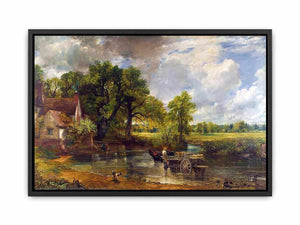
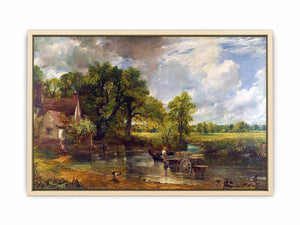
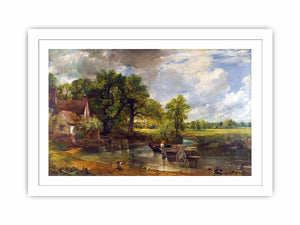
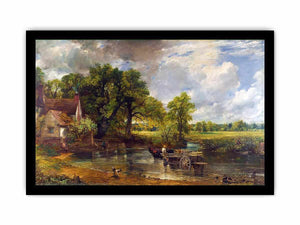
The composition presents a horse-drawn wagon, or hay wain, standing in shallow water as it crosses the river. To the left stands a farmhouse partially shaded by trees; to the right, open meadow stretches into the distance. The scene is balanced yet informal, avoiding rigid symmetry in favour of natural equilibrium. Constable’s arrangement allows the viewer’s eye to move gently across the canvas, following the slow rhythm of rural labour and the quiet flow of the landscape itself.
Perspective is handled with subtlety rather than grandeur. There is no dramatic recession into vast distance, no theatrical viewpoint. Instead, space unfolds gradually, mirroring the way the countryside reveals itself through lived experience rather than spectacle. This measured spatial design reinforces the painting’s sense of calm continuity. The viewer is not positioned as an outsider surveying nature, but as a participant within it.
Light and atmosphere are central to the painting’s emotional resonance. Constable was deeply committed to the scientific study of weather and sky, believing that the sky was the “chief organ of sentiment” in landscape painting. In The Hay Wain, the expansive sky occupies a significant portion of the canvas, filled with billowing clouds that suggest movement without instability. Light filters softly across the scene, illuminating foliage, water, and earth with gentle variation. The effect is neither dramatic nor static, but quietly alive.
Colour is employed with extraordinary sensitivity. Greens dominate the palette, yet they are endlessly varied, shifting from cool shadow to warm sunlit tones. These greens are balanced by earthy browns, muted blues, and soft whites, creating a natural harmony that feels organic rather than composed. Constable avoids artificial colour balance, allowing hues to emerge from direct observation. This commitment to natural colour was radical in its time and would later influence the development of Impressionism.
Constable’s brushwork is lively yet controlled. Leaves, grasses, and reflections are suggested through broken, textured strokes that convey movement and vitality. This painterly freedom was initially criticised by academic viewers, who found it unfinished or rough. Yet it is precisely this vitality that gives The Hay Wain its enduring freshness. The surface of the painting remains responsive and alive, resisting the polished smoothness of idealised landscape traditions.
Symbolically, The Hay Wain is not an allegory in the conventional sense. There are no mythological figures, no moral lessons imposed upon the scene. Its meaning emerges through authenticity rather than symbolism. Rural labour is presented without heroisation or hardship. Nature and human activity coexist in balance, neither dominating the other. The painting thus becomes a quiet statement about harmony, continuity, and the dignity of ordinary life.
Emotionally, the work evokes a sense of calm, nostalgia, and belonging. Yet this is not sentimentality. Constable does not romanticise rural life as untouched paradise. Instead, he presents it as stable, enduring, and deeply rooted in time. Viewers often respond to the painting with a feeling of recognition rather than escape, sensing in it a universal longing for connection to place and rhythm.
Within Constable’s career, The Hay Wain represents a culmination of his artistic philosophy. It exemplifies his belief that painting should be truthful to nature and personal experience rather than academic formula. While the work initially received limited recognition in Britain, it was celebrated in France, where it profoundly influenced artists seeking greater freedom and immediacy in landscape painting. Its impact on European art history cannot be overstated.
In contemporary interiors, The Hay Wain possesses remarkable versatility and timeless appeal. In living rooms, it introduces warmth, calm, and cultural depth without visual dominance. In studies and offices, it fosters reflection and balance, offering respite from visual noise. Within galleries and refined residences across the United States, United Kingdom, Canada, Australia, and Europe, the painting integrates seamlessly with traditional, modern, and minimalist décor alike. Its natural palette and measured composition allow it to anchor a space without overwhelming it.
The enduring relevance of The Hay Wain lies in its affirmation of attentiveness. It reminds viewers that significance can reside in the familiar, that beauty does not require spectacle, and that careful observation can reveal profound truth. In an increasingly accelerated world, Constable’s vision offers a counterpoint—an invitation to slow down, to look closely, and to recognise continuity in the everyday. The painting remains a testament to the power of sincerity in art and to the enduring human need for connection with the natural world.
Buy museum qulaity 400- 450 canvas prints, framed prints, and 100% oil paintings of The Hay Wain by John Constable at Alpha Art Gallery, where world-famous masterpieces are recreated with museum-quality detail, refined craftsmanship, and premium materials.
FAQ
What does The Hay Wain by John Constable depict?
It depicts a rural scene near the River Stour in Suffolk, showing a hay wagon crossing shallow water within a working agricultural landscape.
Why is The Hay Wain considered so important in art history?
It redefined landscape painting by prioritising natural observation, atmosphere, and emotional truth over idealised composition.
What role does the sky play in the painting?
The sky conveys mood and movement, reflecting Constable’s belief that it was central to emotional expression in landscape art.
Is The Hay Wain a romanticised view of rural life?
No, it presents rural labour and nature in balanced coexistence without exaggeration or sentimentality.
How did this painting influence later artists?
It influenced European painters, particularly in France, who sought greater freedom in brushwork and atmospheric realism.
Is The Hay Wain suitable for contemporary interiors?
Yes, its calm palette and balanced composition make it ideal for modern, traditional, and minimalist spaces.
What emotional response does the painting typically evoke?
Viewers often experience calm, familiarity, and a sense of grounded continuity.
Why does The Hay Wain remain relevant today?
Its emphasis on authenticity, observation, and connection to place continues to resonate in modern cultural life.