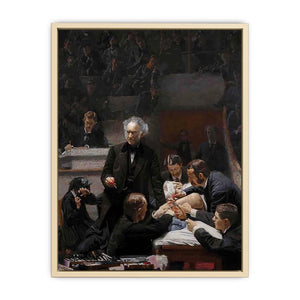
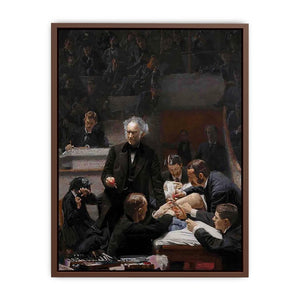
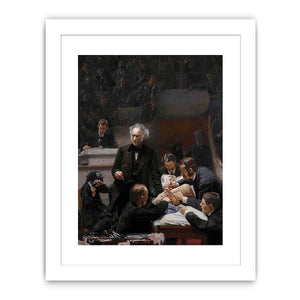
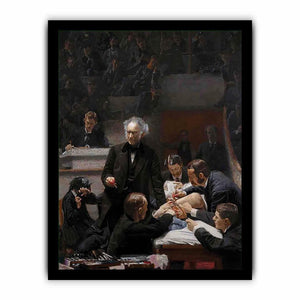
The Gross Clinic, 1875 Painting by Thomas Cowperthwait Eakins
The Gross Clinic stands as one of the most uncompromising and intellectually formidable paintings of the nineteenth century, a work in which Thomas Cowperthwait Eakins confronts the realities of modern science, mortality, and professional authority with unprecedented directness. Completed in 1875, the painting is neither a celebration nor a condemnation of medical practice, but a rigorous examination of knowledge exercised in public view. Eakins presents surgery not as spectacle, but as responsibility—an act that binds intellect, discipline, and ethical weight within a single charged moment.
Painted during a period when American art was still seeking cultural confidence, The Gross Clinic asserted a new seriousness of purpose. Eakins, deeply committed to empirical observation and anatomical truth, rejected idealisation in favour of exacting realism. At a time when historical and mythological subjects were still considered the highest forms of painting, he chose instead a contemporary surgical demonstration, insisting that modern life possessed its own gravity and dignity worthy of monumental art.
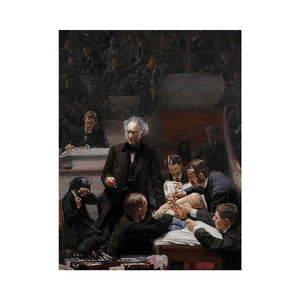
The scene is set within a surgical amphitheatre at Jefferson Medical College in Philadelphia, where Dr. Samuel D. Gross conducts an operation before an audience of students. Eakins structures the composition around Gross’s commanding presence. The surgeon stands upright, emerging from shadow into light, his bloodied hand raised mid-explanation. This gesture is crucial. It signals thought as much as action, intellect guiding incision. Gross is not depicted as a technician alone, but as a teacher, a public authority whose knowledge carries consequence.
The composition is dense yet controlled. Figures are tightly grouped, reinforcing the confined intensity of the operating theatre. The patient lies partially obscured, deliberately denied narrative dominance. Eakins refuses melodrama. Pain is present, but not exploited. Instead, the focus rests on the process of knowledge applied under pressure. The surrounding students lean forward, absorbed, their faces registering concentration rather than horror. Learning, here, is not abstract; it is embodied and irreversible.
Light is deployed with surgical precision. Eakins isolates Gross through illumination, allowing his face and hands to emerge from the surrounding darkness. This chiaroscuro is not theatrical but analytical. Light reveals responsibility. Shadow conceals nothing essential, yet it preserves gravity and restraint. The blood on Gross’s hand is visible, unsoftened, a stark acknowledgment of physical reality. This refusal to aestheticise violence marked the painting as radical in its time.
Colour is sober and restrained. Browns, blacks, muted flesh tones, and subdued whites dominate the palette, creating an atmosphere of seriousness and focus. There is no decorative relief. Every hue serves the painting’s moral tone. The blood, precisely because it is not exaggerated chromatically, carries greater force. It insists on recognition rather than shock.
Eakins’s handling of form is exacting. Anatomy is rendered with clinical accuracy, the result of years of study and dissection. Yet this precision does not diminish humanity. Faces are individualised, bodies weighted with presence. The mother of the patient, recoiling in distress, introduces a counterpoint to professional composure. Her gesture is emotional, instinctive, and human. Eakins does not resolve this tension. He allows science and suffering to coexist within the same frame, bound by circumstance rather than reconciliation.
Symbolically, The Gross Clinic operates as a meditation on authority in the modern age. Knowledge here is earned, not inherited. Gross’s authority derives from study, experience, and public accountability. He is elevated not by idealisation but by responsibility. The amphitheatre setting reinforces this theme. Surgery is performed before witnesses. Knowledge is shared, scrutinised, and passed on. The painting affirms transparency as a moral value.
Emotionally, the work is austere, demanding engagement rather than offering comfort. It does not seek admiration; it requires attention. The viewer is positioned as part of the audience, implicated in the act of looking. There is no safe distance. Eakins challenges the viewer to confront the realities that underpin progress—blood, risk, and irreversible decision.
Within Eakins’s career, The Gross Clinic represents a defining statement of his artistic philosophy. His commitment to truth, even when uncomfortable, is absolute. The painting’s initial rejection by exhibition juries underscores how far ahead of its time it was. Today, it is recognised not only as a masterpiece of American art, but as a foundational work in the visual culture of modern professionalism.
The painting’s relevance today is undiminished. In an era still grappling with questions of expertise, ethics, and public trust in science, The Gross Clinic remains piercingly current. Viewers across the United States, the United Kingdom, Canada, Australia, and Europe respond to its insistence that knowledge carries moral weight, and that progress demands accountability.
In interior spaces, The Gross Clinic introduces gravity and intellectual seriousness. In studies and offices, it reinforces values of discipline, responsibility, and rigorous thought. In galleries and institutional settings, it communicates cultural literacy and engagement with one of the most challenging achievements of realist painting. In private collections and luxury residences, it signals a commitment to art that confronts rather than reassures.
The painting integrates most powerfully into environments that value depth over decoration. Its restrained palette and concentrated composition allow it to coexist with both traditional and modern interiors, where it functions as an anchor of seriousness amid refinement. It does not decorate a space; it defines it.
The enduring importance of The Gross Clinic lies in its refusal to simplify complexity. Eakins presents modern life as it is lived at moments of consequence, where intellect, authority, and vulnerability intersect. The painting endures because it tells the truth without spectacle and demands engagement without compromise.
To live with The Gross Clinic is to engage daily with one of art’s most unflinching examinations of responsibility and knowledge. Through its disciplined composition, moral clarity, and intellectual courage, Thomas Cowperthwait Eakins created a work that continues to challenge, instruct, and resonate. It stands as a testament to art’s capacity to confront reality directly and to find meaning not in idealisation, but in truth.
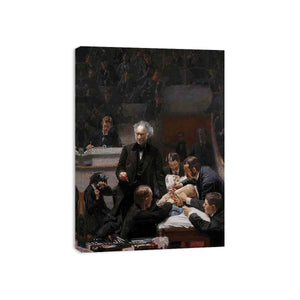
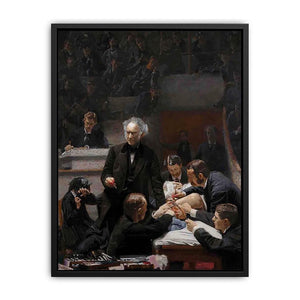
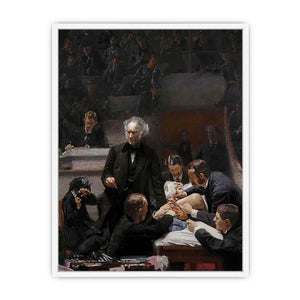
Buy museum qulaity 400- 450 canvas prints, framed prints, and 100% oil paintings of The Gross Clinic by Thomas Cowperthwait Eakins at Alpha Art Gallery, where world-famous masterpieces are recreated with museum-quality detail, refined craftsmanship, and premium materials.
FAQS
What is the central meaning of The Gross Clinic?
The painting examines modern knowledge and responsibility, presenting surgery as an act of intellectual authority carried out under public scrutiny.
Why was The Gross Clinic controversial when first exhibited?
Its unflinching realism, visible blood, and contemporary subject challenged nineteenth-century expectations of acceptable fine art.
Who is the central figure in the painting?
Dr. Samuel D. Gross, a leading American surgeon, is depicted as both practitioner and teacher.
What role does light play in the composition?
Light isolates intellectual authority, drawing attention to Gross’s face and hands as sites of thought and action.
Is The Gross Clinic suitable for contemporary interiors?
Yes. Its restrained palette and intellectual gravity integrate well into modern, traditional, and minimalist spaces that value depth.
What emotional atmosphere does the painting create?
It conveys seriousness, tension, and moral focus rather than comfort or sentimentality.
Does this artwork hold long-term cultural value?
As a foundational work of American realism, it holds enduring artistic, historical, and ethical significance.
Where is the best place to display this painting?
It is especially suited to studies, offices, galleries, and spaces devoted to reflection, learning, and professional purpose.