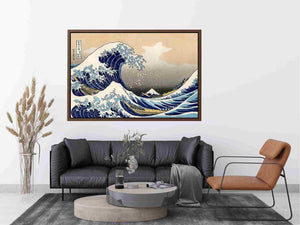
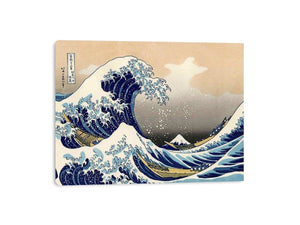
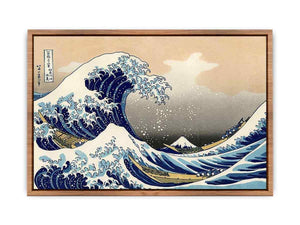
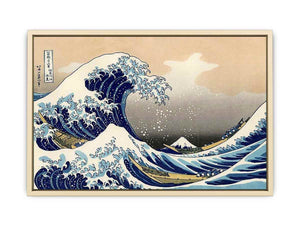
The Great Wave off Kanagawa Painting by Katsushika Hokusai
The Great Wave off Kanagawa Painting by Katsushika Hokusai stands as one of the most recognizable and intellectually profound images ever created, transcending its origins in nineteenth-century Japan to become a universal symbol of nature’s power, human vulnerability, and artistic innovation. Created around 1831 during the late Edo period, this work forms part of Hokusai’s celebrated series depicting Mount Fuji, yet it surpasses its context to occupy a singular position in global visual culture. At once dramatic and disciplined, the image captures a fleeting moment of confrontation between humanity and the natural world, rendered with clarity, tension, and philosophical depth.
Katsushika Hokusai was already an experienced and restless artist when he conceived The Great Wave off Kanagawa. Having reinvented himself multiple times over a long career, Hokusai approached his later years with renewed intensity, seeking to distill the essence of form, movement, and meaning. Working within the ukiyo-e tradition of woodblock printing, he elevated the medium beyond popular illustration into a vehicle for conceptual and aesthetic exploration. The Great Wave reflects this ambition, demonstrating how a reproducible print could achieve the gravitas and permanence traditionally associated with monumental painting.
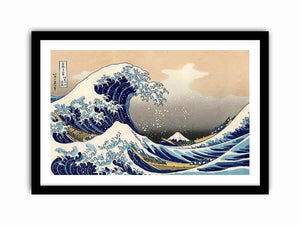
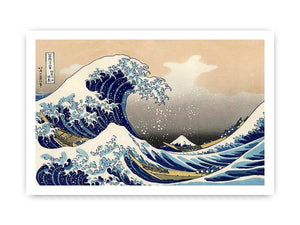
The composition is immediately arresting. A towering wave dominates the foreground, its crest curling inward like a living force poised to collapse. Beneath it, small fishing boats struggle forward, their occupants reduced to rhythmic shapes overwhelmed by scale. In the distance, Mount Fuji appears diminutive yet immovable, a silent counterpoint to the chaos of the sea. This juxtaposition between turbulence and stillness, movement and permanence, forms the structural and philosophical core of the work.
Hokusai’s mastery of composition lies in his ability to orchestrate visual tension without disorder. The sweeping curve of the wave frames the scene, drawing the viewer’s eye inward and downward before releasing it toward the distant horizon. The diagonal thrust of the wave contrasts with the stable triangular form of Mount Fuji, creating a dynamic equilibrium. Every element is carefully placed, reinforcing the sense that the image is not a spontaneous snapshot but a rigorously constructed meditation on balance and force.
Line plays a decisive role in shaping the image’s energy. The wave’s claw-like tendrils are rendered with sharp precision, their repetition creating a rhythmic pattern that echoes the foam and spray. These lines are both descriptive and expressive, transforming water into an almost animate presence. In contrast, the boats and figures are defined with economy, their simplicity emphasizing human fragility. Hokusai’s line does not merely outline form; it conveys motion, pressure, and impending impact.
Colour in The Great Wave off Kanagawa is restrained yet striking. The deep Prussian blue of the sea, a relatively new pigment in Japan at the time, lends the work its distinctive intensity and depth. This blue contrasts sharply with the pale sky and the white foam of the wave, heightening the sense of cold power and immediacy. The limited palette enhances clarity, allowing the composition’s structure to dominate while imbuing the scene with emotional resonance.
Light is implied rather than explicitly rendered. There are no dramatic shadows or highlights; instead, contrast emerges through colour and line. This restraint aligns with Japanese aesthetic principles, where suggestion often carries more weight than explicit depiction. The absence of theatrical lighting reinforces the timeless quality of the scene, making it feel less like a specific moment and more like an eternal condition.
Symbolically, the painting operates on multiple levels. The wave represents the overwhelming force of nature, unpredictable and indifferent to human endeavor. The fishermen, bent low within their boats, embody resilience rather than heroism, persistence rather than conquest. Mount Fuji, sacred and unchanging, stands as a symbol of continuity and spiritual endurance. Together, these elements articulate a worldview in which humanity exists not as master of nature but as a participant within its vast rhythms.
Within the context of Hokusai’s series, The Great Wave off Kanagawa functions as both introduction and philosophical anchor. While Mount Fuji appears in every image, here it is almost obscured, reduced in scale yet magnified in meaning. Hokusai suggests that permanence does not require dominance, and that true stability may reside in quiet presence rather than visible power. This conceptual subtlety distinguishes the work from mere spectacle.
Historically, the painting occupies a pivotal place in the exchange between Eastern and Western art. When Japanese prints entered Europe in the nineteenth century, they profoundly influenced artists such as Claude Monet, Vincent van Gogh, and later modernists who sought alternatives to linear perspective and academic realism. The Great Wave off Kanagawa became a touchstone for this cross-cultural dialogue, demonstrating how flattened space, bold composition, and expressive line could redefine visual language.
In contemporary terms, the painting’s relevance has only intensified. In an era increasingly conscious of environmental forces and human vulnerability, its imagery resonates with renewed urgency. The Great Wave does not moralize or dramatize unnecessarily; it observes. Its power lies in its clarity, its refusal to diminish either the beauty or the danger inherent in nature. This balance ensures its continued emotional and intellectual impact.
In modern interiors across the United States, the United Kingdom, Canada, Australia, and Europe, this painting holds extraordinary versatility. In living rooms, it serves as a commanding focal point, introducing movement and depth without visual excess. In studies and offices, it conveys intellectual curiosity and respect for global artistic heritage. In galleries and refined residential spaces, it asserts cultural literacy and timeless relevance.
The painting adapts seamlessly to traditional interiors, where its iconic status and compositional harmony complement classical design elements. Equally, it thrives in modern and minimalist environments, where its bold form and restrained palette align with contemporary aesthetics. In eclectic settings, it bridges cultures and eras, enriching the space with both visual drama and conceptual depth.
The long-term artistic importance of The Great Wave off Kanagawa lies in its rare fusion of immediacy and permanence. Though it captures a moment of imminent collapse, it remains perfectly composed, eternally suspended between motion and stillness. Hokusai’s achievement is not merely technical but philosophical: he renders uncertainty with clarity, and power with grace.
Today, The Great Wave off Kanagawa endures as more than an image. It is a lens through which humanity continues to contemplate its relationship with the natural world. In its disciplined beauty and quiet severity, it reminds viewers that art can confront immense forces without exaggeration, offering insight through balance, restraint, and profound observation.
Buy museum qulaity 400- 450 canvas prints, framed prints, and 100% oil paintings of The Great Wave off Kanagawa by Katsushika Hokusai at Alpha Art Gallery, where world-famous masterpieces are recreated with museum-quality detail, refined craftsmanship, and premium materials.
FAQS
What is the central meaning of The Great Wave off Kanagawa by Katsushika Hokusai?
The painting explores the relationship between human vulnerability and the overwhelming power of nature, balanced by the quiet permanence of Mount Fuji.
Why is this artwork considered so influential in global art history?
Its innovative composition, use of colour, and flattened space influenced Western modernism and reshaped artistic approaches to perspective and form.
What role does Mount Fuji play in the composition?
Mount Fuji serves as a symbol of stability and continuity, contrasting with the transient violence of the wave.
Is The Great Wave off Kanagawa a painting or a print?
It originates as a woodblock print, though it is widely referred to as a painting due to its artistic significance and visual impact.
Where does this artwork work best in interior spaces?
It is ideal for living rooms, studies, offices, and gallery-style spaces where strong visual presence and cultural depth are desired.
Does this artwork have lasting cultural and artistic value?
Yes, it is considered one of the most important works in world art, with enduring relevance across cultures and generations.
Why does The Great Wave off Kanagawa remain meaningful today?
Its depiction of nature’s power and human resilience resonates strongly in contemporary discussions about environment, uncertainty, and balance.