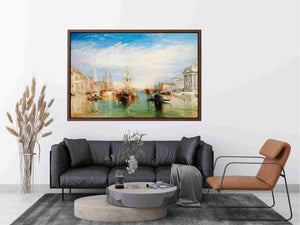
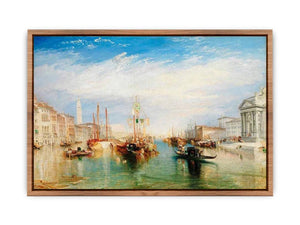
The Grand Canal, Venice 1835 Painting by Joseph Mallord William Turner
The Grand Canal, Venice 1835 Painting by Joseph Mallord William Turner represents one of the most poetic and conceptually advanced visions of Venice ever committed to canvas. Painted in 1835, the work transcends the conventions of the cityscape to become a meditation on light, atmosphere, memory, and impermanence. Turner does not present Venice as a stable architectural entity or a civic spectacle. Instead, he renders it as an experience—fluid, luminous, and perpetually in the process of dissolving into reflection and time.
By the mid-1830s, Joseph Mallord William Turner had reached a level of artistic maturity that allowed him to abandon descriptive certainty in favor of perceptual truth. His Venetian paintings occupy a singular place within his oeuvre, marking a shift from observational landscape toward a form of visual philosophy. Venice, for Turner, was not merely a subject but a condition: a city suspended between water and stone, past and present, endurance and decay. The Grand Canal, Venice encapsulates this vision with remarkable restraint and clarity.
The historical context of the painting is inseparable from Venice’s nineteenth-century status as a city of memory rather than power. Once a dominant maritime republic, Venice had long since relinquished its political authority by Turner’s time. What remained was cultural resonance—architecture softened by age, surfaces eroded by water, and a beauty inseparable from decline. Turner does not attempt to restore Venice to former grandeur. Instead, he accepts its fragility and transforms it into something enduring through light.
Compositionally, the painting is open and gently expansive. The Grand Canal unfolds across the canvas without rigid containment, guiding the eye through a space defined more by movement than by structure. Gondolas and small vessels appear as rhythmic interruptions on the water, not as narrative subjects but as signs of continuity and flow. Buildings line the canal in softened procession, their forms recognizable yet deliberately blurred, as though seen through memory rather than direct observation.
Perspective is fluid and slightly destabilized. Turner avoids anchoring the viewer to a precise vantage point, instead creating the sensation of drifting—of seeing Venice from within its own movement. This approach mirrors the lived experience of the city, where orientation is shaped by water rather than land. The absence of fixed perspective reinforces the painting’s central theme: that Venice cannot be grasped as a static object, only as an unfolding perception.
Light is the dominant force in the painting. Turner bathes the scene in a warm, diffused luminosity that dissolves edges and merges forms. This is not dramatic or directional light, but enveloping light—an atmosphere rather than an event. Stone, sky, and water participate equally in its glow. Light becomes the true subject of the painting, transforming architecture into color and mass into sensation.
The color palette is refined and restrained. Soft golds, pale blues, silvery greys, and muted pinks intermingle, creating a chromatic harmony that feels both radiant and fragile. These colors do not describe surfaces; they suggest states. Turner’s Venice appears weightless, as though suspended between presence and disappearance. Color carries memory as much as sight, evoking a city already slipping into the realm of recollection.
Turner’s technique is fluid and exploratory, yet never careless. Brushwork varies from delicate, translucent passages to looser, more atmospheric areas where paint seems to breathe across the surface. Forms emerge gradually and recede again, rewarding sustained attention rather than immediate comprehension. This technical freedom reflects Turner’s belief that perception itself is unstable, shaped by light, movement, and time.
Symbolically, The Grand Canal, Venice operates as a meditation on impermanence without despair. The canal, once the artery of a global power, now reflects a quieter continuity. Turner does not mourn this transformation. He elevates it. The painting suggests that endurance lies not in permanence, but in the capacity to be re-seen and re-experienced across generations.
Psychologically, the painting induces calm tempered by introspection. There is no urgency, no drama, no moral tension. Instead, there is suspension—a moment held gently before it fades. Turner invites the viewer to linger, to drift mentally as the eye drifts visually. The experience is contemplative rather than narrative, aligning the painting with modern ideas of perception and memory.
Within Turner’s Venetian works, this painting occupies a crucial position. It balances legibility and abstraction with extraordinary finesse. Venice remains identifiable, yet it is already becoming atmosphere. Turner neither documents nor dissolves the city entirely. He allows it to hover between those states, anticipating later artistic movements that would prioritize perception over depiction.
Culturally, The Grand Canal, Venice represents a turning point in the evolution of landscape and cityscape painting. Turner’s refusal to privilege architectural precision over atmospheric truth paved the way for Impressionism and modern abstraction. His Venice is not about civic identity or historical record; it is about how places are felt, remembered, and transformed by time.
In contemporary interiors across the United States, the United Kingdom, Canada, Australia, and Europe, The Grand Canal, Venice integrates with exceptional elegance and versatility. In living rooms, it introduces light, openness, and reflective calm. In studies and offices, it conveys intellectual refinement and cultural depth. In galleries and luxury residences, it anchors interiors with luminous authority, harmonizing seamlessly with traditional, modern, minimalist, and eclectic décor.
The painting remains deeply meaningful today because it addresses a universal truth: that beauty is inseparable from change. In an age increasingly conscious of fragility—cultural, environmental, and historical—Turner’s Venice feels profoundly contemporary. He does not attempt to preserve the city against time. He allows time to become visible within it.
The Grand Canal, Venice 1835 Painting by Joseph Mallord William Turner endures as one of the most poetic cityscapes ever created. Through light that dissolves form, color that carries memory, and composition that resists certainty, Turner transformed Venice into a meditation on perception itself. The painting does not merely show a place. It becomes an experience of it.
Buy museum qulaity 400- 450 canvas prints, framed prints, and 100% oil paintings of The Grand Canal, Venice by Joseph Mallord William Turner at Alpha Art Gallery, where world-famous masterpieces are recreated with museum-quality detail, refined craftsmanship, and premium materials.
FAQs
What does The Grand Canal, Venice depict?
It depicts Venice’s central waterway rendered through light and atmosphere rather than architectural precision.
Is this painting meant to be a realistic city view?
It is observational in origin but prioritizes perception, memory, and mood over strict realism.
Why are the buildings softly defined?
Turner dissolves architectural edges to emphasize light, reflection, and transience.
What role does water play in the composition?
Water acts as a reflective surface that unifies sky, city, and light into a single visual field.
How does this work reflect Turner’s mature style?
It shows his shift toward atmospheric abstraction and perceptual truth over descriptive detail.
Why is this painting considered influential?
Its approach to light and form anticipates Impressionism and modern painting.
Why does the painting remain relevant today?
Its meditation on impermanence and perception resonates strongly with contemporary sensibilities.
Where does this artwork work best in interiors?
It is ideal for living rooms, studies, offices, galleries, and refined private residences.