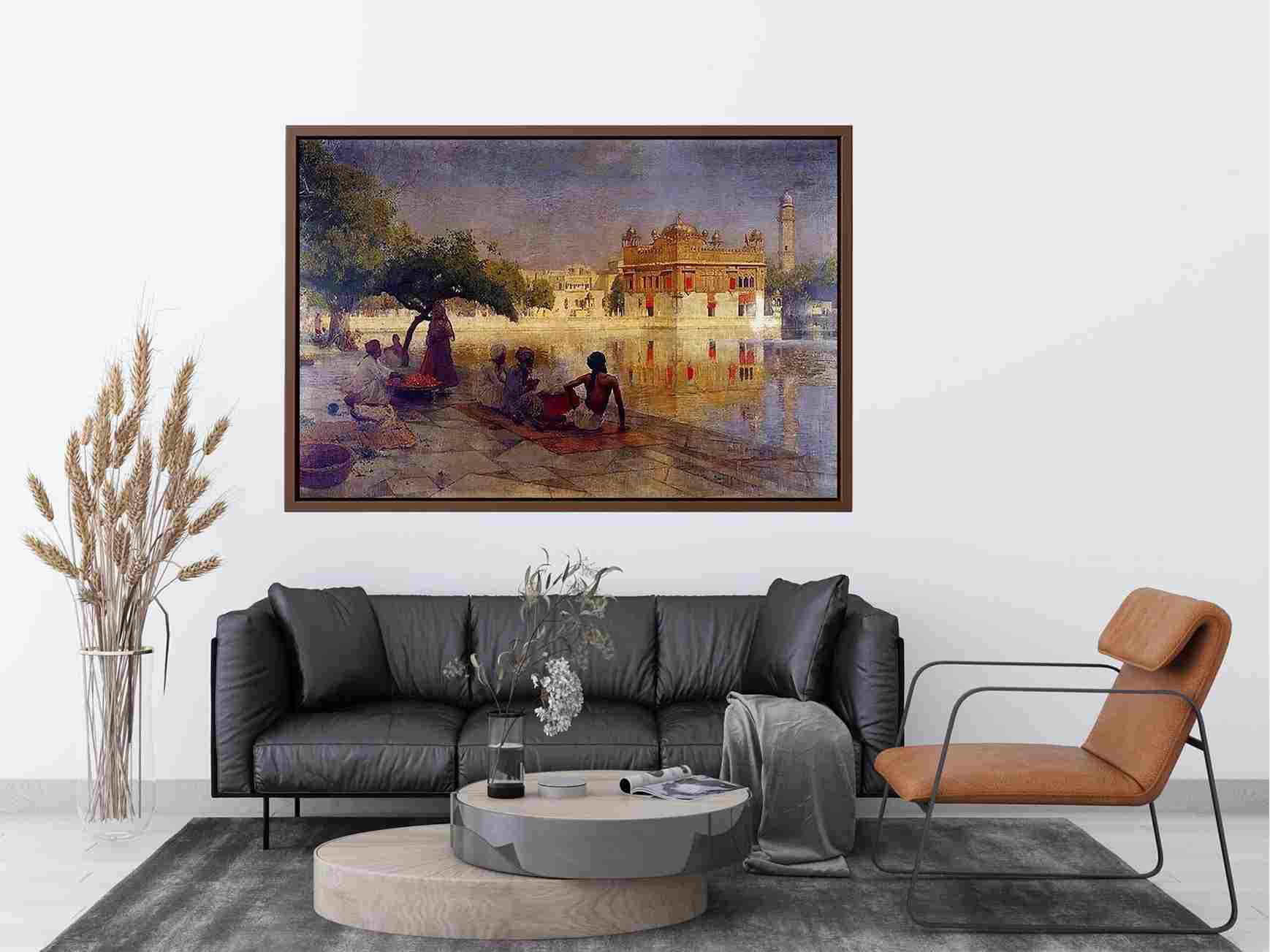
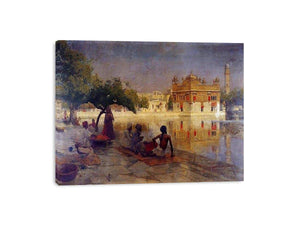
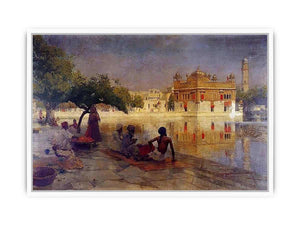
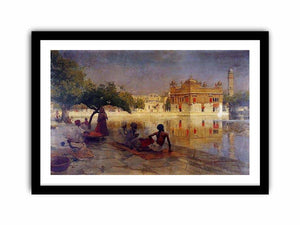
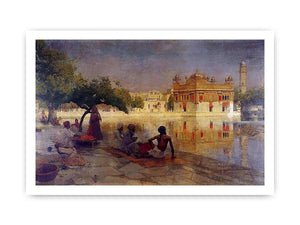
The Golden Temple Amritsar Painting by Edwin Lord Weeks
The Golden Temple Amritsar stands as one of Edwin Lord Weeks’s most luminous and culturally attentive works, a painting in which architectural reverence, spiritual atmosphere, and disciplined observation converge with exceptional clarity. Created by an artist whose reputation was built upon sustained travel and rigorous study, the work presents the Harmandir Sahib not as an exotic spectacle, but as a living centre of faith, humility, and communal presence. Weeks approaches the subject with measured respect, translating the temple’s spiritual gravity and visual harmony into a composition that is at once contemplative, precise, and enduring.
Edwin Lord Weeks was distinguished among nineteenth-century painters of the East by his commitment to first-hand experience. His journeys across India, Persia, and the Islamic world provided him with a depth of understanding rare among his contemporaries. Rather than relying on imaginative invention, Weeks observed architecture, ritual, and daily life with the eye of both artist and documentarian. In The Golden Temple Amritsar, this approach yields a painting grounded in accuracy and sensitivity, one that recognises the sacred site as an active space shaped by devotion and continuity rather than a static monument.
The Golden Temple itself occupies a unique position within Indian religious and cultural history. As the spiritual heart of Sikhism, it embodies principles of equality, openness, and service. Weeks’s painting honours these values through compositional balance and restraint. He does not overwhelm the viewer with decorative excess or theatrical perspective. Instead, he allows the temple’s form, reflection, and setting to speak with calm authority. The painting becomes an invitation to contemplation rather than consumption.
The composition is structured around harmony and reflection. The temple is positioned with clarity and dignity, its relationship to the surrounding water central to the painting’s visual and symbolic logic. The reflective pool does not merely mirror the structure; it extends the sacred space outward, reinforcing the idea that spirituality radiates beyond physical boundaries. Weeks uses this symmetry not for decorative effect, but to suggest equilibrium between the material and the transcendent.
Perspective is carefully moderated. The viewer is neither elevated above the scene nor immersed within it. Instead, Weeks situates the vantage point at a respectful distance, allowing the temple to be seen in full without diminishing its intimacy. This positioning encourages observation marked by humility rather than dominance. The painting reads as an act of witness rather than possession.
Light is the defining expressive element of the work. Weeks bathes the temple in warm, natural illumination that enhances its golden surfaces without exaggeration. Light glides across stone and water, revealing texture and form with quiet assurance. There is no dramatic chiaroscuro, no symbolic spotlight. Illumination here is continuous and enveloping, reinforcing the temple’s role as a place of spiritual clarity rather than spectacle.
Colour is employed with disciplined richness. The golden tones of the temple are balanced against cooler hues of water and sky, creating a visual equilibrium that mirrors the painting’s thematic balance. Whites, soft blues, and muted earth tones provide structure and contrast without competing for attention. Colour functions architecturally, guiding the eye and reinforcing spatial coherence rather than drawing attention to itself.
Weeks’s handling of texture reveals his technical mastery. Stone surfaces are rendered with weight and refinement, water with controlled fluidity, and architectural details with meticulous care. Brushwork remains refined and purposeful, accumulating detail without fragmenting the composition. This technical restraint ensures that the painting’s authority arises from coherence and understanding rather than virtuoso display.
Human presence, whether visible or implied, is integral to the painting’s meaning. The Golden Temple is not presented as an isolated relic, but as a living space shaped by devotion. Weeks avoids crowding the scene, allowing the architecture and its reflection to dominate while still suggesting the continual presence of worshippers and pilgrims beyond the immediate frame. This choice reinforces the idea of the temple as a spiritual constant sustained by collective practice.
Symbolically, The Golden Temple Amritsar operates through openness and reflection. The absence of barriers, the clarity of water, and the balanced composition all point toward Sikhism’s emphasis on accessibility, humility, and inner clarity. Weeks does not impose interpretation; he allows form and atmosphere to carry meaning. The painting’s symbolism is quiet, embedded within structure rather than declared through iconography.
Emotionally, the work conveys serenity and reverence. There is no drama, no tension, no narrative climax. Instead, the painting invites prolonged looking and inward response. Its calm is not emptiness, but fullness held in balance. Weeks captures a sense of spiritual presence that is steady rather than ecstatic, grounded rather than exalted.
Within Weeks’s broader oeuvre, this painting represents one of his most refined engagements with Indian sacred architecture. While he often depicted imperial ceremony and courtly life, The Golden Temple Amritsar demonstrates his capacity for restraint and humility before a subject defined not by power, but by devotion. It reveals an artist attentive not only to visual splendour, but to spiritual atmosphere.
The painting’s relevance today remains strong across the United States, the United Kingdom, Canada, Australia, and Europe. Contemporary viewers respond to its clarity, calm, and cultural respect. In a global context increasingly attentive to cross-cultural understanding, Weeks’s painting offers a model of representation grounded in observation and reverence rather than appropriation.
In interior settings, The Golden Temple Amritsar introduces light, balance, and contemplative presence. In living rooms, it creates a focal point of calm authority. In studies and offices, it supports reflection and clarity of thought. In galleries and luxury residences, it signals engagement with nineteenth-century travel-based painting at its most responsible and refined.
The painting integrates seamlessly into traditional, modern, minimalist, and eclectic décor. Traditional interiors resonate with its architectural dignity and historical depth. Modern spaces benefit from its compositional symmetry and tonal restraint. Minimalist environments amplify its serenity, while eclectic interiors draw cohesion from its balanced palette and spiritual resonance.
The enduring importance of The Golden Temple Amritsar lies in its refusal to reduce sacred architecture to ornament. Weeks presents the Harmandir Sahib as a living centre of faith, shaped by light, water, and human devotion. The painting endures because it recognises that true grandeur arises not from scale or excess, but from balance, openness, and continuity.
To live with The Golden Temple Amritsar is to engage daily with a work that rewards stillness and attention. Through its architectural intelligence, luminous restraint, and cultural sensitivity, the painting continues to affirm Edwin Lord Weeks’s position as one of the most perceptive painters of sacred spaces in the nineteenth century. It stands as a testament to his belief that art, when guided by knowledge and humility, can honour spiritual traditions with lasting clarity.
Buy museum qulaity 400- 450 canvas prints, framed prints, and 100% oil paintings of The Golden Temple Amritsar by Edwin Lord Weeks at Alpha Art Gallery, where world-famous masterpieces are recreated with museum-quality detail, refined craftsmanship, and premium materials.
FAQS
What sacred site does The Golden Temple Amritsar depict?
It depicts the Harmandir Sahib in Amritsar, the central place of worship in Sikhism.
Why is this painting considered culturally significant?
It presents a major spiritual site with accuracy, respect, and architectural clarity rather than exotic spectacle.
How does Edwin Lord Weeks approach religious architecture in this work?
He combines careful observation with compositional restraint, allowing atmosphere and structure to convey meaning.
What role does reflection play in the painting?
The reflective water extends the sacred space visually and symbolically, reinforcing balance and spiritual clarity.
Is The Golden Temple Amritsar suitable for contemporary interiors?
Yes. Its calm palette and balanced composition integrate beautifully into modern and traditional spaces.
What emotional tone does the painting convey?
It conveys serenity, reverence, and contemplative stillness.
Does this artwork have lasting historical and artistic value?
As a refined example of nineteenth-century travel-based sacred architecture painting, it holds enduring cultural importance.
Where is the best place to display The Golden Temple Amritsar?
It is especially well suited to living rooms, studies, galleries, and spaces intended for reflection and calm.