The Gleaners, 1857 Painting by Jean François Millet
The Gleaners, 1857 Painting by Jean François Millet is one of the most influential and morally resonant works of nineteenth-century art, a painting that redefined how labor, poverty, and dignity could be represented on a monumental scale. Created at the height of Millet’s maturity, the work transforms a humble agricultural practice into a profound meditation on endurance, social structure, and the quiet heroism of survival. Far from sentimental or anecdotal, The Gleaners asserts the presence of the rural poor with uncompromising seriousness, challenging both artistic tradition and contemporary social conscience.
The artist behind this transformative vision, Jean François Millet, was a central figure of the Barbizon School and among the first painters to treat peasant life as a subject worthy of grandeur and gravity. Millet did not approach rural labor as picturesque folklore; he understood it as a fundamental condition of human existence. In The Gleaners, his commitment to realism reaches philosophical depth. The painting does not dramatize hardship through spectacle. It allows the weight of repetition, posture, and scale to convey meaning.
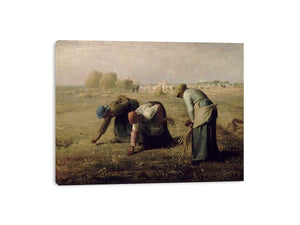
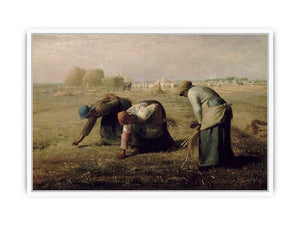
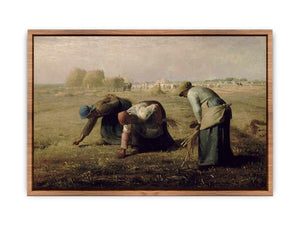
The subject depicts three peasant women bent over a harvested field, gathering leftover stalks of grain after the main harvest has been completed. Gleaning was a legally permitted practice, reserved for the poorest members of rural society, and carried clear social implications. Millet chooses this moment deliberately. There is no harvest celebration, no abundance in the foreground. The act shown is marginal, repetitive, and physically demanding. Yet the women are not portrayed as victims. They are steady, absorbed, and resolute in their task.
Compositionally, the painting is built upon a powerful contrast between foreground and background. The three women dominate the lower portion of the canvas, their bent forms creating a rhythmic sequence of movement from left to right. Their bodies are monumental in scale, modeled with solidity and weight. Behind them stretches a vast field filled with stacked haystacks, distant workers, and signs of agricultural plenty. This spatial separation is not accidental. Millet uses it to articulate social hierarchy without overt commentary. Abundance exists—but it is distant and inaccessible.
Perspective reinforces this division. The horizon line is placed high, compressing the women into the foreground and emphasizing their physical closeness to the earth. The viewer’s eye is drawn downward, forced to confront the repetitive motion of gleaning rather than drifting comfortably into the landscape. Millet denies the viewer an elevated vantage point. Observation occurs at the level of labor, not above it.
Light in The Gleaners is restrained and naturalistic. The scene unfolds under a soft, late-afternoon glow that neither dramatizes nor beautifies the figures. Illumination is even and functional, revealing form without theatrical emphasis. Light here does not romanticize hardship. It clarifies it. The figures are neither obscured nor idealized; they are simply present, working within the rhythms of the day.
The color palette is deliberately earthy and subdued. Browns, ochres, muted golds, and dusty blues dominate the canvas, echoing the tones of soil, straw, and sky. Color reinforces the material reality of the scene rather than offering visual escape. The women’s clothing blends with the landscape, suggesting continuity between body and land. This chromatic unity underscores Millet’s vision of labor as inseparable from environment.
Millet’s technique emphasizes mass and repetition. The women’s postures are similar but not identical, creating a visual cadence that suggests ongoing effort rather than a single frozen moment. Faces are largely obscured, not out of neglect, but by design. Identity here is collective rather than individual. Millet’s brushwork is firm and economical, particularly in the modeling of backs, arms, and hands, where physical strain is communicated through posture rather than expression.
Symbolically, The Gleaners is spare but potent. The act of bending repeatedly toward the earth suggests humility, endurance, and persistence. The leftover grain represents survival rather than prosperity. The distant harvest implies a system in which wealth and labor are unevenly distributed. Yet Millet avoids overt protest imagery. The painting does not accuse. It bears witness. Its power lies in its refusal to simplify complex social realities into sentiment or polemic.
Psychologically, the work is defined by absorption. The women are fully engaged in their task, not performing for the viewer. Their inward focus creates a sense of autonomy and dignity. Millet grants them seriousness by refusing to dramatize their hardship. There is no appeal to pity. Instead, there is an insistence on presence. The women exist on their own terms, bound by necessity but not diminished by it.
Within Millet’s broader oeuvre, The Gleaners stands as a cornerstone. Alongside The Angelus and The Sower, it articulates his belief that rural labor embodies moral gravity and human continuity. Unlike The Angelus, which introduces spiritual pause, The Gleaners remains anchored in physical effort. Together, these works define Millet’s vision of life shaped equally by toil and reflection.
Culturally, the painting was controversial upon its debut. Urban audiences recognized its social implications immediately, interpreting it as an unsettling reminder of poverty at a time of political tension in France. Over time, however, The Gleaners has come to be understood not as agitation, but as moral realism. Its influence extends across modern art, shaping later approaches to social representation and labor imagery.
In contemporary interiors across the United States, the United Kingdom, Canada, Australia, and Europe, The Gleaners introduces exceptional seriousness and grounding presence. In living rooms, it brings depth and human resonance. In studies and offices, it communicates discipline, perseverance, and historical awareness. In galleries and luxury residences, it anchors space with intellectual weight, integrating seamlessly into traditional, modern, minimalist, and eclectic décor through its balanced composition and earthy palette.
The painting remains meaningful today because it addresses enduring questions about work, inequality, and dignity without rhetoric. In an era still defined by labor and its value, Millet’s vision continues to resonate. The Gleaners does not seek sympathy. It commands recognition. It insists that the unseen labor sustaining society is worthy of sustained attention.
The Gleaners, 1857 Painting by Jean François Millet endures as one of the most morally serious works in Western art. Through compositional clarity, restrained naturalism, and profound empathy, Millet transformed an act of survival into a timeless meditation on endurance and human worth. The painting does not explain poverty. It acknowledges humanity.
Buy museum qulaity 400- 450 canvas prints, framed prints, and 100% oil paintings of The Gleaners by Jean François Millet at Alpha Art Gallery, where world-famous masterpieces are recreated with museum-quality detail, refined craftsmanship, and premium materials.
FAQS
What does The Gleaners depict?
It depicts three peasant women collecting leftover grain after the harvest, an activity reserved for the rural poor.
Why was this painting controversial when first exhibited?
Viewers recognized its social implications, as it foregrounded poverty and labor at a monumental scale.
Is The Gleaners a political painting?
It is socially aware rather than overtly political, presenting reality without propaganda or sentimentality.
Why are the women shown bent over?
Their posture conveys physical labor, repetition, and endurance rather than individual identity.
What is the significance of the distant harvest in the background?
It contrasts abundance with scarcity, quietly revealing social hierarchy.
How does this painting relate to The Angelus?
Both honor rural life, but The Gleaners focuses on continuous labor rather than spiritual pause.
Why does the painting feel timeless?
Its restrained palette, universal subject, and absence of anecdote transcend specific historical moments.
Where does this artwork work best in interiors?
It is ideal for living rooms, studies, offices, galleries, and spaces seeking depth, gravity, and human meaning.