The Flute Concert Painting by Adolph von Menzel
The Flute Concert stands as one of Adolph von Menzel’s most intellectually refined and historically resonant masterpieces, a painting in which observation, realism, and cultural insight are fused with exceptional authority. Completed in 1852, the work depicts an evening musical performance at the court of Frederick the Great of Prussia, yet it transcends the conventions of historical painting. Rather than presenting history as spectacle or idealised pageantry, Menzel renders it as lived experience—intimate, concentrated, and psychologically complex. The painting occupies a singular position in nineteenth-century European art, redefining how power, culture, and everyday reality could be visualised within a historical frame.
Menzel was an artist deeply resistant to academic formula. Though largely self-taught, he possessed a rigorous eye for detail and an uncompromising commitment to truth as he perceived it. By the time he painted The Flute Concert, Menzel had already distinguished himself as a chronicler of Prussian history, yet his approach was radically modern. He rejected grandiose symbolism and theatrical composition, choosing instead to observe history as a continuum of human actions, gestures, and environments. This painting exemplifies that philosophy with remarkable clarity.
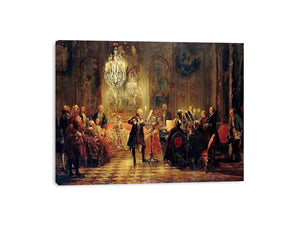
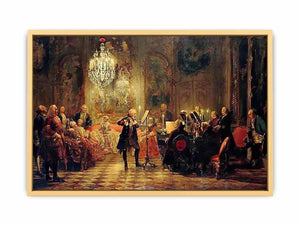
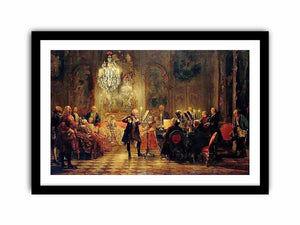
The scene depicts Frederick the Great himself performing on the flute, accompanied by musicians and attended by members of his court. Yet the king is not elevated above the composition through scale or heroic gesture. He is integrated into the ensemble, visually prominent yet human, absorbed in the act of making music. Menzel’s decision to portray a monarch as a participant rather than a symbol was both radical and revealing. Authority here is not asserted; it is exercised quietly, through discipline, intellect, and cultural engagement.
The composition is structured with extraordinary subtlety. Menzel arranges the figures in a shallow, horizontally oriented interior, drawing the viewer into the room rather than placing them at a distance. The eye moves naturally from Frederick at the centre to the surrounding musicians and listeners, guided by posture, light, and implied sound. There is no single dramatic focal point. Instead, the painting unfolds as a network of attentions—each figure engaged in listening, performing, or reflecting. This compositional choice reinforces the painting’s central theme: shared cultural experience.
Perspective is handled with remarkable naturalism. Menzel avoids exaggerated depth or theatrical framing, opting instead for a spatial arrangement that feels convincingly inhabited. The room is neither grandiose nor cramped. It is functional, lived-in, and specific. Architectural elements recede gently, supporting the figures without dominating them. This balance between space and presence reflects Menzel’s broader commitment to realism grounded in observation rather than convention.
Light plays a crucial role in shaping the painting’s atmosphere. Menzel employs warm, controlled illumination that appears to emanate from candles and interior light sources. This light does not dramatise; it clarifies. It settles across faces, fabrics, and instruments, revealing texture and form without sharp contrast. The subdued glow creates intimacy, reinforcing the sense that this is a private moment rather than a ceremonial event. Light here becomes a tool of psychological realism, guiding attention without imposing hierarchy.
Colour is restrained and intelligently modulated. Menzel favours muted earth tones, soft reds, browns, and greys, punctuated by the subtle sheen of instruments and fabrics. This palette avoids decorative excess, allowing the viewer to focus on interaction and mood. Colour supports realism rather than spectacle, reinforcing the painting’s documentary authority. Nothing distracts from the quiet intensity of the scene.
Menzel’s handling of texture is masterful. Fabrics are rendered with precision, yet never fetishised. Wood, metal, and paper are distinguished clearly, contributing to the tactile realism of the environment. Brushwork remains controlled but alive, allowing surfaces to breathe without calling attention to technique. This balance between finish and vitality is one of Menzel’s defining strengths and contributes significantly to the painting’s enduring credibility.
Psychologically, The Flute Concert is remarkably rich. Each figure appears absorbed in their role, whether performing, listening, or observing. Expressions are subtle, gestures restrained. There is no overt emotion, yet the atmosphere is charged with concentration and respect for the music being played. Menzel captures not performance as spectacle, but music as intellectual and emotional discipline. The viewer senses sound without hearing it, an achievement rooted in the painting’s compositional and observational precision.
Historically, the painting offers a nuanced portrait of Enlightenment culture. Frederick the Great was known not only as a military leader but as a patron of the arts and an accomplished musician. Menzel presents this dual identity without commentary. There is no glorification, no critique. Instead, history is allowed to exist in its complexity. Power and culture coexist, neither overshadowing the other. This neutrality is one of the painting’s most modern qualities.
Within Menzel’s oeuvre, The Flute Concert represents a culmination of his approach to history painting. It rejects academic idealisation in favour of empirical observation, yet it remains deeply engaged with the past. The painting demonstrates that historical art need not rely on myth or drama to achieve significance. Instead, it can derive power from accuracy, restraint, and psychological insight.
The painting’s relevance today remains profound. Viewers across the United States, the United Kingdom, Canada, Australia, and Europe continue to respond to its quiet authority and intellectual depth. In a contemporary context, where leadership and culture are often separated or politicised, The Flute Concert offers an image of authority grounded in discipline, participation, and shared experience.
In interior settings, The Flute Concert introduces sophistication, calm, and cultural depth. In living rooms, it creates an atmosphere of reflective elegance. In studies and offices, it reinforces values of focus, learning, and intellectual engagement. In galleries and luxury residences, it signals a serious appreciation for European realism and historically grounded art.
The painting integrates seamlessly into traditional, modern, minimalist, and eclectic décor. Traditional interiors resonate with its historical subject and tonal harmony. Modern spaces benefit from its restraint and psychological clarity. Minimalist environments find contrast in its narrative richness without visual excess, while eclectic interiors draw cohesion from its balanced composition and subdued palette.
The enduring importance of The Flute Concert lies in its refusal to separate history from humanity. Menzel presents a moment where power listens, culture is practiced, and attention is shared. The painting endures because it recognises that history is not only shaped by events, but by the quiet disciplines that give those events meaning.
To live with The Flute Concert is to engage daily with one of the most intelligent and quietly radical works of nineteenth-century art. Through its compositional discipline, historical insight, and psychological realism, the painting continues to affirm that truth, when observed with care and rendered without distortion, possesses lasting authority. It stands as a testament to Menzel’s belief that art can illuminate history not by elevating it, but by understanding it.
Buy museum qulaity 400- 450 canvas prints, framed prints, and 100% oil paintings of The Flute Concert by Adolph von Menzel at Alpha Art Gallery, where world-famous masterpieces are recreated with museum-quality detail, refined craftsmanship, and premium materials.
FAQS
What historical moment does The Flute Concert depict?
It depicts an intimate musical performance at the court of Frederick the Great, presenting history as lived experience rather than spectacle.
Why is this painting considered innovative for its time?
Menzel rejected heroic idealisation, portraying a monarch as a participant in cultural life rather than a symbolic figure.
What role does music play in the painting’s meaning?
Music represents intellectual discipline, shared attention, and cultural refinement rather than entertainment alone.
How does Menzel use light in this work?
Soft interior light creates intimacy and realism, guiding attention without theatrical contrast.
Is The Flute Concert suitable for contemporary interiors?
Yes. Its refined palette and intellectual depth integrate beautifully into both traditional and modern spaces.
What emotional tone does the painting convey?
It conveys concentration, calm authority, and quiet engagement rather than drama or grandeur.
Does this artwork have lasting cultural significance?
As a landmark of nineteenth-century realism and historical painting, it holds enduring artistic and intellectual importance.
Where is the best place to display The Flute Concert?
It is especially well suited to living rooms, studies, offices, and gallery spaces that value culture, history, and reflection.