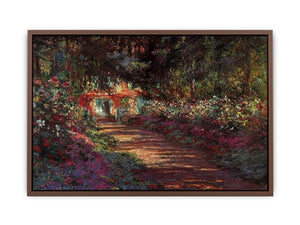
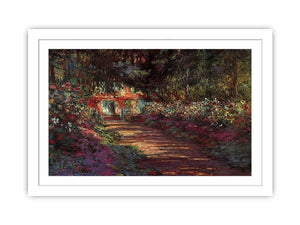
The Flowered Garden Painting by Claude Monet
The Flowered Garden stands as one of Claude Monet’s most quietly confident explorations of cultivated nature as a site of perception, rhythm, and lived experience. Painted during the years when Monet increasingly turned his attention toward gardens as primary subjects, the work reflects a decisive shift in his understanding of landscape. Nature here is neither wild nor symbolic; it is shaped, tended, and experienced through time. In this painting, Monet presents the garden not as a decorative motif but as a dynamic field in which colour, light, and human intention coexist in continuous negotiation.
By the time Monet devoted himself to garden scenes such as The Flowered Garden, he had moved beyond the need to justify modern subject matter. His earlier battles for recognition were largely behind him, and his artistic focus narrowed toward sustained observation rather than innovation for its own sake. Gardens offered Monet an environment where change was constant yet structured, allowing him to study seasonal rhythm, chromatic interaction, and the passage of light without leaving the immediacy of his surroundings. The Flowered Garden emerges from this mindset as a painting rooted in attention rather than spectacle.
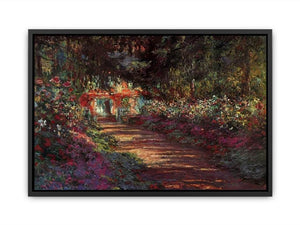
The composition is generous and inviting. A profusion of flowers fills much of the canvas, arranged in broad bands or clusters that guide the eye laterally rather than toward a distant vanishing point. Paths or structural elements, if present, serve as gentle organisers rather than dominant features. Monet resists the temptation to impose rigid geometry. Instead, he allows growth and colour to dictate the painting’s rhythm. The garden unfolds as an immersive space rather than a scene to be surveyed from afar.
Perspective is moderated and experiential. The viewer is positioned within the garden, not above it. Depth is suggested through overlapping forms and tonal modulation rather than through strict linear construction. Flowers advance toward the viewer, while background elements recede softly, maintaining coherence without asserting hierarchy. This approach mirrors the act of walking through a garden, where perception shifts gradually and orientation remains fluid.
Light operates as a unifying presence rather than a dramatic force. Sunlight spreads evenly across the scene, clarifying colour and form without theatrical emphasis. There are no sharp contrasts or pronounced shadows. Illumination feels natural and sustained, reinforcing the sense that this is not a singular moment of effect but a condition of being outdoors. Light reveals rather than transforms, allowing colour relationships to carry expressive weight.
Colour is the painting’s central language. Monet orchestrates a complex harmony of hues—reds, pinks, yellows, whites, and violets—anchored by a dominant field of green. These colours are not applied decoratively. Each tone responds to its neighbour, creating vibration through proximity rather than intensity. Monet avoids pure colour in favour of modulation, allowing blossoms to emerge from foliage organically. The effect is abundance tempered by balance, richness held within restraint.
Monet’s brushwork remains open, responsive, and visibly present. Individual strokes suggest petals, leaves, and stems without defining them botanically. The surface retains the energy of its making, preserving the immediacy of perception. Flowers are built through clustered touches of paint that convey volume and density, while foliage is rendered with directional strokes that imply growth and movement. The painting does not resolve into finish; it remains alive with gesture.
Symbolically, The Flowered Garden resists overt allegory. Its meaning lies in sustained attention rather than metaphor. Yet the garden itself carries implicit significance. It is a space shaped by care, repetition, and patience, qualities mirrored in Monet’s method. Cultivated nature becomes a partner in perception rather than an object of control. The painting suggests harmony not through idealisation, but through coexistence between human intention and natural vitality.
Emotionally, the work conveys calm abundance. There is no urgency, no dramatic tension. Instead, the painting offers visual generosity, inviting the viewer to linger rather than react. The absence of narrative allows the viewer’s experience to remain open, shaped by colour and rhythm rather than story. The garden feels welcoming, not as an escape from the world, but as an extension of lived experience.
Within Monet’s artistic evolution, The Flowered Garden occupies an important position between his earlier explorations of modern life and his later immersive studies of water and reflection. It demonstrates how the garden became a central laboratory for his thinking, allowing him to explore chromatic density and surface organisation without abandoning recognisable form. The painting reflects an artist increasingly interested in continuity—how repeated looking deepens perception rather than exhausting it.
Culturally, the work reflects a broader redefinition of landscape in late nineteenth-century art. Gardens, once symbols of order or status, become spaces of sensory engagement and everyday life. Monet’s approach strips the garden of allegorical burden and restores it as a site of experience. In doing so, he aligns painting with modern ways of seeing, grounded in immediacy and attention rather than inherited meaning.
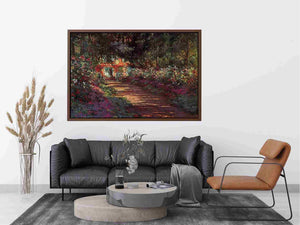
In contemporary interiors, The Flowered Garden integrates with exceptional warmth and adaptability. In living rooms, it introduces colour and vitality while maintaining compositional balance. In dining areas and shared spaces, it reinforces openness and ease, encouraging social presence without visual dominance. In studies and offices, it offers chromatic richness tempered by order, supporting focus rather than distraction. Across interiors in the United States, United Kingdom, Canada, Australia, and Europe, the painting complements traditional, modern, minimalist, and eclectic décor alike. Its floral abundance enlivens neutral environments, while its structural harmony ensures lasting visual comfort.
The enduring relevance of The Flowered Garden lies in its affirmation of attention as value. Monet demonstrates that sustained looking transforms ordinary spaces into sources of depth and meaning. The painting does not seek to astonish; it rewards patience. By presenting a cultivated garden as a site of ongoing perception, Monet offers a vision of beauty grounded in continuity rather than climax. The work endures because it reminds viewers that richness often resides not in rarity or spectacle, but in the quiet persistence of care, colour, and time.
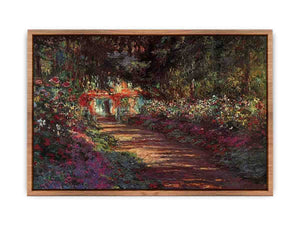
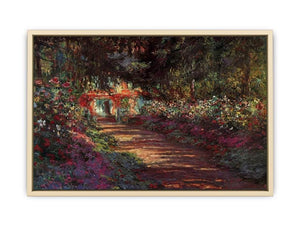
Buy museum qulaity 400- 450 canvas prints, framed prints, and 100% oil paintings of The Flowered Garden by Claude Monet at Alpha Art Gallery, where world-famous masterpieces are recreated with museum-quality detail, refined craftsmanship, and premium materials.
FAQS
What does The Flowered Garden by Claude Monet depict?
It depicts a cultivated garden filled with flowering plants, presented as an immersive field of colour and perception rather than a formal landscape view.
Why did Monet focus so often on gardens as subjects?
Gardens allowed him to study light, colour, and seasonal change through sustained observation in a controlled yet living environment.
Is The Flowered Garden a realistic or expressive painting?
It is expressive, prioritising sensation and colour relationships over precise botanical detail.
How does Monet create harmony in such a dense composition?
He balances vibrant floral colours with stabilising greens and uses rhythmic brushwork to unify the surface.
Does the painting include symbolic meaning?
Its meaning is implicit rather than allegorical, centred on attention, care, and lived experience.
How is space constructed in the painting?
Space is created through overlapping forms and tonal variation rather than linear perspective.
Is The Flowered Garden suitable for contemporary interiors?
Yes, its balanced composition and rich yet calming palette suit a wide range of modern and traditional spaces.
Why does The Flowered Garden remain relevant today?
Its emphasis on everyday beauty, patience, and sustained perception resonates strongly in contemporary life.