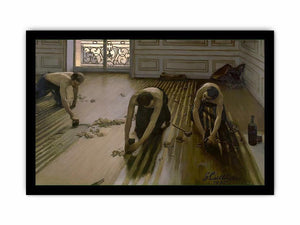
The Floor Scrapers 1875 Painting by Gustave Caillebotte
The Floor Scrapers stands as one of the most uncompromising and quietly radical paintings of nineteenth-century modern life, a work in which Gustave Caillebotte redirected the gaze of high art toward labour, physical exertion, and the unvarnished reality of contemporary interiors. Painted in 1875, the work occupies a pivotal position between Realism and Impressionism, yet resists full alignment with either movement. Instead, it asserts Caillebotte’s singular vision: a modern painting grounded in precision, perspective, and the dignity of work, rendered without sentimentality or theatrical gesture.
At the time Caillebotte painted The Floor Scrapers, French academic tradition continued to privilege historical, mythological, and allegorical subjects. Even within Impressionism, modern life was often depicted through leisure—boulevards, cafés, gardens, and domestic comfort. Caillebotte chose a different path. He turned his attention inward, into a Parisian apartment stripped of decoration and social performance, and focused on labour normally unseen, uncelebrated, and physically demanding. In doing so, he challenged both academic hierarchy and bourgeois complacency.
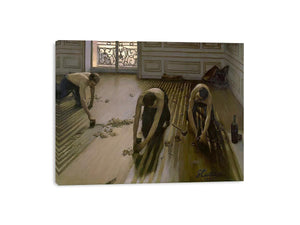
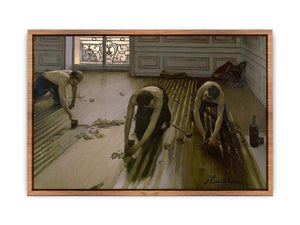
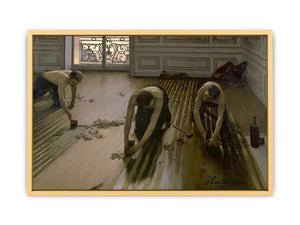
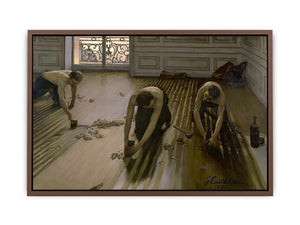
The subject is deceptively simple: three men scraping a wooden floor, bent low to their task, bodies aligned in repetitive motion. Yet this simplicity is precisely the painting’s strength. Caillebotte does not dramatise the work through exaggerated gesture or narrative. Instead, he presents labour as sustained physical discipline, governed by rhythm, repetition, and endurance. The men’s faces are largely obscured, their individuality subordinated to action. What matters is not who they are, but what they do.
Compositionally, The Floor Scrapers is rigorously constructed. The floor dominates the canvas, stretching forward with powerful linear perspective. Its long, parallel boards draw the viewer’s eye into depth, anchoring the entire composition. The workers are arranged diagonally across this surface, their bodies echoing the direction of the floorboards and reinforcing a sense of structural order. This geometry transforms the interior into an architectural space of labour rather than comfort. The room is not yet lived in; it is being made ready.
Perspective is one of the painting’s most striking features. Caillebotte places the viewer low, near the level of the floor, intensifying awareness of physical proximity and effort. This vantage point aligns the viewer with the labour itself, rather than with detached observation. The shallow angle elongates the workers’ bodies and exaggerates their bent posture, emphasising strain and repetition. Perspective here is not neutral; it is ethical, compelling recognition of work as bodily experience.
Light enters the room from a window at the far end, illuminating the scraped wood with subtle warmth. Rather than flooding the space, light glides across the floor, catching on freshly exposed surfaces and creating a delicate contrast between finished and unfinished sections. This light does not romanticise the scene. It clarifies it. The illumination reveals texture, dust, and grain, reinforcing the material reality of the work. Light becomes an instrument of truth rather than atmosphere.
Colour in The Floor Scrapers is restrained and disciplined. Warm tones of wood dominate, offset by the muted flesh tones of the workers and the subdued whites and greys of the surrounding walls. There is no decorative palette, no chromatic indulgence. Colour functions structurally, supporting the painting’s emphasis on material and form. The harmony of tones contributes to a sense of cohesion and focus, ensuring that nothing distracts from the act of labour itself.
Caillebotte’s technique is precise and controlled. Unlike the looser brushwork associated with Impressionism, his handling of paint is smooth, deliberate, and exacting. Surfaces are carefully defined, edges crisp, textures convincingly rendered. This precision underscores the seriousness with which he approaches the subject. The painting does not aestheticise labour through painterly flourish. It respects it through clarity and discipline.
Emotionally, The Floor Scrapers is remarkably restrained. There is no overt hardship, no melodrama, yet neither is there comfort or ease. The workers’ bent bodies convey exertion without complaint. The scene is quiet, almost meditative, yet charged with physical intensity. Viewers often experience a subtle discomfort, born not of tragedy, but of recognition. The painting insists on attention to work normally ignored, asking the viewer to remain present with it.
Symbolically, the painting operates on several levels without resorting to allegory. On one level, it represents modern urban transformation—the renovation of private interiors in a rapidly changing Paris. On another, it asserts the legitimacy of labour as subject matter for serious art. Caillebotte does not frame the workers as heroic or pitiable. He presents them as essential. The absence of narrative elevates the act itself, suggesting that meaning resides in process rather than spectacle.
Within Caillebotte’s artistic development, The Floor Scrapers marks a defining statement. While he was associated with the Impressionists and supported them financially and intellectually, this painting reveals his independent stance. He embraced modern subject matter but rejected optical dissolution. Instead, he pursued a vision of modernity grounded in structure, perspective, and clarity. This approach anticipated later developments in modern art, where ordinary spaces and labour would become central themes.
Culturally, The Floor Scrapers challenged contemporary audiences. Its depiction of shirtless labourers in a bourgeois interior unsettled expectations of propriety and taste. The painting was rejected by the official Salon, not for technical deficiency, but for subject matter deemed inappropriate. This rejection underscores the painting’s radical nature. Caillebotte was not merely depicting modern life; he was confronting social boundaries embedded within artistic convention.
In contemporary interiors, The Floor Scrapers integrates with exceptional intellectual and visual strength. In living rooms, it introduces depth, seriousness, and architectural rhythm. In studies and offices, it communicates discipline, focus, and cultural awareness. In galleries and luxury residences across the United States, United Kingdom, Canada, Australia, and Europe, the painting complements modern, minimalist, and industrial interiors with particular resonance. Its linear structure and restrained palette harmonise with contemporary design, while its subject matter anchors the space in human reality.
The enduring relevance of The Floor Scrapers lies in its honesty. Caillebotte does not transform labour into metaphor or spectacle. He presents it as fact—repetitive, physical, and essential. The painting endures because it recognises a truth that remains constant across centuries: that modern life is built not only on vision and leisure, but on unseen work performed with discipline and precision. In The Floor Scrapers, Gustave Caillebotte offers a vision of modernity stripped of illusion, grounded in effort, structure, and the quiet dignity of making space inhabitable.
Buy museum qulaity 400- 450 canvas prints, framed prints, and 100% oil paintings of The Floor Scrapers by Gustave Caillebotte at Alpha Art Gallery, where world-famous masterpieces are recreated with museum-quality detail, refined craftsmanship, and premium materials.
FAQS
What does The Floor Scrapers by Gustave Caillebotte depict?
It depicts three men scraping a wooden floor inside a Parisian apartment, focused on physical labour.
Why was The Floor Scrapers controversial when first shown?
Because it portrayed working-class labour in a bourgeois interior without idealisation or narrative justification.
Is this painting Impressionist?
It is associated with Impressionism but differs through its precision, structure, and controlled technique.
What role does perspective play in the painting?
The low viewpoint aligns the viewer with the labour, emphasising physical effort and spatial depth.
Why are the workers’ faces not emphasised?
Caillebotte prioritises action and movement over individual identity, focusing on labour itself.
What is the emotional tone of the painting?
The tone is restrained and serious, conveying effort without drama or sentimentality.
Is The Floor Scrapers suitable for contemporary interiors?
Yes, its linear composition and modern subject matter suit minimalist, modern, and industrial spaces.
Why does The Floor Scrapers remain relevant today?
Its focus on unseen labour, modern interiors, and dignity of work continues to resonate in contemporary society.