The Fighting Temeraire Painting by Joseph Mallord William Turner
The Fighting Temeraire Painting by Joseph Mallord William Turner is one of the most elegiac, intellectually profound, and emotionally resonant works in the entire history of British art. Painted in 1838 and exhibited the following year, the canvas stands as a meditation on time, memory, and the inexorable passage from one era to another. At once a historical painting, a maritime scene, and a philosophical reflection, The Fighting Temeraire transforms a specific event into a universal statement about decline, progress, and the cost of modernity.
By the late 1830s, Joseph Mallord William Turner had reached a stage of artistic maturity in which narrative accuracy mattered less than moral and emotional truth. His work had become increasingly concerned with light, atmosphere, and symbolism, allowing him to address history not as a sequence of facts but as a lived and felt experience. The Fighting Temeraire exemplifies this approach. Though grounded in a real event—the towing of the once-glorious warship HMS Temeraire to the breakers’ yard—Turner reshapes reality to express something far larger: the quiet dignity of obsolescence and the melancholy beauty of endings.
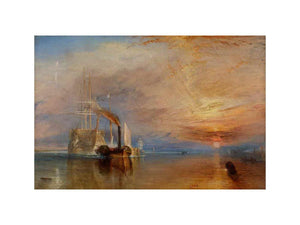
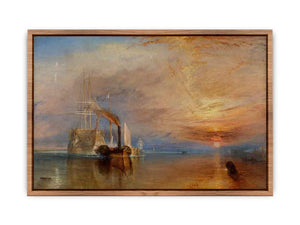
The historical background of the painting is essential to its meaning. HMS Temeraire earned enduring fame at the Battle of Trafalgar in 1805, where it played a decisive role in securing British naval victory. By 1838, however, the ship had become outdated, a relic of the age of sail rendered obsolete by technological change. Turner depicts the moment when the great vessel, stripped of sails and power, is towed up the River Thames by a small steam tug. This unassuming act of removal becomes, in Turner’s hands, a ritual of farewell.
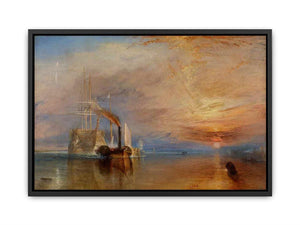
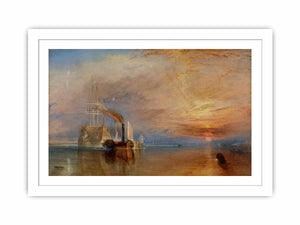
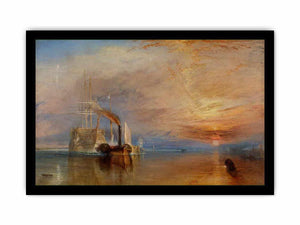
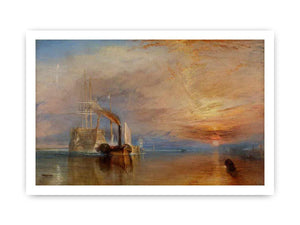
Compositionally, the painting is both balanced and deeply symbolic. The massive, pale hull of the Temeraire dominates the left side of the canvas, its form ghostly and luminous, while the small but forceful steam tug occupies the right, churning dark water as it pulls the old ship forward. The diagonal relationship between the two vessels establishes a visual and conceptual tension: grandeur versus utility, past versus future, silence versus noise. Turner carefully orchestrates this contrast so that neither vessel overwhelms the other; instead, they exist in a poignant state of dependency.
Perspective in the painting is calm and measured, unlike the violent instability seen in some of Turner’s storm scenes. The river stretches gently into the distance, guiding the viewer’s eye toward the horizon. This controlled spatial arrangement reinforces the painting’s elegiac tone. There is no chaos here, no resistance. The transition from sail to steam unfolds quietly, almost ceremonially, underscoring the inevitability of change.
Light is the painting’s emotional core. Turner bathes the scene in the golden glow of a setting sun, its fiery disc sinking toward the horizon. This sunset is not merely descriptive; it is profoundly symbolic. The day’s end mirrors the end of an era, casting the Temeraire in a radiant yet fading light. The ship’s pale tones seem to absorb and reflect the sunset’s warmth, enhancing its spectral presence. Light here becomes memory itself—beautiful, fleeting, and irreversible.
The color palette is among Turner’s most lyrical. Warm oranges, reds, and golds dominate the sky, while cooler blues and greys settle over the water and distant land. The contrast between the glowing heavens and the darker river reinforces the emotional duality of the scene: celebration and loss, beauty and sorrow. The steam tug’s dark, smoky hues intrude upon this harmony, introducing the sooty palette of industrial modernity into a world previously defined by wind and canvas.
Turner’s handling of paint is characteristically expressive yet controlled. The Temeraire is rendered with softened edges, its form dissolving gently into atmosphere, as though already slipping into memory. By contrast, the steam tug is painted more solidly, its mechanical presence asserted through darker tones and firmer strokes. Water and sky are treated with fluid, layered brushwork that allows light to shimmer and shift across the surface. This painterly contrast reinforces the conceptual opposition between the two vessels.
Symbolism permeates every element of the painting. The Temeraire, though being towed eastward toward dismantling, is bathed in the light of the setting sun in the west—a poetic reversal of geographical reality that Turner employs deliberately. The ship appears to sail toward the sunset, toward honor and remembrance, rather than toward destruction. Even the small flag flying from the tug, often interpreted as the Union Jack, reinforces the painting’s national resonance, linking the ship’s fate to Britain’s evolving identity.
Psychologically, The Fighting Temeraire is deeply moving because it refrains from overt drama. There is no visible human figure mourning the ship, no gesture of farewell. The emotion arises instead from restraint. Turner allows the viewer to supply the feeling, trusting that the quiet dignity of the scene will resonate. The absence of spectacle intensifies the sense of loss, transforming the painting into a shared act of remembrance.
Within Turner’s broader oeuvre, this painting occupies a unique position. While many of his works explore nature’s power over humanity, The Fighting Temeraire addresses a different force: historical change. Here, it is not the storm or the sea that overwhelms human endeavor, but progress itself. Turner does not condemn this progress outright. The steam tug is efficient, purposeful, and undeniably effective. Yet its triumph is shadowed by the cost of what it replaces. The painting thus resists simple interpretation, offering instead a nuanced reflection on advancement and sacrifice.
The cultural significance of The Fighting Temeraire is immense. It has come to be regarded as a national icon, not because it glorifies victory, but because it honors memory. Turner reframes heroism as something that endures beyond utility, suggesting that the value of the past cannot be measured solely by its continued function. In doing so, he articulates a vision of history rooted in respect rather than nostalgia.
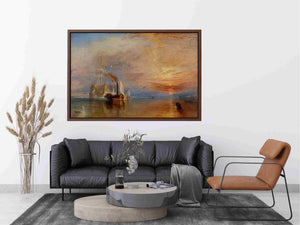
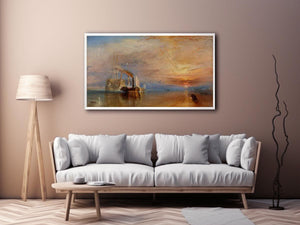
In contemporary interiors across the United States, the United Kingdom, Canada, Australia, and Europe, The Fighting Temeraire carries exceptional emotional and intellectual weight. In living rooms, it introduces warmth, reflection, and a sense of narrative depth. In studies and offices, it conveys historical awareness, cultural seriousness, and philosophical engagement. In galleries and luxury residences, it anchors space with quiet grandeur, harmonizing with traditional, modern, minimalist, and eclectic décor through its balanced composition and luminous palette.
The painting remains profoundly meaningful today because its central theme is universal. Societies continue to confront the replacement of the old by the new, the question of what is lost in the name of progress. Turner’s vision reminds viewers that progress, while necessary, is never neutral. It carries with it memory, emotion, and moral responsibility. The Fighting Temeraire does not resist change; it insists on remembrance.
The Fighting Temeraire Painting by Joseph Mallord William Turner endures as one of the most poetic and philosophically rich works ever painted. Through radiant light, symbolic composition, and emotional restraint, Turner transformed the dismantling of a ship into a timeless meditation on history and human value. The painting does not cry out in protest. It glows with understanding. In that quiet glow lies its enduring power.
Buy museum qulaity 400- 450 canvas prints, framed prints, and 100% oil paintings of The Fighting Temeraire by Joseph Mallord William Turner at Alpha Art Gallery, where world-famous masterpieces are recreated with museum-quality detail, refined craftsmanship, and premium materials.
What does The Fighting Temeraire depict?
It depicts the historic warship HMS Temeraire being towed by a steam tug to be dismantled.
Why is this painting considered one of Turner’s greatest works?
Because it unites technical mastery with profound symbolism and emotional depth.
What does the sunset symbolize in the painting?
The sunset represents the end of an era and the passage of time.
Why is the steam tug important to the composition?
It symbolizes modern industrial power replacing the age of sail.
Is the painting historically accurate?
It is based on real events but altered symbolically to express deeper meaning.
What emotions does the painting convey?
It conveys melancholy, dignity, reflection, and quiet acceptance.
How does this painting differ from Turner’s storm scenes?
It emphasizes calm transition rather than dramatic conflict.
Why does The Fighting Temeraire remain relevant today?
Its meditation on progress, memory, and loss continues to resonate across generations.