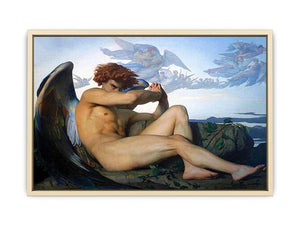
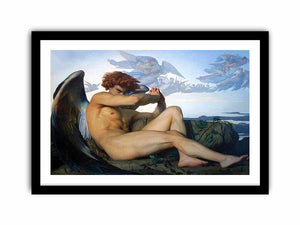
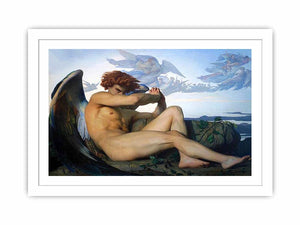
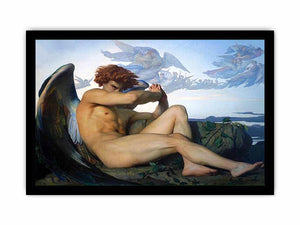
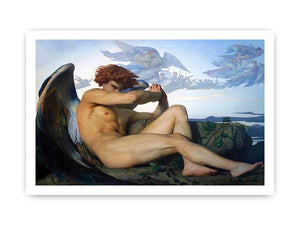
The Fallen Angel Painting by Alexandre Cabanel
The Fallen Angel Painting by Alexandre Cabanel is a masterful synthesis of academic precision, psychological intensity, and Romantic drama, presenting a vision of spiritual rebellion rendered with exquisite control and unsettling emotional depth. Painted in the mid-nineteenth century, the work occupies a singular position within academic art, revealing how technical perfection can be harnessed to explore themes of defiance, exile, and wounded pride. Cabanel transforms a biblical subject into a profoundly human meditation on loss and resistance, where beauty itself becomes a vehicle for moral and emotional complexity.
Alexandre Cabanel was among the most celebrated painters of the French academic tradition, renowned for his command of anatomy, surface finish, and idealized form. Yet The Fallen Angel demonstrates that Cabanel’s art was not confined to decorative myth or polished sentiment. Beneath its flawless execution lies a penetrating psychological portrait, one that challenges the viewer to confront the inner life of a figure traditionally cast as pure evil. Cabanel does not depict Satan as monstrous or grotesque, but as heartbreakingly beautiful, suspended at the moment when defiance curdles into despair.
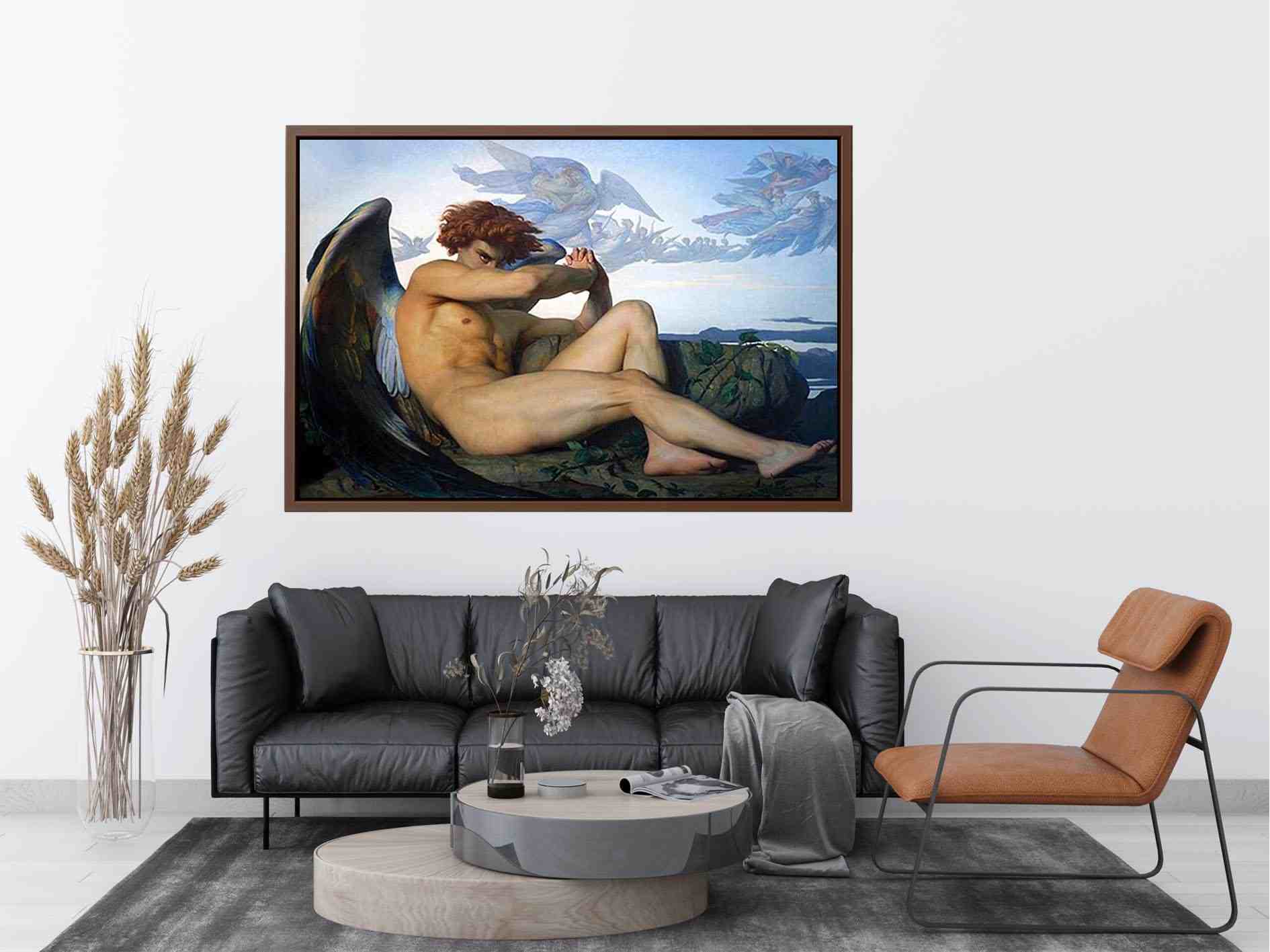
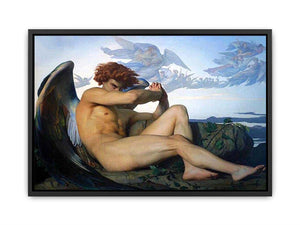
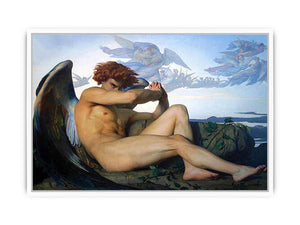
The subject is Lucifer, cast out of Heaven, seated upon a rocky precipice in the aftermath of his fall. His body is contorted yet controlled, muscular yet tense, embodying both divine origin and mortal vulnerability. One arm shields his face partially, while his eyes, luminous and charged with emotion, glare outward with unmistakable intensity. This gaze is the emotional fulcrum of the painting. It conveys rage, humiliation, sorrow, and unbroken will simultaneously, collapsing complex psychological states into a single, unforgettable expression.
Compositionally, the painting is tightly controlled, focusing attention on the figure rather than narrative environment. Cabanel situates the angel in a compressed space, isolating him against a muted, atmospheric background. This confinement intensifies the sense of exile. There is no visible Heaven above, no Hell below—only the immediacy of loss. The figure’s wings, once symbols of divine freedom, now lie heavy and inert, reinforcing the physical and spiritual consequences of the fall.
Perspective places the viewer at an intimate distance, close enough to register the strain in the body and the subtle modulation of expression. Cabanel avoids heroic scale or sweeping gesture. Instead, he draws the viewer into a private moment of reckoning. The fallen angel is not presented as a distant allegory, but as a being caught in the raw immediacy of emotional collapse. This intimacy transforms the painting from mythological illustration into psychological encounter.
Light is deployed with extraordinary subtlety. Cabanel uses soft, controlled illumination to model the body with sculptural clarity while preserving the painting’s somber mood. Light caresses the contours of flesh, emphasizing the angel’s beauty and divine origin, even as shadow pools around him. This contrast underscores the painting’s central tension: the coexistence of grace and condemnation, purity and rebellion.
Color is restrained and harmonized, dominated by cool flesh tones, muted blues, and earthy shadows. Cabanel avoids dramatic chromatic contrast, allowing tonal variation to carry emotional weight. The subdued palette reinforces the painting’s introspective atmosphere, ensuring that nothing distracts from the figure’s psychological presence. Color here serves form and feeling rather than spectacle.
Cabanel’s technique is exemplary of academic mastery. The surface is polished, transitions are seamless, and anatomy is rendered with idealized precision. Yet this perfection is not cold. On the contrary, it heightens the painting’s emotional impact. The flawless execution mirrors the angel’s original perfection, making his fall all the more tragic. Technique becomes meaning, not ornament.
Emotionally, The Fallen Angel is charged with restrained intensity. There is no overt gesture of despair—no collapse, no weeping. Instead, Cabanel presents controlled suffering, the kind born of pride wounded but not extinguished. The angel’s clenched posture and piercing gaze suggest resistance rather than submission. This emotional ambiguity is central to the painting’s power. The viewer is left uncertain whether the figure inspires condemnation, pity, or uneasy admiration.
Psychologically, the work explores the moment when identity fractures. Lucifer is no longer what he was, yet he refuses to become what he is expected to be. Cabanel captures this liminal state with extraordinary sensitivity. The fallen angel exists between past glory and future damnation, defined by consciousness of loss rather than acceptance of fate. This psychological depth elevates the painting beyond doctrinal narrative into universal human experience.
Symbolically, the painting resonates far beyond its biblical source. The fallen angel can be read as an embodiment of pride, rebellion, or the cost of autonomy. He may also be understood as a figure of tragic individuality, punished not for weakness but for defiance. Cabanel does not resolve these interpretations. He allows the image to remain open, inviting viewers to project their own understanding of rebellion, loss, and resilience.
Within Cabanel’s career, The Fallen Angel stands apart from his more serenely idealized mythological works. It reveals an artist capable of psychological intensity and moral ambiguity, working within academic tradition while subtly expanding its expressive range. The painting demonstrates that academic art, often dismissed as emotionally shallow, could engage profoundly with inner life when guided by intelligence and restraint.
Culturally, the painting reflects nineteenth-century fascination with the figure of the rebel—an era shaped by political upheaval, philosophical questioning, and romanticized defiance. The fallen angel embodies this spirit, standing as a symbol of resistance to absolute authority and the emotional cost of such resistance. The work’s enduring popularity testifies to its ability to speak across changing cultural contexts.
In contemporary interiors across the United States, the United Kingdom, Canada, Australia, and Europe, The Fallen Angel commands powerful presence. In living rooms, it introduces dramatic intensity and psychological depth. In studies and offices, it reflects intellectual seriousness and engagement with moral complexity. In galleries and luxury residences, it signals refined appreciation for figurative mastery and emotionally charged classical art.
The painting integrates strikingly into traditional interiors, where its academic precision and mythological subject resonate with classical values. It also creates compelling contrast in modern and minimalist spaces, where its emotional gravity and sculptural clarity assert themselves with authority. In eclectic environments, it functions as a focal point, anchoring diverse elements through shared intensity.
The long-term artistic importance of The Fallen Angel lies in its demonstration that beauty and suffering are not opposites, but interdependent forces. Cabanel shows that perfection can coexist with anguish, and that technical mastery can serve emotional truth. The painting endures because it confronts viewers with an image that is as unsettling as it is beautiful.
Today, The Fallen Angel remains profoundly relevant. In a world still grappling with questions of power, rebellion, and identity, its vision of wounded defiance speaks with undiminished force. Through impeccable technique, restrained color, and piercing psychological insight, Alexandre Cabanel created a painting that continues to challenge, disturb, and captivate—an image of beauty forever marked by the cost of resistance.
Buy museum qulaity 400- 450 canvas prints, framed prints, and 100% oil paintings of The Fallen Angel by Alexandre Cabanel at Alpha Art Gallery, where world-famous masterpieces are recreated with museum-quality detail, refined craftsmanship, and premium materials.
FAQS
What does The Fallen Angel by Alexandre Cabanel depict?
It depicts Lucifer immediately after his fall from Heaven, capturing a moment of wounded pride, defiance, and emotional collapse.
Why is the angel shown as beautiful rather than monstrous?
Cabanel emphasizes the angel’s divine origin and psychological complexity rather than portraying evil as grotesque.
What emotion defines the painting most strongly?
Controlled anguish and defiance dominate, conveyed through posture, gaze, and restraint rather than overt drama.
Is the painting purely religious in meaning?
While rooted in biblical tradition, it also functions as a universal meditation on rebellion, loss, and identity.
Where does this artwork work best in interior spaces?
It suits living rooms, studies, offices, galleries, and statement luxury interiors.
Is The Fallen Angel suitable for modern décor?
Yes, its sculptural clarity and emotional intensity create powerful contrast in modern and minimalist spaces.
Does the painting have lasting artistic significance?
It is regarded as one of the most psychologically compelling works of academic art, admired for both technical mastery and emotional depth.