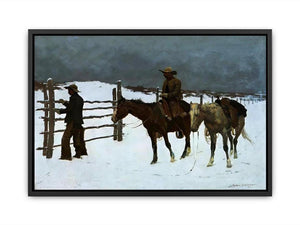
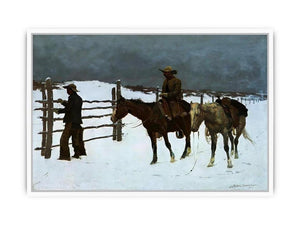
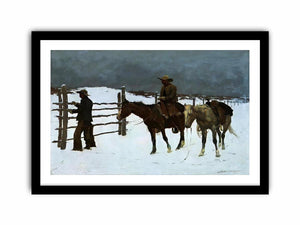
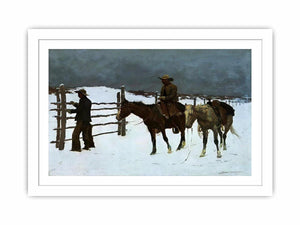
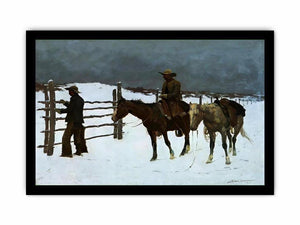
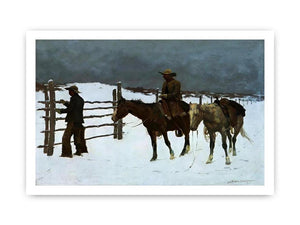
The Fall of the Cowboy Painting by Frederic Remington
The Fall of the Cowboy stands as one of Frederic Remington’s most sobering and psychologically resonant works, a painting in which the mythology of the American West gives way to vulnerability, loss, and the abrupt fragility of human control. Rather than celebrating triumph, motion, or heroic mastery, Remington fixes his attention on the precise instant when power collapses and the rider is unseated—both physically and symbolically. The painting captures not an epic narrative, but a moment of irreversible consequence, where gravity, chance, and exhaustion overwhelm skill and experience.
Frederic Remington’s authority as an interpreter of the American West derived from direct engagement with its people, landscapes, and rhythms. By the time he painted The Fall of the Cowboy, he had already established himself as the foremost visual chronicler of frontier life in transition. The era of open range and unregulated motion was waning, and Remington’s work increasingly reflected a consciousness that the West was not merely heroic but perilous, finite, and unforgiving. This painting emerges from that awareness, rejecting romantic inevitability in favour of lived risk.
The composition is centred on the instant of collapse. The cowboy, thrown violently from his horse, is captured mid-fall, his body twisted and suspended between control and impact. The horse, once an extension of the rider’s will, surges forward without him, its momentum indifferent to human presence. This separation between man and horse is crucial. Remington presents the bond as powerful yet conditional, capable of rupture in a single misjudged moment. The ground rises to meet the fallen body, asserting nature’s dominance over even the most skilled rider.
Remington structures the scene to emphasise imbalance and disruption. The diagonal thrust of the horse’s movement contrasts sharply with the downward trajectory of the cowboy’s fall. This opposing motion fractures the composition, creating tension and inevitability. There is no stable centre, no compositional refuge. The eye is drawn immediately to the falling figure, then forced to acknowledge the forward motion that will not pause to accommodate him. The land does not respond; it receives.
Perspective places the viewer close to the incident, denying emotional distance. We are not positioned as witnesses to a resolved outcome, but as observers caught in the fraction of time before impact. Depth is compressed, heightening immediacy and risk. The surrounding landscape is rendered with restraint, avoiding distraction. Remington ensures that nothing competes with the gravity of the fall itself. Space becomes an arena of consequence rather than spectacle.
Light in The Fall of the Cowboy is direct and unsentimental. Remington does not cloak the scene in dramatic shadow or atmospheric flourish. Illumination clarifies form and action, revealing the strain in the horse’s muscles and the vulnerability of the human body mid-descent. Light serves truth rather than drama, reinforcing the painting’s refusal to romanticise misfortune. The clarity intensifies the viewer’s awareness of physical reality and impending harm.
Colour is grounded in the earthy palette characteristic of Remington’s Western works. Browns, ochres, muted blues, and dusty yellows bind figures to terrain, reinforcing the inseparability of human action from environment. The cowboy’s clothing does not distinguish him heroically from the land; it blends into it. This chromatic unity underscores a central theme of the painting: the West does not elevate individuals—it absorbs them. Colour functions as cohesion rather than ornament.
Remington’s brushwork is vigorous and assured, particularly in the rendering of motion. The horse’s form is articulated through confident strokes that convey strength and forward force. The cowboy’s body is rendered with equal clarity, its awkward twist emphasising loss of control. There is no excess detail, no decorative finish. Every stroke contributes to momentum, tension, and inevitability. Technique here is subordinate to action, reinforcing Remington’s belief that truth lies in movement rather than polish.
Symbolically, The Fall of the Cowboy marks a profound shift away from frontier myth. The cowboy, often celebrated as an emblem of independence and mastery, is shown here as vulnerable to chance and error. The fall becomes a metaphor for the limits of individual control within a landscape that rewards skill but tolerates no mistake. Remington does not condemn the cowboy, nor does he sentimentalise his plight. He presents the fall as fact—an inherent risk of frontier life rather than a moral failure.
Emotionally, the painting is stark and restrained. There is no visible panic, no dramatic gesture of despair. Instead, the moment is charged with inevitability and silence. Viewers experience tension not through exaggerated expression, but through recognition of what is about to occur. The emotional force arises from anticipation rather than aftermath. Remington understands that the true drama lies in the instant before consequence, when time seems briefly suspended.
Within Remington’s artistic evolution, The Fall of the Cowboy represents a maturing perspective. Earlier works often emphasised speed, pursuit, and heroic exertion. Here, Remington confronts the cost of that exertion. The painting acknowledges that the West was not defined solely by success, but by injury, failure, and loss. This shift aligns Remington with a more reflective realism, one that recognises the frontier as a place where identity was constantly tested and often undone.
Culturally, the painting occupies an important position in the visual history of the American West. It challenges simplified narratives that equate frontier life with dominance and freedom. Instead, it preserves a more honest memory—one in which survival was provisional and mastery never absolute. The Fall of the Cowboy contributes to a deeper understanding of Western experience as precarious rather than triumphant, shaped by physical reality rather than legend.
In contemporary interiors, The Fall of the Cowboy integrates with commanding seriousness and narrative depth. In studies, libraries, and offices, it communicates realism, resilience, and historical awareness. In living rooms and private collections, it serves as a focal work that invites reflection rather than decoration. In galleries and luxury residences across the United States, United Kingdom, Canada, Australia, and Europe, the painting complements traditional, rustic, and modern interiors alike, its restrained palette and dramatic structure lending gravitas without excess.
The enduring relevance of The Fall of the Cowboy lies in its unflinching honesty. Remington does not preserve the cowboy as myth; he restores him as human. The painting endures because it captures a universal truth: that control is always temporary, and that identity forged through risk is inseparable from the possibility of collapse. In The Fall of the Cowboy, Frederic Remington offers not a legend, but a reckoning—one that continues to resonate wherever strength meets uncertainty and momentum yields to gravity.
Buy museum qulaity 400- 450 canvas prints, framed prints, and 100% oil paintings of The Fall of the Cowboy by Frederic Remington at Alpha Art Gallery, where world-famous masterpieces are recreated with museum-quality detail, refined craftsmanship, and premium materials.
FAQS
What does The Fall of the Cowboy by Frederic Remington depict?
It depicts a cowboy being violently thrown from his horse, captured at the moment of loss of control.
Why is this painting considered significant in Remington’s work?
It shifts focus from heroic motion to vulnerability, highlighting the risks inherent in frontier life.
What is the symbolic meaning of the fall?
The fall represents the limits of human mastery and the unpredictable nature of the Western landscape.
How does Remington convey motion and impact?
Through diagonal composition, compressed space, and vigorous brushwork that emphasise instability and momentum.
Is the cowboy portrayed as a failure?
No, he is portrayed as human—skilled yet subject to chance and physical reality.
What emotional tone defines the painting?
The tone is tense and restrained, focused on inevitability rather than drama.
Is The Fall of the Cowboy suitable for contemporary interiors?
Yes, its narrative depth and earthy palette suit both traditional and modern spaces.
Why does The Fall of the Cowboy remain relevant today?
Its exploration of vulnerability, risk, and loss of control continues to resonate beyond its historical setting.