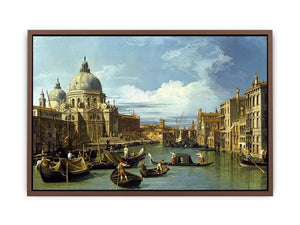
The Entrance to the Grand Canal, Venice, c.1730 Painting by Giovanni Antonio Canal (Canaletto)
The Entrance to the Grand Canal, Venice, c.1730 Painting by Giovanni Antonio Canal (Canaletto) is one of the most intellectually assured and visually authoritative cityscapes of the eighteenth century, a painting in which Venice is revealed as a rational, ceremonial, and enduring civic organism. Executed around 1730, at the moment when Canaletto had fully mastered the principles of perspective, light, and architectural orchestration, the work presents Venice not as romantic fantasy or picturesque decay, but as a city defined by order, balance, and continuity. It is a vision of urban identity shaped by centuries of governance, commerce, and cultural confidence.
The artist responsible for this refined vision, Giovanni Antonio Canal (Canaletto), transformed the veduta into a form of visual reasoning. His paintings are not casual views captured by chance, but carefully constructed compositions in which accuracy serves meaning. By the early 1730s, Canaletto had established a visual language capable of satisfying both documentary expectation and aesthetic ambition. The Entrance to the Grand Canal stands among his most eloquent statements, demonstrating how urban space can be rendered with both precision and dignity.
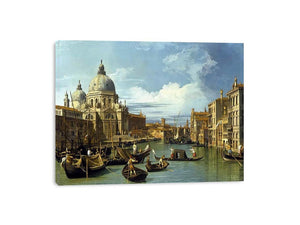
The subject depicts the ceremonial threshold where the Grand Canal opens toward the Venetian Lagoon, a location of immense symbolic and practical importance. This is the point at which Venice meets the wider world, where internal civic order encounters maritime openness. By choosing this vantage point, Canaletto frames the city as a republic in dialogue with the sea—defined not by isolation, but by structured exchange. The canal functions as both artery and axis, carrying movement, commerce, and identity through the heart of the city.
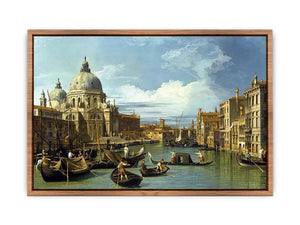
Compositionally, the painting is governed by clarity and equilibrium. The Grand Canal forms a decisive horizontal sweep through the center of the composition, establishing spatial order and visual stability. Architectural masses on either side—palaces, churches, and public buildings—are arranged with measured balance, creating a rhythmic alternation of solids and voids. Canaletto resists crowding the scene. Instead, he allows space to articulate structure, giving the composition both authority and ease.
Perspective is rigorously controlled, yet never ostentatious. Linear recession draws the viewer’s eye smoothly into depth, guiding it along the canal toward the distant lagoon. Each architectural plane is clearly articulated, ensuring legibility at every scale. Canaletto’s mastery lies in making complexity appear effortless. The city unfolds logically, reinforcing the impression of Venice as an intelligible and governable environment rather than a labyrinth of accident.
Light is crisp, even, and revealing. Canaletto employs Venetian daylight not for atmospheric drama, but for structural clarity. Sunlight illuminates façades and water surfaces evenly, allowing architectural detail to emerge without harsh contrast. Shadows are present but restrained, anchoring forms rather than disrupting them. Light here is a tool of understanding. It affirms permanence rather than transience, reinforcing the painting’s intellectual calm.
The color palette is restrained and harmonious. Pale stone whites, warm ochres, muted reds, and cool blues establish a balanced chromatic order. Reflections in the water are handled with subtle modulation, echoing the surrounding architecture without dissolving into painterly effect. Color serves architecture rather than competing with it. The result is an image that feels timeless, resistant to fashion or emotional excess.
Canaletto’s technique is disciplined and exacting. Brushwork is controlled, edges are precise, and surfaces are rendered with meticulous care. Architectural details—columns, windows, cornices—are observed with fidelity but never fetishized. Human figures and boats are present in measured proportion, animating the scene without diverting attention from the city itself. Movement exists, but it is orderly, reinforcing the sense of a functioning civic system.
Symbolically, The Entrance to the Grand Canal operates as a portrait of Venice’s public identity. The canal becomes a metaphor for governance and continuity, linking private palaces with public space, commerce with ceremony. There is no overt allegory, yet the message is unmistakable: Venice is a city sustained by balance, structure, and collective discipline. Power is expressed through coherence rather than monumentality.
Psychologically, the painting conveys assurance and composure. There is no anxiety, no romantic melancholy, no sense of impending decline. The city appears confident in its own form, secure in its rhythms. This emotional steadiness is central to Canaletto’s enduring appeal. He does not seek to astonish; he seeks to convince. The pleasure of the painting lies in its clarity.
Within Canaletto’s broader body of work, this painting ranks among his most representative Venetian views, created during a period when his reputation was expanding rapidly among European collectors, particularly in Britain. Yet its importance extends beyond historical popularity. The Entrance to the Grand Canal encapsulates Canaletto’s philosophy of urban depiction: that a city’s character is revealed through proportion, order, and light rather than dramatic incident.
Culturally, the painting reflects Enlightenment ideals applied to the cityscape. Venice is presented as a rational organism shaped by human intention across centuries. This vision resists both romantic nostalgia and theatrical spectacle. Instead, it offers a model of urban dignity grounded in coherence and restraint, a model that continues to resonate in discussions of civic space and architectural identity.
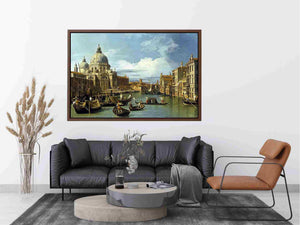
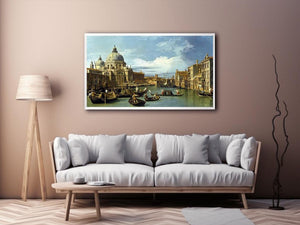
In contemporary interiors across the United States, the United Kingdom, Canada, Australia, and Europe, The Entrance to the Grand Canal integrates with exceptional authority and refinement. In living rooms, it introduces architectural calm and spatial depth. In studies and offices, it conveys perspective, discipline, and historical awareness. In galleries and luxury residences, it anchors space with intellectual elegance, harmonizing seamlessly with traditional, modern, minimalist, and eclectic décor through its balanced composition and luminous restraint.
The painting remains meaningful today because it demonstrates how cities can be seen not as chaotic accumulations, but as ordered expressions of collective life. In an era of rapid urban transformation, Canaletto’s Venice offers a vision of permanence achieved through clarity and proportion. The painting does not escape history. It structures it.
The Entrance to the Grand Canal, Venice, c.1730 Painting by Giovanni Antonio Canal (Canaletto) endures as one of the most composed and authoritative cityscapes in Western art. Through rigorous perspective, disciplined light, and architectural intelligence, Canaletto transformed a vital waterway into a timeless meditation on civic order and urban beauty. The painting does not overwhelm. It endures.
Buy museum qulaity 400- 450 canvas prints, framed prints, and 100% oil paintings of The Entrance to the Grand Canal, Venice by Giovanni Antonio Canal (Canaletto) at Alpha Art Gallery, where world-famous masterpieces are recreated with museum-quality detail, refined craftsmanship, and premium materials.
FAQs
What does The Entrance to the Grand Canal depict?
It depicts the ceremonial opening of Venice’s main canal toward the lagoon, framed by major civic architecture.
Why is this location significant in Venice?
It represents the city’s interface between internal civic life and maritime exchange.
How does Canaletto achieve such clarity and balance?
Through rigorous linear perspective, controlled light, and carefully measured composition.
Is the painting purely documentary?
It is topographically accurate but artistically composed to emphasize order and civic identity.
What role do boats and figures play in the scene?
They provide scale, movement, and a sense of daily life without dominating the architecture.
Why does the painting feel calm and stable?
Canaletto minimizes dramatic effects in favor of structural clarity and tonal harmony.
Why does this artwork remain relevant today?
Its vision of urban coherence and balance continues to resonate in modern culture.
Where does this artwork work best in interiors?
It is ideal for living rooms, studies, offices, galleries, and spaces emphasizing architectural elegance and historical depth.