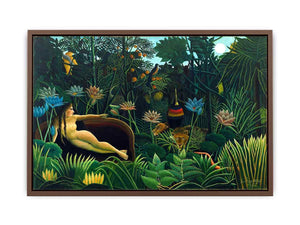
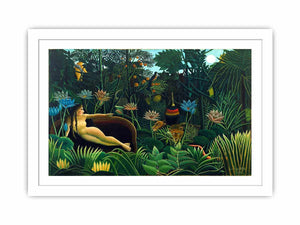
The Dream Painting by Henri Rousseau
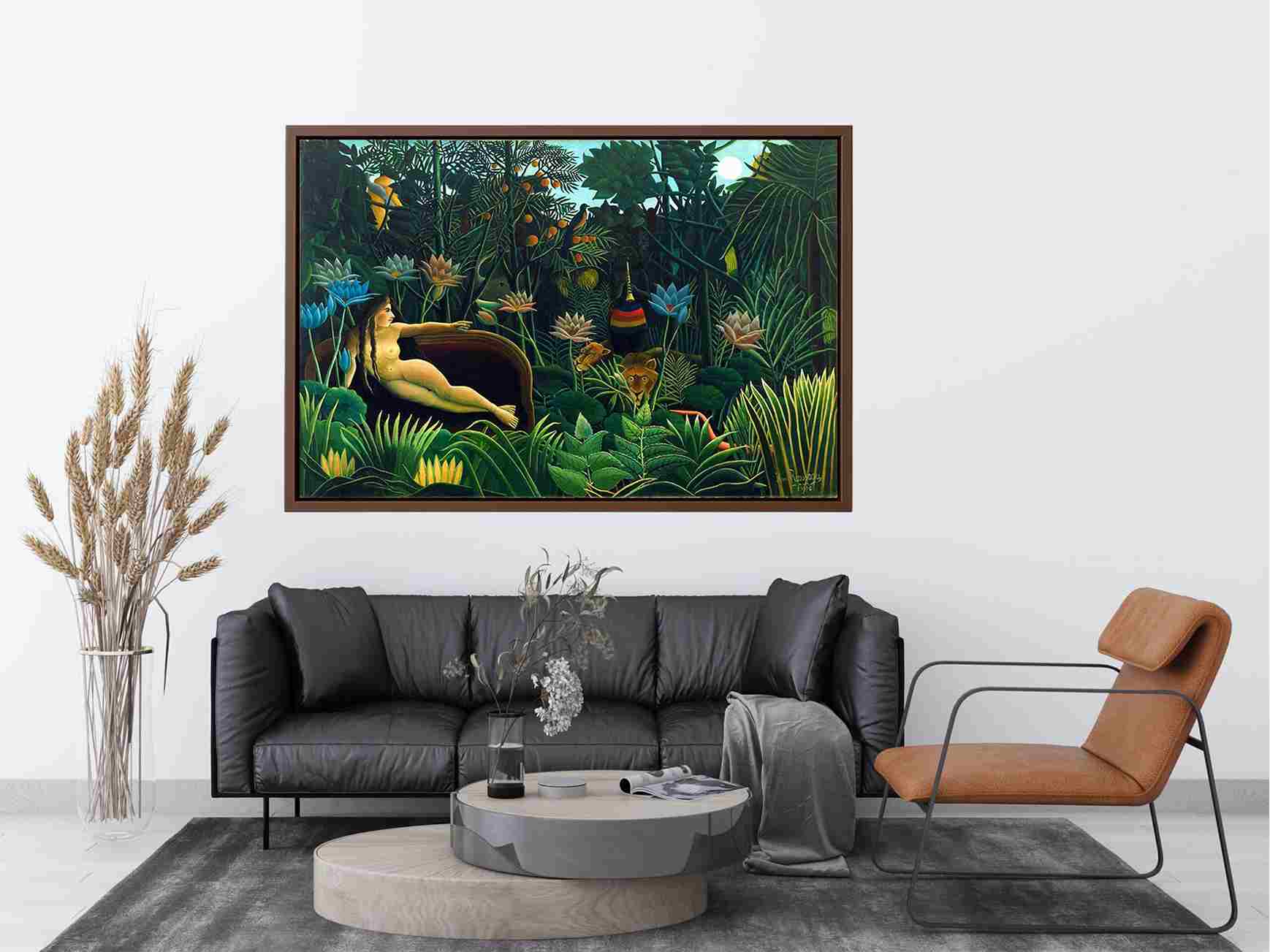
Painted in 1910, The Dream by Henri Rousseau stands as one of the most enigmatic and quietly revolutionary works of early modern art. Vast in scale and ambition, the painting presents a luxuriant jungle scene populated by exotic flora, animals, and a reclining nude who appears utterly at ease within an imagined wilderness. Yet beneath its apparent simplicity lies a profound meditation on imagination, memory, and the boundaries between reality and inner vision. The Dream is not a depiction of nature as observed; it is nature as conceived, filtered through the mind of an artist who rejected academic convention in favour of poetic truth.
The historical context of The Dream is inseparable from the cultural climate of Paris at the dawn of the twentieth century. This was a period of artistic upheaval, when established hierarchies were being dismantled and new modes of seeing were emerging. Rousseau, self-taught and often dismissed by academic critics, occupied a unique position within this landscape. He was neither aligned with Impressionism nor fully integrated into avant-garde circles, yet his work profoundly influenced them. The Dream, exhibited at the Salon des Indépendants shortly before his death, was widely recognised by younger artists as a masterpiece of imaginative freedom.
Within Rousseau’s artistic life, The Dream represents the culmination of decades of exploration into fantasy landscapes and symbolic worlds. Though he never travelled beyond France, Rousseau constructed his jungles from visits to botanical gardens, illustrated books, and his own vivid imagination. This deliberate distance from direct observation allowed him to create scenes untethered from geography. In The Dream, his characteristic flatness, precise outlines, and improbable juxtapositions achieve unprecedented scale and coherence, transforming what had once been considered naïveté into visionary authority.
The painting belongs to what later came to be called Naïve or Primitivist modernism, yet such labels only partially capture its significance. Rousseau’s art is not primitive in intent, but radical in its independence from academic illusionism. He rejects linear perspective and naturalistic modelling, favouring instead a clarity that treats every element—leaf, animal, figure—with equal emphasis. This democratic vision of the picture plane aligns The Dream with broader modernist concerns, anticipating Surrealism’s fascination with dream logic and inner reality.
Compositionally, The Dream is constructed as a dense, all-encompassing field. The jungle fills the canvas edge to edge, denying any conventional foreground or background. The reclining female figure, improbably placed upon a sofa amid the foliage, anchors the composition while simultaneously destabilising it. Her presence collapses interior and exterior space, suggesting that the jungle itself is a projection of the mind. The eye moves rhythmically through repeating patterns of leaves and branches, guided not by perspective but by visual cadence.
Perspective in the traditional sense is absent, replaced by a layered accumulation of forms. Animals appear without threat or hierarchy: lions, birds, and elephants coexist in a state of suspended attention. This spatial ambiguity reinforces the painting’s dreamlike quality. There is no sense of narrative progression or temporal urgency. Instead, the scene exists in a perpetual present, echoing the logic of dreams where elements coexist without explanation.
Colour plays a central role in shaping the painting’s emotional and symbolic atmosphere. Rousseau employs rich greens, deep blues, and warm earth tones with remarkable consistency. These colours are not modulated to suggest light or shadow; they assert themselves as surface realities. Light is evenly distributed, denying drama and reinforcing the painting’s calm intensity. The result is a world that feels at once lush and still, vibrant yet contemplative.
Texture and detail are rendered with meticulous care. Rousseau’s leaves are individually articulated, creating a dense ornamental surface that borders on abstraction. This attention to detail does not serve realism but immersion. The viewer is invited to enter the painting slowly, discovering patterns and repetitions that reward prolonged viewing. The surface becomes a visual analogue for consciousness itself—layered, repetitive, and inexhaustible.
Symbolically, The Dream resists singular interpretation. The reclining woman has been read as a figure of memory, fantasy, or desire, while the jungle suggests both abundance and the unknown. The title itself directs interpretation inward. This is not an external scene but a dreamscape, where personal and collective imagery merge. Rousseau does not explain the dream; he presents it whole, allowing meaning to arise through association rather than narrative clarity.
Emotionally, the painting conveys serenity rather than anxiety. Unlike later Surrealist visions, The Dream is not unsettling. Its power lies in its calm acceptance of improbability. The animals do not threaten, the figure does not fear, and the jungle does not overwhelm. This emotional equilibrium gives the work its timeless appeal, offering a vision of imagination as a place of harmony rather than conflict.
Culturally, The Dream occupies a pivotal position in the history of modern art. It demonstrated that technical orthodoxy was not a prerequisite for artistic depth, and that imagination could rival observation as a source of truth. Artists such as Picasso and the Surrealists recognised in Rousseau a precursor to their own explorations of inner reality. The painting’s influence extends beyond style, affirming the legitimacy of subjective vision within modern culture.
The relevance of The Dream today is unmistakable. In a world saturated with literal imagery, Rousseau’s unapologetic imagination offers an alternative mode of seeing—one that values inward experience and poetic construction. The painting speaks to contemporary audiences precisely because it refuses explanation, allowing viewers to project their own memories, desires, and reveries onto its surface.
Within contemporary interiors across the United States, United Kingdom, Canada, Australia, and Europe, The Dream integrates with striking versatility. In living rooms, it becomes a focal point of conversation and contemplation. In studies and offices, it fosters creativity and reflective thought. Galleries and luxury residences benefit from its iconic status and sustained visual engagement, as the painting continues to unfold over time.
Across decorative styles, the artwork adapts seamlessly. In minimalist spaces, its dense imagery provides contrast and depth. Traditional interiors gain narrative richness through its symbolic presence. Eclectic environments find cohesion in its balanced colour and rhythmic structure. The painting does not merely decorate a space; it transforms it into a site of imagination.
Ultimately, The Dream by Henri Rousseau stands as a testament to the power of artistic independence. Through disciplined invention, compositional clarity, and emotional calm, Rousseau created a work that transcends category and period. The painting endures because it affirms a simple yet radical truth: that the inner world, when rendered with conviction, can be as vast and convincing as reality itself.
Buy museum qulaity 400- 450 canvas prints, framed prints, and 100% oil paintings of The Dream by Henri Rousseau at Alpha Art Gallery, where world-famous masterpieces are recreated with museum-quality detail, refined craftsmanship, and premium materials.
FAQS
What is the meaning of The Dream by Henri Rousseau?
The painting represents an imagined dreamscape where memory, fantasy, and inner vision merge without narrative explanation.
Why is the woman shown reclining in a jungle?
Her presence collapses interior and exterior space, suggesting the jungle exists within the realm of the imagination.
Is The Dream based on real travel or observation?
No. Rousseau created the scene from imagination, botanical studies, and illustrated sources rather than direct experience.
What artistic movement does this painting belong to?
It is associated with Naïve modernism and is considered a precursor to Surrealism.
Why does the painting feel flat yet immersive?
Rousseau rejects traditional perspective, using repetition and pattern to create depth through accumulation.
Does The Dream suit contemporary interiors?
Yes. Its rich colour and symbolic openness integrate well into modern, traditional, and eclectic spaces.
Why is Henri Rousseau important in art history?
He demonstrated that imagination and independence could redefine modern painting outside academic tradition.
Where is the best place to display this artwork?
It is especially effective in living rooms, studies, offices, galleries, and refined interiors that value creativity and contemplation.