The Dog Painting by Francisco de Goya y Lucientes
The Dog stands as one of Francisco de Goya y Lucientes’s most enigmatic and profoundly modern works, a painting whose apparent simplicity conceals an extraordinary depth of emotional, philosophical, and artistic inquiry. Created between 1819 and 1823 as part of the series known as the Black Paintings, The Dog abandons narrative clarity, decorative purpose, and conventional symbolism in favour of an image that feels suspended between presence and erasure. Few works in the history of art achieve such expressive force with so little visual information. In this painting, Goya confronts the viewer not with spectacle, but with silence.
Goya painted The Dog late in life, after illness, political disillusionment, and the trauma of war had profoundly altered his worldview. Spain had endured invasion, repression, and the collapse of Enlightenment hopes that once animated Goya’s career. Retreating to his house, the Quinta del Sordo, Goya covered its walls with images that were never intended for public display. These works were private, inward, and uncompromising. The Dog emerges from this context as a distilled expression of existential uncertainty, stripped of social commentary and allegorical explanation.
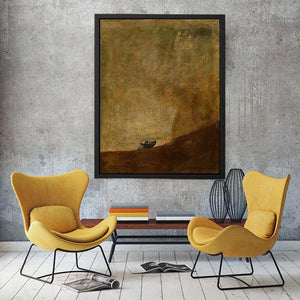
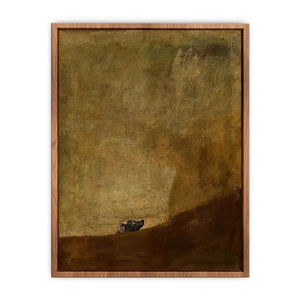
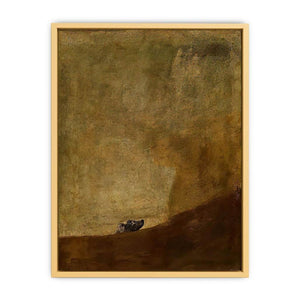
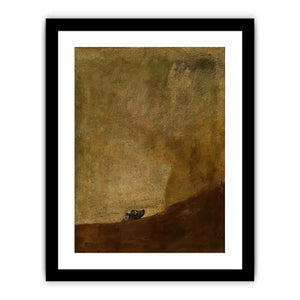
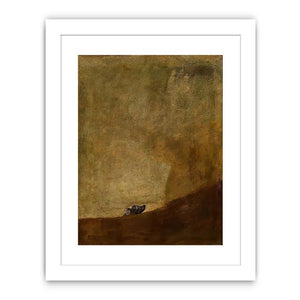
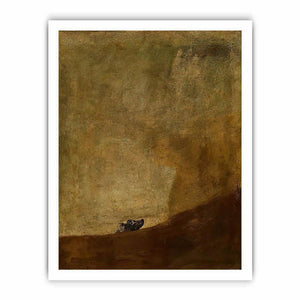
The composition is radically spare. A vast, empty expanse of earth-toned space dominates the canvas, rising diagonally upward and swallowing nearly the entire pictorial field. At the lower edge, barely visible, appears the head of a dog, its body submerged or obscured, its gaze lifted toward something unseen. The animal’s placement is precarious, as though it is sinking, trapped, or simply isolated by the overwhelming scale of its surroundings. Goya provides no ground, no horizon, no environmental context to explain the situation. The absence is deliberate and devastating.
Perspective in The Dog is destabilising. The viewer cannot situate themselves comfortably within the space. There is no foreground to stand upon, no middle ground to traverse, no background to orient the eye. The dog appears isolated within an undefined void, creating a sensation of weight, gravity, and helplessness. Goya eliminates spatial logic to evoke psychological truth. The painting does not describe a place; it creates a condition.
Light is subdued and ambiguous. There is no clear source, no illumination that offers clarity or rescue. Instead, the surface appears uniformly muted, as though light itself has been drained of purpose. This restraint reinforces the painting’s emotional severity. Light does not guide the eye or reveal form; it merely allows the image to exist. In doing so, Goya denies the viewer the reassurance traditionally offered by illumination, aligning visual experience with uncertainty.
Colour is reduced to a narrow, desolate range. Earthy ochres, browns, and muted greys dominate the composition, producing an atmosphere of aridity and emotional exhaustion. These tones are neither warm nor cool; they are suspended, inert. Against this overwhelming field, the dog’s dark head emerges with fragile contrast. The chromatic relationship intensifies the sense of vulnerability, as though the figure might be absorbed into the surrounding void at any moment.
Goya’s brushwork is restrained to the point of erasure. The surface appears raw, with broad, unmodulated passages that refuse decorative refinement. There is no attempt to model detail, texture, or depth in the traditional sense. This economy of means is essential to the painting’s power. By refusing to embellish, Goya forces attention onto the emotional core of the image. Technique becomes an instrument of negation, removing anything that might soften the confrontation.
The dog itself is rendered with extraordinary sensitivity despite its minimal depiction. Its upward gaze is the painting’s emotional anchor. The eyes, barely defined, convey a sense of longing, fear, or silent appeal without narrative specification. The animal does not bark, struggle, or move. It looks. That act of looking becomes the painting’s central drama. The viewer is left to wonder what the dog sees, or whether it sees anything at all. Goya offers no answer.
Symbolically, The Dog resists definitive interpretation. Some have read the animal as a symbol of abandonment, loyalty betrayed, or the human condition reduced to helplessness. Others view it as a meditation on mortality, insignificance, or the silence of the universe. Goya does not anchor the image to any single meaning. Instead, he creates a space in which meaning collapses into feeling. The painting does not explain suffering; it presents it as an unresolved fact.
Emotionally, The Dog is devastating in its restraint. There is no violence, no explicit despair, yet the painting evokes profound unease and empathy. The scale of emptiness overwhelms the fragile presence of the animal, creating a sense of isolation that resonates deeply with human experience. Viewers often project their own fears, losses, and questions into the void surrounding the figure. Goya’s genius lies in allowing this projection without guiding it.
Within Goya’s artistic evolution, The Dog represents a radical culmination. Earlier works exposed cruelty, superstition, and political corruption through satire and allegory. Here, Goya abandons social critique entirely. The painting reflects a mind no longer interested in reforming the world, but in confronting existence itself. In this sense, The Dog anticipates modern and even contemporary art, prefiguring abstraction, existentialism, and minimalism by more than a century.
Culturally, The Dog holds a unique position as one of the earliest works to reject narrative and representation as primary artistic goals. It challenges the assumption that art must depict recognisable stories or moral lessons. Instead, it asserts that emotional truth can emerge from absence, uncertainty, and silence. This conceptual leap makes The Dog one of the most forward-looking paintings in Western art history.
In contemporary interiors, The Dog integrates with extraordinary psychological and visual power. In living rooms and studies, it functions as a contemplative focal work that invites stillness and introspection. In offices and galleries, it communicates intellectual depth, emotional honesty, and cultural sophistication. In luxury residences across the United States, United Kingdom, Canada, Australia, and Europe, the painting resonates strongly with minimalist, modern, and avant-garde interiors. Its muted palette and stark composition allow it to command space without ornament, making it both subtle and unforgettable.
The enduring relevance of The Dog lies in its refusal to console. Goya does not offer redemption, explanation, or resolution. He presents a solitary being confronting an overwhelming void, and he leaves the meaning open. The painting endures because it speaks to a condition that transcends time and culture: the experience of vulnerability in a world that offers no answers. In The Dog, Francisco de Goya y Lucientes distils human awareness to its most essential form—presence without certainty—and in doing so, creates one of the most haunting images ever committed to paint.
Buy museum qulaity 400- 450 canvas prints, framed prints, and 100% oil paintings of The Dog by Francisco de Goya y Lucientes at Alpha Art Gallery, where world-famous masterpieces are recreated with museum-quality detail, refined craftsmanship, and premium materials.
FAQS
What does The Dog by Francisco de Goya y Lucientes depict?
It depicts the head of a dog emerging from an undefined, vast space, surrounded by emptiness and ambiguity.
Why is The Dog considered one of Goya’s most modern works?
Because it abandons narrative, symbolism, and detail in favour of psychological and emotional expression.
Is The Dog part of a larger series?
Yes, it is one of Goya’s Black Paintings, created late in his life for his private residence.
What does the dog symbolise?
The dog has no fixed meaning and may represent vulnerability, abandonment, or existential isolation.
Why is the background so empty?
The emptiness intensifies emotional impact and removes narrative context, forcing direct confrontation with feeling.
Does the painting have a political meaning?
Not explicitly; it reflects Goya’s inward turn toward existential and psychological themes.
Is The Dog suitable for contemporary interiors?
Yes, especially for modern and minimalist spaces that value emotional depth and visual restraint.
Why does The Dog remain relevant today?
Its exploration of isolation, uncertainty, and silent endurance continues to resonate in modern human experience.