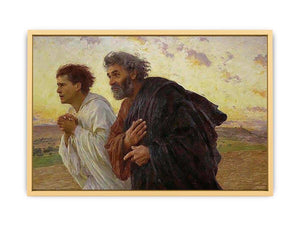
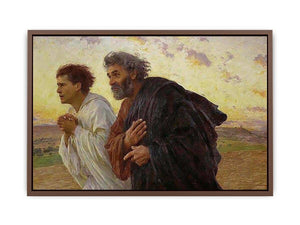
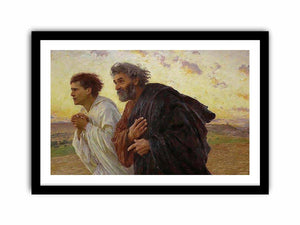
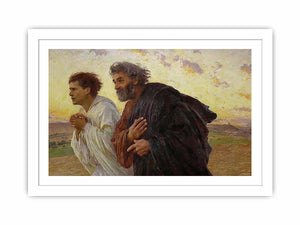
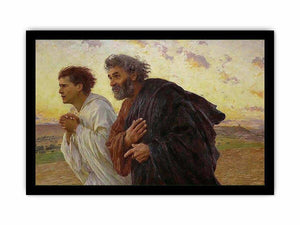
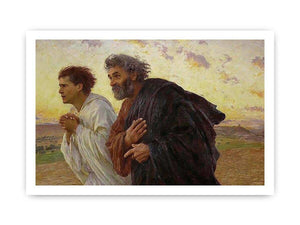
Peter and John Running to the Tomb Painting by Eugene Burnand
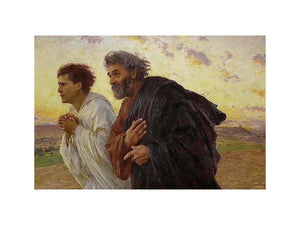
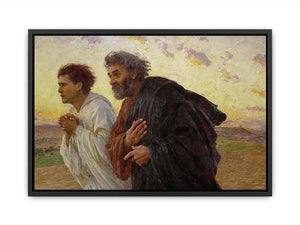
Peter and John Running to the Tomb Painting by Eugene Burnand is one of the most psychologically charged and intellectually disciplined religious paintings of the late nineteenth century, a work that transforms a brief Gospel moment into an enduring meditation on faith, doubt, age, and spiritual urgency. Painted in 1898, the canvas captures not the Resurrection itself, nor the empty tomb, but the charged interval between knowledge and proof—the moment when belief is tested by speed, breath, and human limitation. Burnand’s decision to focus on this transitional instant elevates the painting beyond narrative illustration, placing it firmly within the realm of moral and psychological inquiry.
Eugene Burnand was renowned for his synthesis of rigorous realism and spiritual seriousness. Trained in Paris and deeply influenced by naturalism, Burnand rejected theatrical religious symbolism in favor of lived human truth. His sacred paintings are grounded in anatomy, landscape, and psychology, yet animated by profound theological intelligence. Peter and John Running to the Tomb is widely regarded as his masterpiece, precisely because it unites physical realism with metaphysical tension.
The subject derives from the Gospel of John, which recounts how Peter and John ran together to the tomb after hearing of Christ’s disappearance, with John arriving first but Peter entering first. Burnand isolates the run itself, stripping the story of its miraculous resolution and concentrating instead on the human response to astonishing news. This choice emphasizes faith as an embodied experience—something felt in the lungs, the muscles, the eyes—rather than a purely intellectual or doctrinal act.
Compositionally, the painting is defined by forward momentum. The two figures move directly toward the viewer, their bodies cutting through space with urgency and imbalance. Burnand positions them close to the picture plane, eliminating narrative distance and forcing confrontation. The viewer does not observe from safety; the viewer is in the path of their motion. This compositional strategy intensifies emotional engagement, making the moment immediate and unavoidable.
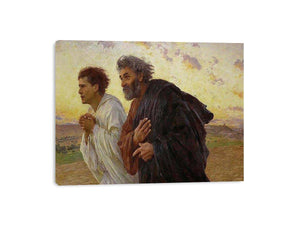
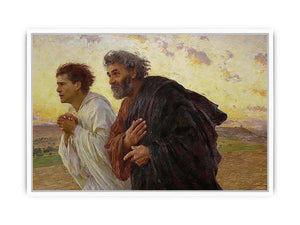
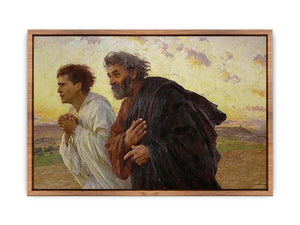
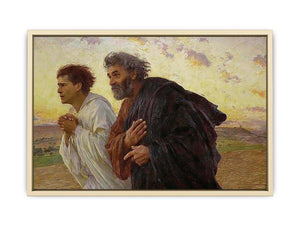
The contrast between the two apostles is central to the painting’s meaning. John, younger and physically agile, runs with alert intensity, his gaze sharp and outward. Peter, older and heavier, labors forward with effort visible in his posture and expression. Burnand renders this contrast without caricature or judgment. Youth and age are not presented as virtue and weakness, but as differing modes of response to the same spiritual shock. Faith, the painting suggests, does not move through all bodies equally.
Facial expression is handled with exceptional psychological precision. John’s face conveys anticipation, concentration, and restrained fear. Peter’s expression is heavier, burdened by memory and doubt, marked by exhaustion and internal struggle. Burnand allows these expressions to carry theological weight. The Resurrection is not yet confirmed; what we see is uncertainty in motion. Faith here is not serenity, but urgency mixed with fear.
The handling of anatomy reinforces this psychological reading. Burnand’s realism is uncompromising. Muscles strain, garments pull, breath seems audible. The apostles’ physical exertion is rendered with anatomical accuracy, grounding the spiritual narrative in bodily truth. This insistence on physicality asserts that belief is lived through flesh, not apart from it.
The landscape is deliberately restrained. Earth and sky recede into a neutral backdrop, offering no symbolic intervention. Nature neither confirms nor denies the miracle. It remains indifferent, emphasizing that the crisis unfolding is internal rather than cosmic—at least for now. This restraint ensures that attention remains focused on the human figures and their emotional state.
Light in the painting is natural and directional, illuminating faces and bodies without theatrical emphasis. There is no divine radiance, no supernatural glow. Burnand refuses to signal the miracle visually. Instead, light functions as descriptive truth, reinforcing realism and postponing revelation. The Resurrection exists here only as rumor and hope.
Colour is subdued and purposeful. Earth tones dominate, reinforcing gravity and realism. The apostles’ garments are rendered in muted hues that suggest humility and lived wear rather than symbolic costume. Colour serves structure and mood, not ornament. The palette supports the painting’s seriousness, preventing any drift toward sentimentality.
Symbolically, the act of running becomes central. Running suggests urgency, uncertainty, and incomplete understanding. Unlike kneeling or praying, it is unstable and ungraceful. Burnand elevates this awkward movement into a theological statement: faith often advances before comprehension, propelled by hope rather than certainty. The apostles do not yet know what they will find. They run anyway.
Within Burnand’s artistic career, Peter and John Running to the Tomb represents the fullest realization of his philosophy. It demonstrates his conviction that religious painting must speak through truth rather than idealization. By refusing to depict the miracle directly, Burnand preserves its mystery while exploring its human consequences. The painting becomes a meditation on response rather than result.
Culturally, the work holds a significant place in modern religious art. Created in an era marked by scientific skepticism and theological uncertainty, it presents belief as struggle rather than assumption. Burnand acknowledges doubt without negating faith, offering an image that speaks powerfully to modern sensibilities. The painting affirms that spiritual conviction often emerges through effort, fear, and incomplete knowledge.
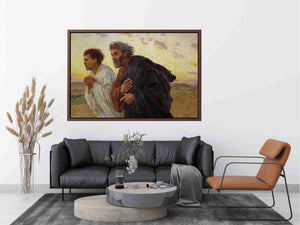
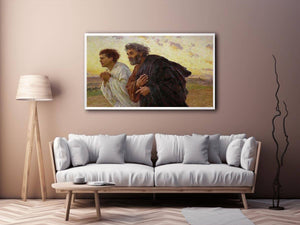
In contemporary interiors across the United States, the United Kingdom, Canada, Australia, and Europe, Peter and John Running to the Tomb carries extraordinary intellectual and emotional presence. In living rooms, it introduces narrative tension and moral depth. In studies, libraries, and private offices, it supports reflection on belief, responsibility, and urgency. In galleries and curated residences, it signals serious engagement with religious art grounded in realism rather than sentiment.
The painting integrates naturally into traditional interiors, where its biblical subject and classical realism align with established aesthetics. At the same time, it functions powerfully in modern and minimalist spaces, where its raw humanity and forward motion provide contrast and intensity. In eclectic settings, it serves as a focal point of philosophical inquiry, anchoring the space through emotional gravity.
The long-term artistic importance of Peter and John Running to the Tomb lies in its redefinition of religious drama. Burnand demonstrates that the most profound spiritual moments may occur not at revelation itself, but in the human rush toward it. By honoring uncertainty, effort, and embodied response, he creates a work that remains deeply relevant across time and belief systems.
Today, the painting continues to resonate because it speaks to the universal experience of moving toward truth without guarantee. Through uncompromising realism, psychological depth, and theological intelligence, Eugene Burnand created an image that does not instruct belief, but understands it. Peter and John Running to the Tomb endures as one of the most honest and powerful representations of faith in motion ever committed to canvas.
Buy museum qulaity 400- 450 canvas prints, framed prints, and 100% oil paintings of Peter and John Running to the Tomb by Eugene Burnand at Alpha Art Gallery, where world-famous masterpieces are recreated with museum-quality detail, refined craftsmanship, and premium materials.
FAQS
What biblical moment does Peter and John Running to the Tomb depict?
It depicts the moment when Peter and John run toward Christ’s tomb after hearing it is empty, before discovering the Resurrection.
Why did Eugene Burnand choose to show the apostles running rather than the empty tomb?
Burnand focused on human response and uncertainty, emphasizing faith as movement toward truth rather than confirmation of it.
What is the significance of the contrast between Peter and John?
Their differing ages and expressions reflect varied human responses to the same spiritual shock—urgency, doubt, hope, and effort.
Is this painting considered realist or symbolic?
It is realist in technique and symbolic in meaning, using physical truth to convey spiritual tension.
Where does this artwork work best in interior spaces?
It is well suited to living rooms, studies, libraries, galleries, offices, and contemplative residential interiors.
Is Peter and John Running to the Tomb suitable for modern décor?
Yes, its realism, movement, and psychological depth integrate effectively into modern, traditional, and minimalist spaces.
Does the painting have lasting artistic and spiritual value?
Its fusion of human realism and theological insight ensures enduring relevance across cultures and generations.