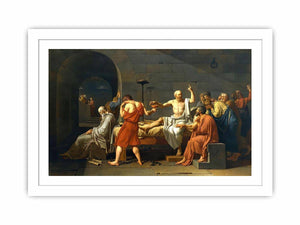
The Death of Socrates Painting by Jacques-Louis David
The Death of Socrates stands as one of the most intellectually rigorous and morally charged paintings of the late eighteenth century, a work in which philosophy, politics, and artistic discipline converge with exceptional clarity. Painted in 1787 by Jacques-Louis David, the composition embodies the ideals of Neoclassicism while advancing a profound meditation on reason, civic virtue, and the dignity of moral choice. Far from illustrating a tragic end alone, the painting transforms the death of Socrates into an affirmation of ethical conviction, presenting philosophy not as abstraction but as lived principle.
Jacques-Louis David created The Death of Socrates during a period of growing political and intellectual ferment in France. Enlightenment ideals concerning reason, individual conscience, and resistance to tyranny were challenging established authority, and classical antiquity offered a moral framework through which these ideas could be explored. David, deeply committed to the moral seriousness of art, turned to the trial and execution of Socrates as a timeless exemplar of integrity under oppression. The ancient philosopher, condemned by the Athenian state for corrupting youth and impiety, becomes in David’s hands a symbol of unwavering devotion to truth over expedience.
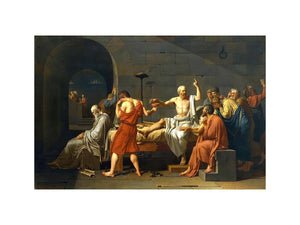
The painting depicts the moment immediately before Socrates drinks the cup of hemlock. He sits upright on his bed, calm and composed, one hand extended toward the poison while the other gestures upward, as if continuing a philosophical argument. This gesture is central to the painting’s meaning. Socrates does not recoil from death, nor does he surrender to emotion. Instead, he remains engaged in discourse, suggesting that reason transcends physical existence. David presents him not as a victim, but as a moral agent who chooses death rather than abandon his principles.
Surrounding Socrates are his disciples, each responding differently to the impending loss. Their reactions form a visual spectrum of human emotion: grief, disbelief, restraint, and quiet despair. Some avert their gaze, unable to confront the moment, while others lean toward Socrates in anguish. This contrast between the philosopher’s serenity and his followers’ emotional turmoil reinforces the painting’s central tension between reason and feeling. David does not diminish emotion, but he subordinates it to moral clarity, aligning with Enlightenment values that privileged rational thought as the foundation of ethical life.
Compositionally, the painting is constructed with architectural precision. Socrates occupies the visual and moral centre, his body illuminated and clearly defined. The figures around him are arranged in a frieze-like manner, recalling classical relief sculpture and reinforcing the Neoclassical emphasis on order and clarity. The spatial depth is carefully controlled, guiding the viewer’s eye inward toward the central act without distraction. Every element is placed with deliberation, reflecting David’s belief that composition itself carries ethical weight.
Light plays a crucial role in articulating meaning. It falls most strongly on Socrates, isolating him as a figure of intellectual illumination amid surrounding shadow. This use of light is not theatrical but symbolic, suggesting clarity of mind rather than divine intervention. The environment is austere, stripped of unnecessary detail, allowing the philosophical drama to unfold without visual excess. David’s restraint ensures that attention remains focused on gesture, expression, and moral consequence.
Colour is employed with discipline and purpose. Muted earth tones dominate the palette, lending the scene gravity and timelessness. Accents of white and red draw attention to key figures and gestures without overwhelming the composition. This controlled use of colour aligns with Neoclassical ideals, rejecting ornamental excess in favour of intellectual coherence. The painting’s visual language mirrors its philosophical message: clarity over indulgence, structure over chaos.
Symbolically, The Death of Socrates operates as a manifesto for moral courage. The cup of hemlock, extended calmly, represents obedience to law even when the law is unjust. Socrates’ upward gesture recalls his teachings on the immortality of the soul, suggesting that death is not an end but a transition. The chains removed from his ankles lie discarded at his feet, a subtle reminder that true freedom resides in the mind rather than the body. David weaves these symbols seamlessly into the narrative, avoiding allegorical heaviness while sustaining intellectual depth.
Emotionally, the painting exerts a restrained yet powerful impact. It does not seek to overwhelm through pathos. Instead, it invites contemplation. Viewers are asked not simply to mourn Socrates, but to consider the cost of integrity and the responsibilities of citizenship. The work challenges the audience to reflect on their own relationship to authority, conscience, and truth. This ethical engagement distinguishes the painting from mere historical illustration.
Within David’s career, The Death of Socrates marks a crucial stage in his development as a moral artist. It anticipates the revolutionary fervour that would later define his work while remaining grounded in classical restraint. The painting demonstrates how ancient history could be mobilised to address contemporary concerns, establishing a model for politically engaged art that would resonate throughout the nineteenth century.
In contemporary interiors, The Death of Socrates retains remarkable relevance and presence. Its balanced composition and intellectual gravity make it particularly suited to studies, offices, libraries, and gallery spaces, where it communicates seriousness, reflection, and cultural depth. In living rooms and refined residences across the United States, United Kingdom, Canada, Australia, and Europe, it integrates seamlessly with both classical and modern décor, offering historical weight without visual excess. The painting’s disciplined palette and architectural clarity allow it to command attention without overwhelming a space.
The enduring significance of The Death of Socrates lies in its affirmation of moral agency. It presents a vision of humanity defined not by fear or compliance, but by the capacity to choose principle over survival. In every era where questions of conscience, authority, and truth arise, the painting speaks with undiminished force. David’s work reminds viewers that the highest form of courage may lie not in action, but in steadfast thought.
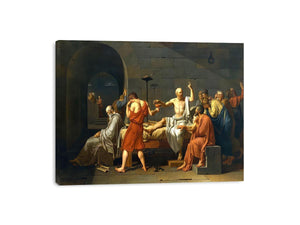
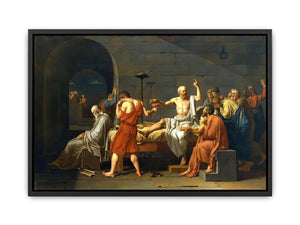
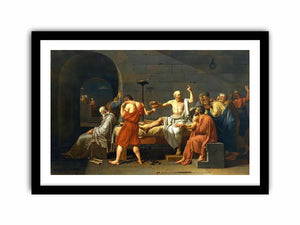
Buy museum qulaity 400- 450 canvas prints, framed prints, and 100% oil paintings of The Death of Socrates by Jacques Louis David at Alpha Art Gallery, where world-famous masterpieces are recreated with museum-quality detail, refined craftsmanship, and premium materials.
FAQ
What moment does The Death of Socrates depict?
It shows the moment just before Socrates drinks the cup of hemlock, choosing death rather than renouncing his philosophical principles.
Why is Socrates shown calm while his students are distressed?
David contrasts reason and emotion, presenting Socrates as a model of rational integrity while his followers express natural human grief.
What philosophical ideas does the painting emphasise?
The painting highlights moral courage, obedience to conscience, and the belief that truth and reason transcend physical life.
How does this work reflect Neoclassical ideals?
Its clarity of form, restrained colour, classical composition, and moral seriousness exemplify Neoclassical principles.
Why was this subject important in David’s time?
It resonated with Enlightenment values and growing political tensions, offering a historical example of resistance to unjust authority.
Is The Death of Socrates relevant today?
Yes, its exploration of conscience, civic responsibility, and ethical choice continues to speak to modern audiences.
Where does this painting work best in an interior setting?
It is especially suited to studies, offices, libraries, and gallery-style spaces where contemplation and intellectual depth are valued.
Why is The Death of Socrates considered a masterpiece?
Because it unites philosophical depth, compositional discipline, and emotional restraint into a timeless statement on moral integrity.