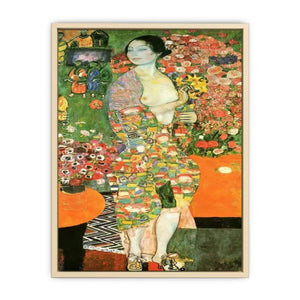
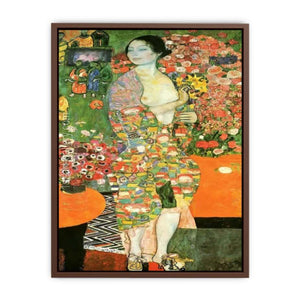
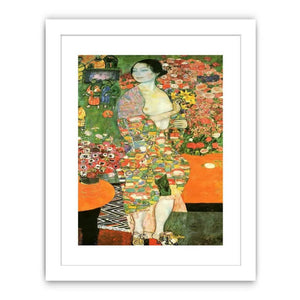
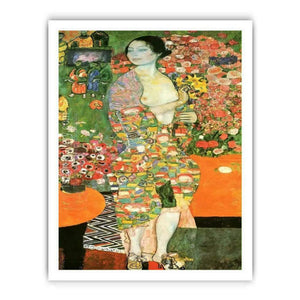
The Dancer Painting by Gustav Klimt
The Dancer occupies a luminous and psychologically charged position within Gustav Klimt’s mature body of work, revealing an artist at the height of his powers who had fully mastered the fusion of movement, ornament, and emotional suggestion. Created during the early years of the twentieth century, when Klimt was deeply engaged with the aesthetic and philosophical ambitions of the Vienna Secession, the painting reflects a moment in which the human figure becomes both subject and sensation. Rather than depicting dance as performance or spectacle, Klimt transforms it into a state of being—an expression of rhythm, freedom, and inner vitality translated into visual form.
By the time The Dancer emerged, Klimt had already dismantled the conventions of academic portraiture and narrative painting. His work no longer sought to describe reality as it appeared, but to capture how it was felt. Dance, with its ephemeral gestures and emotional immediacy, offered an ideal subject for this pursuit. In The Dancer, Klimt does not anchor the figure within a recognisable stage or social context. Instead, the body seems to exist in a suspended realm, liberated from gravity, chronology, and external constraint. This suspension is central to the painting’s power, allowing movement itself to become the primary content.
The female figure at the centre of the composition embodies fluidity and release. Her posture suggests motion captured at its most expressive moment, where control gives way to instinct and rhythm overrides structure. Yet there is no sense of chaos. Klimt balances dynamism with compositional harmony, ensuring that movement unfolds within a carefully orchestrated visual field. The dancer’s form is neither anatomically rigid nor naturalistically rendered. Instead, it is stylised, elongated, and absorbed into the surrounding pattern, blurring the distinction between body and ornament.
This dissolution of boundaries reflects Klimt’s broader artistic philosophy. For him, the human figure was not an isolated entity but part of a larger aesthetic and emotional system. In The Dancer, the body becomes one element within a decorative universe of colour, texture, and rhythm. Fabric, skin, and background interact seamlessly, creating a unified surface that prioritises sensation over description. The dancer does not dominate the composition; she participates in it.
Colour plays a decisive role in conveying the painting’s emotional energy. Klimt employs a rich palette that often includes luminous golds, deep reds, vibrant blues, and warm flesh tones, orchestrated to create both contrast and continuity. These colours do not merely adorn the surface but establish a rhythmic pulse that mirrors the act of dance itself. Gold, a defining element of Klimt’s work during this period, functions symbolically as well as visually. It dissolves spatial boundaries, elevates the figure beyond the material world, and infuses the scene with a sense of timeless radiance.
The flattened pictorial space is characteristic of Klimt’s mature style. Traditional depth and perspective are deliberately suppressed, allowing the viewer’s attention to remain on surface relationships and ornamental flow. This approach draws from a wide range of influences, including Byzantine mosaics and Japanese prints, both of which prioritise pattern and rhythm over illusionistic space. In The Dancer, this flattening intensifies the immediacy of the image. The viewer does not look into the scene but encounters it directly, as a visual experience unfolding across the canvas.
Symbolically, The Dancer can be understood as a meditation on liberation and transformation. Dance, in this context, is not entertainment but a metaphor for inner freedom—the moment when the self transcends social roles and rational control. The absence of a defined setting reinforces this interpretation, suggesting that the dance occurs in an interior, psychological space rather than a physical one. The figure becomes an embodiment of instinct, creativity, and emotional truth.
The painting also reflects Klimt’s evolving portrayal of femininity. Unlike traditional representations that frame women as objects of observation or narrative devices, The Dancer presents the female figure as autonomous and self-directed. Her movement is not performed for an audience; it exists for its own sake. This autonomy aligns with Klimt’s broader challenge to conventional power structures within art, positioning feminine energy as a source of creativity rather than passive beauty.
Emotionally, the work oscillates between intensity and grace. The implied motion suggests passion and release, while the harmonious composition conveys control and balance. This duality gives the painting its psychological depth, allowing it to resonate with viewers on multiple levels. Some may experience it as an expression of joy and vitality, others as a more introspective exploration of freedom and self-expression. Klimt does not prescribe a single response; instead, he creates a visual environment open to interpretation.
Within the context of Klimt’s career, The Dancer exemplifies his ability to synthesise diverse influences into a coherent and unmistakable personal language. It bridges his decorative impulses with his interest in emotional states, demonstrating how ornament can serve as a vehicle for meaning rather than mere embellishment. The painting also contributes to a broader modernist rethinking of the body in art, where movement and sensation replace static representation.
In contemporary cultural terms, The Dancer remains strikingly relevant. Its emphasis on freedom, bodily expression, and inner rhythm speaks to modern audiences navigating identities shaped by constant motion and change. The painting does not depict a specific era or costume, allowing it to transcend historical boundaries and engage viewers across time.
In interior spaces, The Dancer offers exceptional versatility and presence. In living rooms, it functions as a dynamic focal point, introducing energy and sophistication without overwhelming the environment. In studies and private offices, it encourages creativity and reflection, serving as a visual reminder of balance between discipline and freedom. Within galleries and luxury residences across the United States, United Kingdom, Canada, Australia, and Europe, the painting integrates seamlessly with modern, minimalist, and eclectic décor. Its flattened space and ornamental richness complement contemporary design sensibilities, while its emotional depth lends cultural gravitas.
The enduring appeal of The Dancer lies in its capacity to transform motion into meaning. Klimt captures not the external appearance of dance, but its essence—the moment when body, emotion, and rhythm align. As a work of art, it stands as a testament to his belief that beauty is not static, but alive, evolving, and deeply human.
Buy museum qulaity 400- 450 canvas prints, framed prints, and 100% oil paintings of The Dancer by Gustav Klimt at Alpha Art Gallery, where world-famous masterpieces are recreated with museum-quality detail, refined craftsmanship, and premium materials.
FAQ
What does The Dancer by Gustav Klimt represent?
The painting symbolises movement, inner freedom, and emotional expression, using dance as a metaphor for liberation and creativity.
Why is The Dancer important in Klimt’s artistic development?
It exemplifies his mature synthesis of ornament, symbolism, and psychological depth, reflecting his departure from traditional representation.
Is the dancer portrayed as a specific individual?
No, the figure is not a portrait but an archetype, allowing the work to transcend personal identity and focus on universal sensation.
How does Klimt convey movement in a static medium?
Through rhythmic composition, flowing lines, and colour harmonies that guide the eye and suggest continuous motion.
What role does gold play in The Dancer?
Gold dissolves spatial boundaries and elevates the figure into a timeless, symbolic realm, enhancing the painting’s emotional resonance.
Is The Dancer suitable for modern interiors?
Yes, its flattened space and decorative rhythm integrate beautifully with contemporary, minimalist, and eclectic décor.
What emotional response does the painting tend to evoke?
Viewers often experience a sense of vitality, freedom, and introspection, reflecting the painting’s layered psychological tone.
Does The Dancer have lasting cultural value?
Its exploration of movement, autonomy, and expression ensures its continued relevance within both art history and contemporary visual culture.