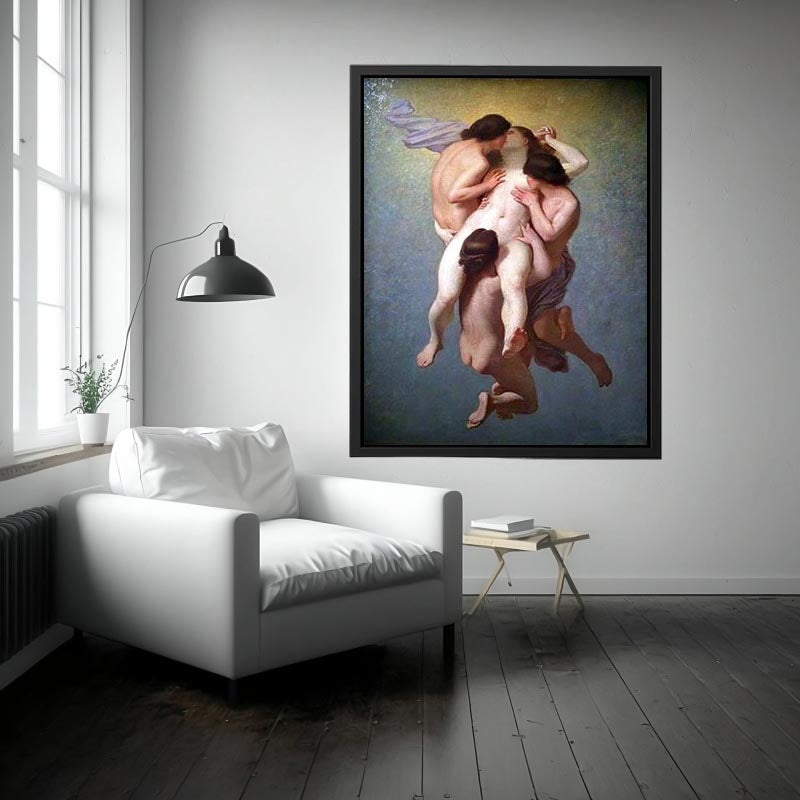
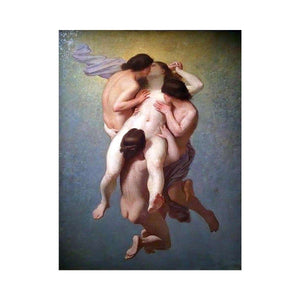
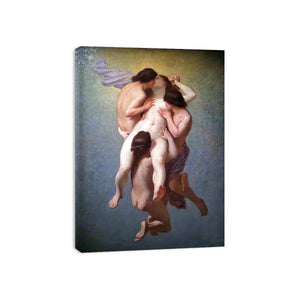
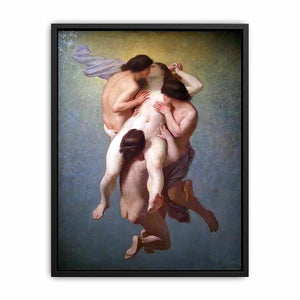
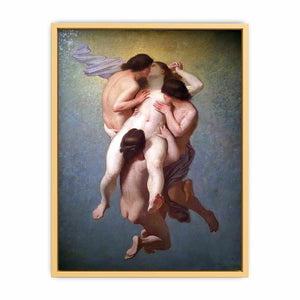
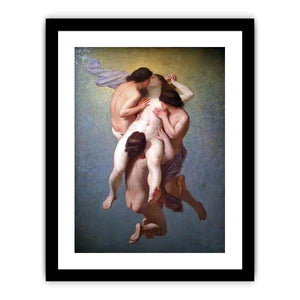
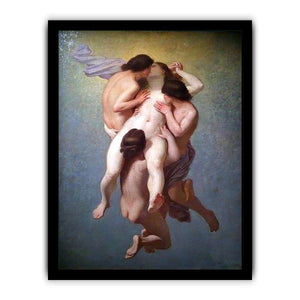
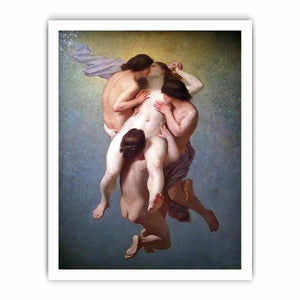
The Cursed Woman Painting by Octave Tassaert
Painted in the mid-nineteenth century, The Cursed Woman by Octave Tassaert is a work of profound psychological intensity, moral complexity, and emotional gravity. It stands among the most uncompromising visual examinations of despair, social judgment, and spiritual isolation produced during the Romantic era. Rather than offering consolation or redemption, Tassaert confronts the viewer with the raw interior reality of a woman marked by suffering—one whose anguish is not merely personal, but shaped and intensified by the moral structures surrounding her. The painting is neither anecdotal nor sentimental; it is an indictment, a lament, and a psychological study rendered with devastating clarity.
The historical context of The Cursed Woman is inseparable from nineteenth-century Europe’s evolving relationship with morality, religion, and social control. Tassaert worked at a time when industrialisation, urban poverty, and rigid moral codes coexisted uneasily with Romantic ideals of emotional truth and individual suffering. Women, in particular, were subject to harsh judgment, with social transgression often equated to moral damnation. Tassaert’s painting emerges from this environment as a radical act of empathy. Rather than condemning his subject, he exposes the mechanisms of condemnation themselves.
Within Tassaert’s artistic life, this work represents the culmination of his deeply introspective and often melancholic vision. Known for his sensitivity to human suffering and moral ambiguity, Tassaert repeatedly turned toward themes of despair, alienation, and spiritual crisis. The Cursed Woman reflects not only his artistic concerns but his personal struggles, as the artist himself grappled with poverty, illness, and psychological distress. This convergence of lived experience and artistic intent lends the painting an authenticity that resists detachment. It is a work felt as much as it is observed.
The painting belongs to the Romantic tradition, yet it diverges sharply from Romantic idealisation. There is no heroic suffering here, no poetic beautification of pain. Instead, Tassaert embraces psychological realism. The woman is not mythologised; she is profoundly human. Her suffering is specific, embodied, and unrelenting. This refusal to aestheticise despair places the painting at the edge of Romanticism, anticipating later realist and symbolist explorations of inner torment.
Compositionally, The Cursed Woman is constructed to heighten psychological confinement. The figure dominates the space, yet she appears trapped within it. Her posture is tense and inward, suggesting both physical exhaustion and emotional collapse. The surrounding environment offers no refuge; space closes in rather than opening outward. Tassaert uses spatial compression deliberately, denying the viewer any sense of escape. The painting becomes an emotional enclosure, mirroring the subject’s internal state.
Perspective reinforces this intimacy and discomfort. The viewer is positioned close, drawn into the woman’s private suffering without the buffer of narrative distance. This proximity is not voyeuristic but confrontational. It demands recognition rather than observation. The painting does not allow the viewer to remain neutral; to look is to participate in the act of witnessing pain that society has chosen to ignore or condemn.
Colour and light are employed with extraordinary restraint and intelligence. Tassaert favours muted, sombre tones that drain the scene of warmth. Flesh is rendered with a pallor that suggests both physical depletion and emotional erosion. Light does not redeem; it exposes. It falls selectively, illuminating the woman’s form while leaving surrounding elements subdued, as though the world itself has withdrawn. This controlled use of illumination transforms light into a moral instrument, revealing suffering without alleviating it.
Texture is handled with subtle discipline. Brushwork remains refined and controlled, resisting expressive excess. This restraint amplifies the painting’s emotional power, as anguish is conveyed through posture, expression, and atmosphere rather than painterly dramatics. The surface remains calm even as the subject is not, creating a haunting dissonance between form and feeling. The painting’s technical control underscores its ethical seriousness.
Symbolically, The Cursed Woman operates on multiple levels. On one level, it addresses individual despair—psychological anguish born of guilt, shame, or abandonment. On another, it functions as a critique of moral absolutism. The title itself implicates society: who has cursed her, and by what authority? Tassaert offers no clear transgression, no explicit crime. The absence of narrative clarity shifts responsibility from the individual to the structures that label, exclude, and condemn. The woman becomes a symbol not of sin, but of judgment.
Emotionally, the painting is unflinching. There is no catharsis, no moment of release. The woman’s expression conveys exhaustion rather than hysteria, resignation rather than repentance. This emotional restraint intensifies the work’s impact, as it reflects a suffering that has become chronic, internalised, and inescapable. Viewers are not invited to pity her from a position of superiority; they are asked to confront the discomfort of her reality.
Culturally, The Cursed Woman occupies an important place within nineteenth-century art as an early and courageous exploration of psychological suffering, particularly female suffering, without moral judgment. It challenges the conventions of academic painting by prioritising inner truth over external narrative. In doing so, it anticipates modern approaches to mental health, trauma, and social alienation, making it remarkably forward-looking.
The relevance of this work today is profound. In contemporary societies still grappling with stigma, shame, and moral policing—particularly toward women—The Cursed Woman remains unsettlingly current. It speaks to experiences of isolation, judgment, and psychological burden that transcend time and culture. The painting’s refusal to explain or resolve suffering ensures that it continues to provoke reflection rather than offering comfort.
Within contemporary interiors across the United States, United Kingdom, Canada, Australia, and Europe, the painting carries immense emotional and intellectual weight. In living rooms, it establishes a space of depth and seriousness, inviting conversation and contemplation. In studies and offices, it reinforces an atmosphere of empathy, reflection, and moral awareness. Galleries and luxury residences benefit from its capacity to sustain long engagement, as the work reveals itself slowly through emotional resonance rather than spectacle.
Across interior styles, The Cursed Woman integrates with distinction. In minimalist settings, its restrained palette and psychological intensity provide powerful contrast without visual excess. Traditional interiors gain gravity through its Romantic lineage and ethical seriousness. Eclectic spaces are anchored by its emotional authenticity, which cuts through stylistic variation. The painting does not decorate; it bears witness.
Ultimately, The Cursed Woman by Octave Tassaert endures as one of the most honest and haunting portrayals of human despair in nineteenth-century art. Through compositional discipline, psychological insight, and moral courage, Tassaert created a work that confronts suffering without judgment and empathy without sentimentality. Its power lies in its silence—in what it refuses to explain, and in what it asks the viewer to acknowledge. This is a painting that does not console, but it endures, because truth often does.
Buy museum qulaity 400- 450 canvas prints, framed prints, and 100% oil paintings of The Cursed Woman by Octave Tassaert at Alpha Art Gallery, where world-famous masterpieces are recreated with museum-quality detail, refined craftsmanship, and premium materials.
FAQS
What is the central meaning of The Cursed Woman by Octave Tassaert?
The painting explores psychological despair and social judgment, focusing on the emotional consequences of moral condemnation rather than specific wrongdoing.
Is the woman depicted as guilty or sinful?
No. Tassaert deliberately avoids defining her transgression, shifting attention toward the cruelty of judgment itself.
Why is this painting considered psychologically powerful?
Its restrained composition, intimate perspective, and emotional realism create an intense portrayal of internal suffering.
What artistic movement does this work belong to?
It is rooted in Romanticism, with strong anticipations of later realist and symbolist approaches to psychological subject matter.
Does the painting have modern relevance?
Yes. Its themes of stigma, isolation, and emotional burden remain deeply relevant today.
Is The Cursed Woman suitable for contemporary interiors?
It is best suited to spaces that value emotional depth and intellectual engagement, including living rooms, studies, and galleries.
Why is Octave Tassaert significant in art history?
He was a pioneering figure in portraying psychological suffering with empathy and moral complexity.
Where does this artwork work best in a home or collection?
It is particularly effective in studies, offices, galleries, and refined interiors where sustained reflection is encouraged.