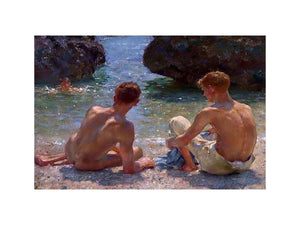
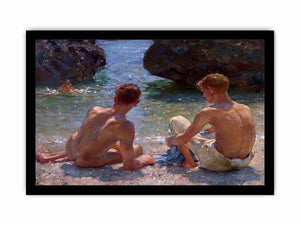
The Critics Painting by Henry Scott Tuke
The Critics stands as one of Henry Scott Tuke’s most intellectually charged and quietly subversive works, a painting in which observation, self-awareness, and artistic identity are examined with wit and compositional restraint. Created during a period when Tuke was refining his position within British art, the painting operates on multiple levels: as a genre scene, as a commentary on artistic judgment, and as a subtle reflection on the relationship between creator, subject, and audience. Rather than presenting criticism as confrontation or spectacle, Tuke renders it as a lived condition—ever-present, quietly influential, and inseparable from the act of making art itself.
Henry Scott Tuke is best known for his luminous depictions of male figures in coastal settings, works that combine naturalism, classical influence, and an unusually candid approach to the male body. Yet his artistic intelligence extended well beyond subject choice. Tuke was deeply conscious of the structures that governed artistic production in late nineteenth- and early twentieth-century Britain: exhibition culture, academic authority, public opinion, and the unspoken power of commentary. The Critics emerges from this awareness, revealing an artist capable of turning a reflective gaze upon his own professional environment.
The composition is deliberate and controlled. Tuke arranges the figures in a manner that suggests observation rather than action. The critics themselves are positioned as viewers within the painting, their attention directed toward something outside the frame or just beyond immediate clarity. This compositional choice is essential. By withholding the object of scrutiny, Tuke shifts focus from what is being judged to the act of judgment itself. The painting becomes less about an artwork and more about the human mechanisms of evaluation.
Perspective plays a crucial role in establishing psychological distance. The viewer occupies a position slightly removed from the critics, observing them as they observe. This layered act of looking creates a subtle hierarchy of awareness. Tuke invites the viewer to consider not only how art is judged, but how judgment itself can be subject to scrutiny. The painting thus operates reflexively, engaging the viewer in the very process it depicts.
Gesture and posture are rendered with understated precision. The critics’ body language conveys contemplation, deliberation, and quiet authority rather than aggression or dogmatism. There is no caricature, no overt satire. Tuke resists easy mockery, choosing instead to portray critics as thoughtful participants within the cultural ecosystem. This restraint prevents the painting from becoming polemical. Instead, it achieves a more nuanced tone, acknowledging criticism as both necessary and potentially limiting.
Light is employed with characteristic sensitivity. Tuke avoids dramatic contrast, favouring a balanced illumination that allows figures and space to coexist without hierarchy. Light clarifies form and expression without spotlighting any single individual. This evenness reinforces the painting’s intellectual neutrality. The scene is neither accusatory nor defensive. It exists in a state of quiet analysis, mirroring the measured atmosphere of judgment itself.
Colour is subdued and harmonious. Tuke favours a restrained palette that avoids emotional manipulation. Earth tones, softened neutrals, and controlled highlights create an atmosphere of seriousness and attentiveness. Colour supports coherence rather than emphasis, ensuring that no single element overwhelms the composition. This chromatic discipline aligns with the painting’s theme, reinforcing contemplation over reaction.
Tuke’s brushwork remains controlled and confident. Surfaces are articulated clearly without excess detail, allowing the viewer to focus on relationship and meaning rather than technical display. The painting’s finish reflects Tuke’s academic grounding while avoiding rigidity. Technique here serves clarity and intention, reinforcing the painting’s intellectual character.
Symbolically, The Critics operates as a meditation on power and vulnerability within the art world. Critics, positioned as observers and arbiters, wield influence through interpretation rather than creation. Yet by rendering them as subjects, Tuke rebalances that power. They too become objects of observation, their authority contextualised rather than absolute. The painting suggests that criticism, like art, is shaped by perspective, temperament, and circumstance.
Emotionally, the work is restrained and reflective. There is no conflict, no visible tension. Instead, the painting conveys a calm awareness of the quiet negotiations that define artistic life. Tuke neither resents nor glorifies criticism. He acknowledges it as an integral presence—one that shapes reception, legacy, and meaning without fully determining them. This emotional equilibrium is central to the painting’s enduring relevance.
Within Tuke’s broader oeuvre, The Critics occupies a distinctive position. While his coastal figure paintings explore freedom, youth, and natural harmony, this work turns inward toward the structures of culture and perception. It reveals an artist capable of intellectual self-examination, willing to interrogate not only how art looks, but how it is seen and discussed. The painting thus complements his more celebrated works by demonstrating conceptual range and critical awareness.
The painting’s relevance today remains strong across the United States, the United Kingdom, Canada, Australia, and Europe. In a contemporary world saturated with commentary, review, and instant judgment, The Critics feels strikingly prescient. It invites viewers to consider the dynamics of evaluation with patience and humility, reminding us that criticism is itself a human practice, shaped by context and subject to interpretation.
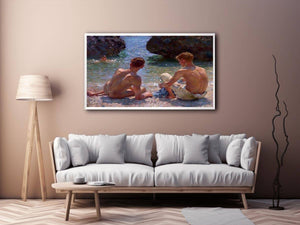
In interior settings, The Critics introduces intellectual depth and quiet sophistication. In living rooms, it encourages conversation about art, perception, and authority. In studies and offices, it reinforces reflection, discernment, and critical thinking. In galleries and luxury residences, it signals a refined engagement with art that values ideas as much as aesthetics.
The painting integrates seamlessly into traditional, modern, minimalist, and eclectic décor. Traditional interiors resonate with its academic clarity and measured tone. Modern spaces benefit from its conceptual relevance and restrained palette. Minimalist environments amplify its psychological subtlety, while eclectic interiors draw cohesion from its balanced composition and thoughtful subject.
The enduring importance of The Critics lies in its refusal to dramatise judgment or reduce it to caricature. Tuke presents criticism as a quiet, pervasive force—one that influences without spectacle and persists without resolution. The painting endures because it recognises that artistic meaning is never fixed, but negotiated through layers of looking, thinking, and response.
To live with The Critics is to engage daily with a work that honours reflection over reaction. Through its disciplined composition, psychological intelligence, and conceptual clarity, the painting continues to affirm Henry Scott Tuke’s position as an artist of uncommon depth and awareness. It stands as a testament to his belief that art does not end at the canvas, but continues in the conversations, judgments, and perceptions that surround it.
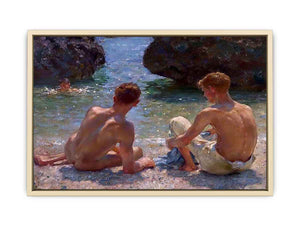
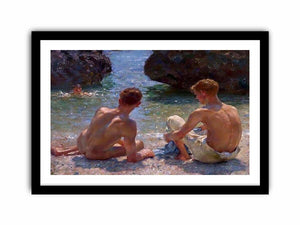
Buy museum qulaity 400- 450 canvas prints, framed prints, and 100% oil paintings of The Critics by Henry Scott Tuke at Alpha Art Gallery, where world-famous masterpieces are recreated with museum-quality detail, refined craftsmanship, and premium materials.
FAQS
What is the subject of The Critics?
It depicts figures engaged in the act of evaluation, focusing on the process of judgment rather than the artwork being judged.
Is The Critics a satirical painting?
No. It is reflective rather than satirical, portraying criticism with nuance and restraint.
Why is this painting considered intellectually significant?
It examines how art is perceived and judged, turning critical observation into a subject of contemplation.
How does Henry Scott Tuke use composition in this work?
He creates layered observation by positioning the viewer as an observer of observers, deepening psychological engagement.
Is The Critics suitable for contemporary interiors?
Yes. Its conceptual depth and restrained palette integrate well into modern and traditional spaces.
What emotional tone does the painting convey?
It conveys calm reflection and intellectual seriousness rather than conflict or humour.
Does this artwork have lasting relevance?
As a meditation on criticism and perception, it remains highly relevant in contemporary cultural discourse.
Where is the best place to display The Critics?
It is especially well suited to studies, offices, galleries, and living spaces that value thoughtful engagement with art.