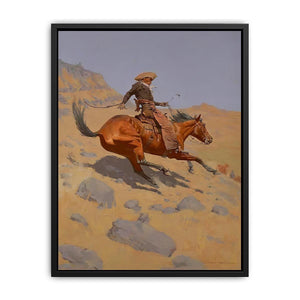
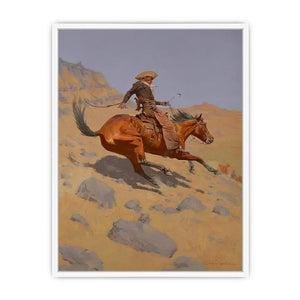
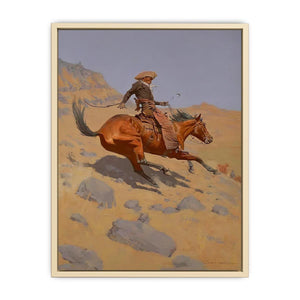
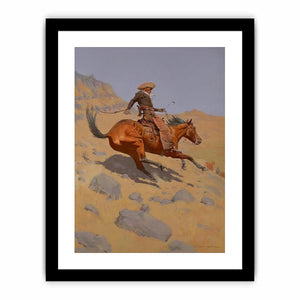
The Cowboy Painting by Frederic Remington
The Cowboy stands as one of Frederic Remington’s most emblematic and quietly authoritative representations of the American West, a work in which restraint, observation, and cultural definition converge. Unlike Remington’s more kinetic scenes of pursuit, conflict, or collapse, this painting pauses the narrative of the frontier to consider its central figure in a state of composure and presence. Here, the cowboy is neither fleeing nor falling, neither triumphant nor defeated. He exists within the landscape as a fact of life—self-possessed, alert, and shaped by the demands of the environment he inhabits.
Frederic Remington’s vision of the West was forged at a moment when the frontier was already receding into memory. By the late nineteenth century, railroads, fences, and settlements had begun to erode the open range that had defined Western life for decades. Remington understood that the cowboy, as both worker and symbol, was becoming a historical figure even as he remained a living one. The Cowboy emerges from this tension between presence and disappearance. It is not a nostalgic invention, but a considered record of a way of life understood to be finite.
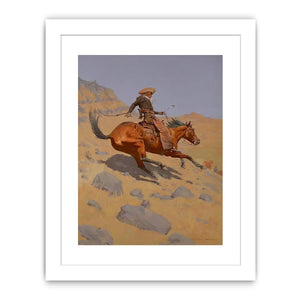
The composition centres the cowboy as an individual, yet never isolates him from his surroundings. Horse and rider form a unified silhouette, their relationship presented as practical rather than romantic. The posture is controlled and economical, suggesting long familiarity rather than display. Remington avoids theatrical gesture. The cowboy does not perform for the viewer; he attends to his environment. This compositional restraint grants the figure credibility. He is not elevated above the land, nor diminished by it. He belongs to it.
Perspective reinforces this sense of grounded presence. The viewer encounters the cowboy at a respectful distance, neither intruding nor idealising. There is no dramatic foreshortening, no exaggerated scale. Space unfolds naturally, allowing horse, rider, and terrain to coexist without hierarchy. Remington’s choice of viewpoint reflects his broader commitment to observation over invention. The painting does not dramatise the cowboy’s role; it recognises it.
Light in The Cowboy is clear and functional. Remington does not employ dramatic chiaroscuro or atmospheric effects to heighten emotion. Illumination serves to reveal form, texture, and posture with directness. The cowboy is visible, not spotlighted. Light affirms the physical reality of the scene rather than transforming it into spectacle. This clarity reinforces the painting’s documentary authority while maintaining painterly refinement.
Colour is rooted in the earthy palette that characterises Remington’s Western works. Browns, tans, muted blues, and dusty greys dominate, binding figure and landscape into a coherent whole. The cowboy’s clothing does not distinguish him symbolically; it functions practically, blending into the environment. This chromatic unity underscores a central truth of Remington’s vision: the cowboy is not an emblem imposed upon the land, but a product of it. Colour here affirms continuity rather than contrast.
Remington’s brushwork is controlled and assured, particularly in the rendering of horse and rider. Musculature is suggested with economy, conveying strength without excess. Details are selective, emphasising structure and posture rather than ornament. The surface retains vitality without calling attention to technique. Remington’s hand remains visible but disciplined, reinforcing the painting’s balance between realism and artistic intention.
Symbolically, The Cowboy resists mythmaking. The figure does not stand as an abstract ideal of freedom or conquest. Instead, he represents labour, vigilance, and adaptation. Remington presents the cowboy as a professional shaped by routine rather than romance. The painting acknowledges skill and endurance without elevating them into legend. In doing so, it offers a more durable and honest understanding of Western identity.
Emotionally, the work is marked by quiet confidence rather than intensity. There is no urgency, no visible threat. The mood is one of alert stillness, suggesting readiness rather than repose. This emotional register distinguishes The Cowboy from Remington’s action-driven compositions. It invites contemplation rather than excitement, allowing viewers to consider the psychological dimensions of frontier life—patience, attentiveness, and self-reliance.
Within Remington’s artistic development, The Cowboy represents a stabilising counterpoint to his more dramatic works. While Remington is often celebrated for his depictions of speed and violence, this painting demonstrates his equal capacity for restraint and character study. It reflects a mature understanding that the West was defined as much by routine and endurance as by crisis. The painting contributes to a more nuanced and complete vision of frontier existence.
Culturally, The Cowboy occupies a foundational place in the visual construction of American identity. The cowboy has become one of the most enduring symbols of the United States, yet Remington’s treatment resists caricature. By grounding the figure in observation and environment, he preserves the cowboy as a historical reality rather than a mythic abstraction. The painting thus serves as both cultural document and artistic statement, shaping how generations would imagine the West.
In contemporary interiors, The Cowboy integrates with exceptional versatility and authority. In living rooms and studies, it introduces a sense of grounded presence and historical depth. In offices and private collections, it communicates resilience, independence, and cultural awareness. In galleries and luxury residences across the United States, United Kingdom, Canada, Australia, and Europe, the painting complements rustic, traditional, and modern interiors alike. Its restrained palette and balanced composition allow it to command space without visual excess, making it equally effective as focal work or contextual anchor.
The enduring relevance of The Cowboy lies in its refusal to exaggerate. Remington presents the cowboy not as legend, but as lived reality—defined by skill, awareness, and relationship to land. The painting endures because it captures a universal human condition: the quiet dignity of competence, exercised daily in an environment that demands respect. In The Cowboy, Frederic Remington does not celebrate conquest or conflict; he honours presence. That measured honesty ensures the painting’s lasting resonance across cultures and eras.
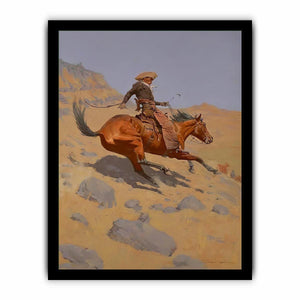
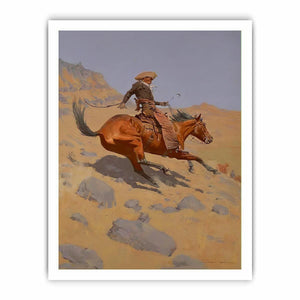
Buy museum qulaity 400- 450 canvas prints, framed prints, and 100% oil paintings of The Cowboy by Frederic Remington at Alpha Art Gallery, where world-famous masterpieces are recreated with museum-quality detail, refined craftsmanship, and premium materials.
FAQS
What does The Cowboy by Frederic Remington depict?
It depicts a solitary cowboy on horseback, presented with restraint and realism rather than dramatic action.
Why is this painting important in Remington’s work?
It highlights his ability to portray the West through calm observation and character rather than motion and conflict.
Does the painting idealise the cowboy?
No, it presents the cowboy as a working figure shaped by environment and routine, not as a mythic hero.
What emotional tone defines The Cowboy?
The tone is quiet, composed, and attentive, emphasising presence and readiness rather than drama.
How does Remington use colour in this painting?
He employs an earthy, restrained palette that integrates the figure seamlessly with the landscape.
Is The Cowboy historically grounded?
Yes, it reflects Remington’s firsthand understanding of Western life and the realities of frontier labour.
Is The Cowboy suitable for contemporary interiors?
Yes, its balanced composition and muted tones suit both traditional and modern spaces.
Why does The Cowboy remain relevant today?
Its portrayal of dignity, competence, and connection to environment continues to resonate as a timeless human ideal.