The Cardsharps Painting by Caravaggio
The Cardsharps stands as one of the most incisive and transformative early works by Caravaggio, a painting in which the everyday world becomes a stage for moral revelation. Created around 1594, shortly after the artist’s arrival in Rome, the work announces a radical departure from idealised Renaissance conventions and signals the emergence of a new visual realism grounded in lived experience. In The Cardsharps, Caravaggio does not depict myth, history, or divine narrative. He turns instead to the precarious theatre of ordinary life, revealing deception, innocence, and calculation with unflinching clarity.
At the time this painting was made, Caravaggio was a young and largely unknown artist struggling to establish himself. Roman painting was still dominated by artificial elegance and learned references to antiquity. Against this backdrop, The Cardsharps was revolutionary. It presented common people engaged in a recognisable, morally ambiguous situation, rendered with unprecedented naturalism. This choice was not incidental. Caravaggio believed that truth in art resided in direct observation, not in ideal forms. The Cardsharps embodies this conviction fully, positioning everyday human behaviour as a subject worthy of serious artistic attention.
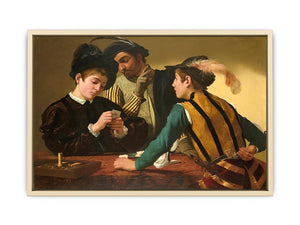
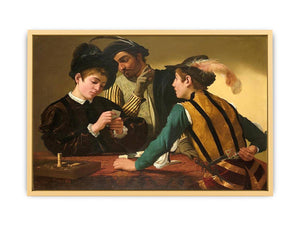
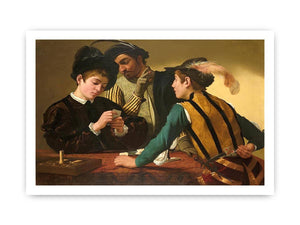
The scene depicts three figures at a gaming table. At the centre is a young, well-dressed but naïve player, absorbed in his hand of cards. Flanking him are two cheats working in silent coordination. One peers over the victim’s shoulder, subtly signalling information to his accomplice, who prepares to draw a hidden card from behind his back. The drama is quiet, almost suspended, yet charged with tension. Nothing overt has happened, yet everything is about to. This precise moment of anticipation is central to the painting’s power.
Caravaggio’s compositional intelligence is evident in the way he arranges the figures. The triangular grouping creates balance while reinforcing narrative focus. The victim’s brightly lit face becomes the emotional centre, surrounded by the darker, more guarded expressions of the deceivers. Spatial depth is shallow, bringing the figures close to the viewer and collapsing the distance between observer and event. This proximity intensifies the psychological engagement, making the viewer complicit in the unfolding deception.
Light plays a decisive role in shaping meaning. Although The Cardsharps predates Caravaggio’s most dramatic chiaroscuro, light is already used with strategic intent. It falls across faces, hands, and fabric, directing attention to gestures that carry narrative weight. The illuminated cards, the tense grip on the table edge, and the concealed movement behind the back all become focal points. Light does not moralise; it reveals. It exposes the imbalance between knowledge and ignorance that defines the scene.
Colour is employed with restraint and purpose. Rich yet muted tones dominate the composition: earthy browns, deep reds, and soft blacks balanced by the lighter hues of silk and skin. These colours ground the painting in material reality, emphasising texture and presence. Fabrics are rendered with tactile precision, from the crisp finery of the young victim to the worn garments of the cheats. This contrast subtly reinforces social difference and vulnerability without resorting to overt symbolism.
Gesture and expression are central to the painting’s psychological realism. The young player’s posture conveys trust and absorption, his body open and unaware. By contrast, the cheats are physically closed and guarded. Their movements are economical, practiced, and silent. Caravaggio’s deep attention to hands is particularly striking. Fingers signal, conceal, and prepare action, functioning as instruments of intention rather than mere anatomical detail. These gestures communicate more than facial expression alone, underscoring Caravaggio’s understanding of human behaviour.
Symbolically, The Cardsharps operates as a moral study without overt didacticism. Gambling becomes a metaphor for risk, youth, and susceptibility, while deception is shown as ordinary rather than monstrous. Caravaggio does not condemn through exaggeration. He presents a slice of reality and allows meaning to emerge through observation. The absence of moral judgement makes the painting more unsettling. Viewers are left to recognise the inevitability of such moments within human interaction.
Emotionally, the painting evokes a complex response. There is amusement in recognising the trick, tension in anticipating its success, and discomfort in witnessing innocence about to be exploited. This layered emotional engagement reflects Caravaggio’s refusal to simplify human experience. His realism is not merely visual but psychological, capturing the subtle interplay of power, awareness, and vulnerability.
Within Caravaggio’s career, The Cardsharps is a foundational work. It established his reputation among important patrons and announced the arrival of a new artistic voice capable of transforming genre scenes into vehicles of profound insight. The painting would influence countless artists across Europe, laying the groundwork for Baroque realism and redefining what subjects were considered worthy of serious art.
Culturally, the painting remains remarkably contemporary. Its themes of deception, social imbalance, and misplaced trust transcend historical context. The scene could unfold in any era, wherever experience confronts naivety and advantage exploits vulnerability. This timelessness is central to the work’s lasting relevance.
In contemporary interiors, The Cardsharps offers exceptional depth and adaptability. In living rooms, it functions as a compelling focal point that invites conversation and close viewing. In studies and offices, it introduces intellectual seriousness and psychological complexity. Within galleries and refined residences across the United States, United Kingdom, Canada, Australia, and Europe, the painting integrates seamlessly with both classical and modern décor. Its restrained palette and intimate scale allow it to command attention without overwhelming a space.
The enduring power of The Cardsharps lies in its honesty. Caravaggio reveals human behaviour without embellishment, presenting moral complexity as an inherent part of everyday life. In doing so, he affirms art’s capacity to illuminate truth not through idealisation, but through attentive observation. The painting remains a testament to his belief that reality, when truly seen, is more compelling than any myth.
Buy museum qulaity 400- 450 canvas prints, framed prints, and 100% oil paintings of The Cardsharps by Caravaggio at Alpha Art Gallery, where world-famous masterpieces are recreated with museum-quality detail, refined craftsmanship, and premium materials.
FAQ
What is the subject of The Cardsharps by Caravaggio?
It depicts a young man being deceived by two professional cheats during a card game, capturing a moment of imminent betrayal.
Why is The Cardsharps considered revolutionary?
It elevated an everyday genre scene into serious art through unprecedented realism and psychological depth.
How does Caravaggio use light in the painting?
Light directs attention to key gestures and expressions, revealing narrative tension without overt symbolism.
What moral themes are present in the work?
The painting explores deception, vulnerability, and the imbalance between experience and innocence.
Is The Cardsharps an early work by Caravaggio?
Yes, it was painted early in his career and helped establish his reputation in Rome.
Why are gestures so important in the composition?
Hands and body language communicate intention, secrecy, and complicity more powerfully than words.
Is The Cardsharps suitable for modern interiors?
Its intimate scale, muted palette, and narrative depth make it well suited to both contemporary and classical spaces.
Why does The Cardsharps remain relevant today?
Its depiction of human manipulation and trust reflects timeless aspects of social interaction.