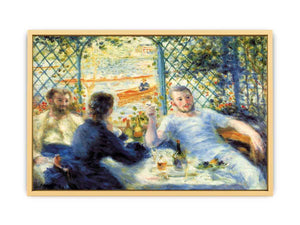
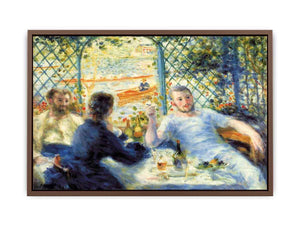
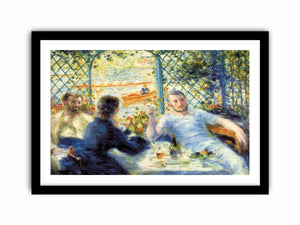
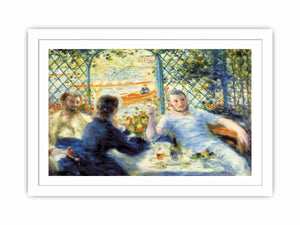
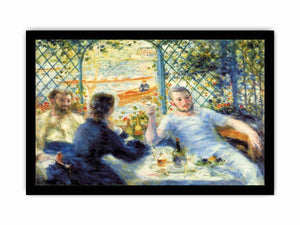
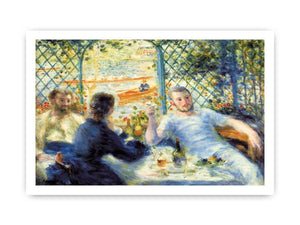
The Canoeists Luncheon Painting by Pierre-Auguste Renoir
The Canoeists Luncheon stands as one of the most luminous and life-affirming paintings of late nineteenth-century French art, a work in which Pierre-Auguste Renoir distilled his belief that painting should celebrate human presence, shared experience, and the quiet pleasures of everyday life. Completed in 1881, at a moment when Impressionism was reaching both technical maturity and philosophical self-confidence, the painting embodies a rare balance between spontaneity and structure. It is neither a fleeting sketch nor a casual genre scene, but a carefully composed vision of modern leisure rendered with warmth, intelligence, and emotional generosity.
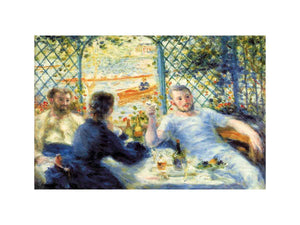
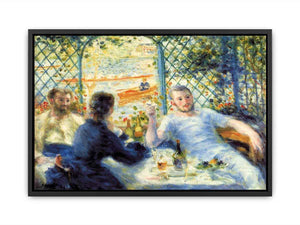
By the early 1880s, Renoir had already secured his position as a central figure within the Impressionist movement. Unlike some of his contemporaries, however, he never abandoned the human figure in favour of landscape alone. Renoir believed that people, when observed attentively and sympathetically, were the highest subject of art. The Canoeists Luncheon reflects this conviction fully. It depicts a group of friends relaxing after boating on the Seine at the Maison Fournaise, a popular riverside restaurant just outside Paris. Yet the painting transcends its specific setting, transforming a casual gathering into a meditation on sociability, youth, and the pleasure of being present in the moment.
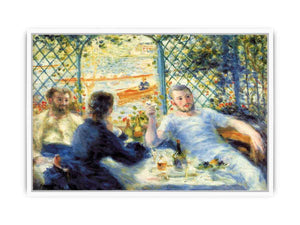
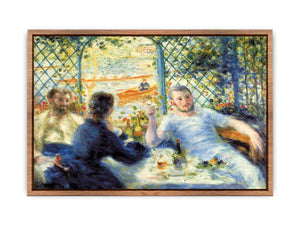
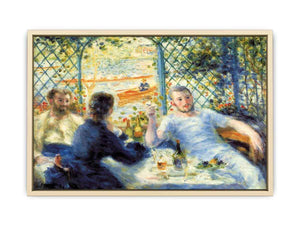
The composition is deceptively effortless. A long table occupies the foreground, crowded with plates, glasses, fruit, and bottles, all arranged with a natural irregularity that suggests recent activity rather than formal arrangement. Around it, figures converse, lean, laugh, and reflect, each absorbed in a distinct psychological state. Renoir orchestrates these individual presences into a unified whole, allowing variety without fragmentation. The eye moves fluidly from face to face, gesture to gesture, guided by subtle alignments of posture, colour, and light.
Perspective is handled with great sensitivity. The balcony setting opens onto the river beyond, where soft reflections and distant foliage introduce depth without distracting from the human drama in the foreground. The railing serves as both boundary and bridge, separating the social interior from the natural exterior while allowing light and air to circulate freely. This spatial openness reinforces the painting’s atmosphere of ease and connection, situating the gathering within a broader world rather than enclosing it in intimacy alone.
Light is central to the painting’s emotional tone. Renoir captures the filtered sunlight of an afternoon meal, where brightness is softened by shade and movement. Light does not fall evenly or dramatically; it flickers across faces, clothing, and tableware, animating the scene with gentle variation. This light is not symbolic or theatrical. It is lived light, observed through prolonged attention, conveying warmth rather than spectacle. In this respect, the painting exemplifies Impressionism’s commitment to perceptual truth tempered by emotional sensitivity.
Colour is applied with extraordinary richness and restraint. Warm flesh tones, creamy whites, soft blues, and straw yellows dominate the palette, punctuated by the vivid reds of fruit and ribbons. These colours are harmonised rather than contrasted aggressively, creating a visual cohesion that mirrors the social harmony of the group. Renoir’s handling of colour avoids sharp edges, allowing forms to dissolve slightly into one another, reinforcing the sense of shared space and collective presence.
The brushwork is fluid and confident, yet never careless. Renoir balances looseness with control, suggesting texture and volume without heavy modelling. Fabrics shimmer, skin glows, and glassware catches light with effortless precision. This painterly freedom supports the painting’s emotional accessibility. Nothing feels overworked or rigid. The scene breathes, as though time has paused briefly to allow observation.
Symbolically, The Canoeists Luncheon resists grand allegory. Its meaning arises from attentiveness rather than abstraction. The act of shared leisure becomes significant precisely because it is unforced. In an era marked by rapid industrialisation and social change, Renoir presents modern life not as alienating but as capable of joy, intimacy, and connection. The painting affirms the value of companionship, conversation, and physical presence in a world increasingly shaped by speed and transition.
Emotionally, the work radiates ease without complacency. Each figure remains distinct, engaged in private thought or exchange, yet all belong to the same moment. There is laughter, contemplation, flirtation, and quiet observation, none exaggerated, none imposed. Renoir does not dramatise emotion; he allows it to exist naturally. This emotional restraint gives the painting its enduring appeal. Viewers are not instructed how to feel; they are invited to participate.
Within Renoir’s career, The Canoeists Luncheon represents a synthesis of his artistic priorities. It unites his devotion to the figure with Impressionist techniques of light and colour, while demonstrating increased compositional discipline. The painting is often understood as a culmination of his early Impressionist period, before his later turn toward more classical structure. It shows an artist fully at ease with his language, capable of generosity without excess.
Culturally, the painting has come to symbolise a vision of modern life defined by balance rather than rupture. It offers an image of community grounded in pleasure, conversation, and shared experience. Over time, it has become one of the most recognisable expressions of Impressionism’s humanistic core, reminding viewers that modernity need not be estranged from warmth or connection.
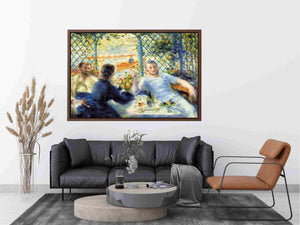
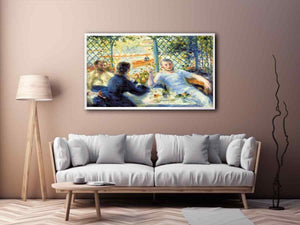
In contemporary interiors, The Canoeists Luncheon remains remarkably adaptable. In living rooms, it introduces vitality, warmth, and cultural refinement without visual aggression. In dining spaces, it resonates naturally with themes of gathering and hospitality. In studies and offices, it offers a reminder of balance between work and leisure. Within galleries and luxury residences across the United States, United Kingdom, Canada, Australia, and Europe, the painting integrates seamlessly with modern, traditional, and eclectic décor alike. Its layered composition and harmonious palette allow it to anchor a space while maintaining openness and light.
The enduring relevance of The Canoeists Luncheon lies in its affirmation of presence. It captures a moment that is not monumental, yet deeply human. In doing so, Renoir asserts that meaning can be found not only in history or myth, but in shared time, attentive observation, and the simple act of being together. The painting remains a testament to his belief that art, at its highest level, should be generous—to the eye, to the emotions, and to life itself.
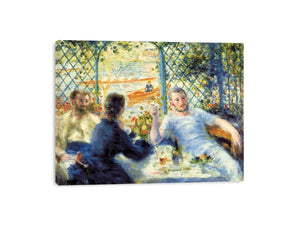
Buy museum qulaity 400- 450 canvas prints, framed prints, and 100% oil paintings of The Canoeists Luncheon by Pierre Auguste Renoir at Alpha Art Gallery, where world-famous masterpieces are recreated with museum-quality detail, refined craftsmanship, and premium materials.
FAQ
What does The Canoeists Luncheon depict?
It depicts a group of friends relaxing after boating on the Seine, sharing food, conversation, and leisure at a riverside restaurant.
Why is this painting important in Renoir’s career?
It represents a mature synthesis of his Impressionist technique and his lifelong devotion to the human figure.
How does light function in the painting?
Light animates the scene gently, filtering across faces and objects to create warmth and movement without drama.
Is The Canoeists Luncheon a purely casual scene?
While it appears informal, the composition is carefully structured to balance individuality and unity.
What emotions does the painting convey?
It conveys ease, companionship, and quiet joy, allowing varied emotional states to coexist naturally.
Does the painting reflect Impressionist principles?
Yes, particularly in its treatment of light, colour, and everyday modern life.
Is The Canoeists Luncheon suitable for contemporary interiors?
Its warmth, colour harmony, and social theme make it highly adaptable to modern and traditional spaces.
Why does the painting remain relevant today?
It celebrates shared presence and human connection, values that continue to resonate across cultures and generations.