The Burning of the Houses of Parliament Painting by Joseph Mallord William Turner
The Burning of the Houses of Parliament Painting by Joseph Mallord William Turner is one of the most electrifying visual testimonies of modern history transformed into art, a work in which catastrophe, spectacle, and perception converge with unprecedented intensity. Painted in the aftermath of the fire that destroyed the old Palace of Westminster in 1834, the work does not merely record an event; it reimagines it as a meditation on light, transience, and the sublime force of change. Turner converts a moment of national crisis into a vision of elemental drama, where architecture dissolves, time accelerates, and human presence is rendered fragile against overwhelming natural and man-made forces.
Joseph Mallord William Turner occupied a unique position in nineteenth-century art, bridging the traditions of topographical painting and the radical possibilities of modern abstraction. By the time he painted The Burning of the Houses of Parliament, Turner had moved decisively beyond descriptive realism. His concern was no longer the faithful rendering of structures, but the visual and emotional experience of seeing. This painting stands at the height of that transformation, revealing Turner’s conviction that truth in art lies not in form alone, but in sensation, atmosphere, and the instability of the visible world.
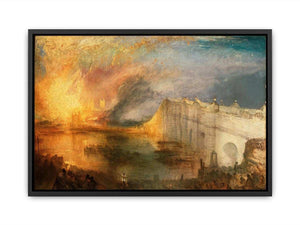
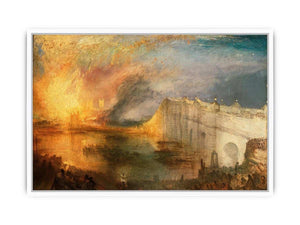
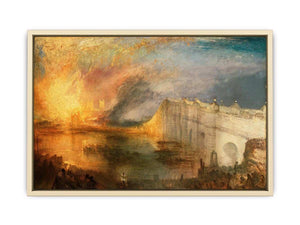
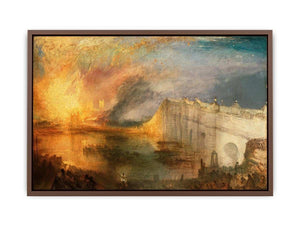
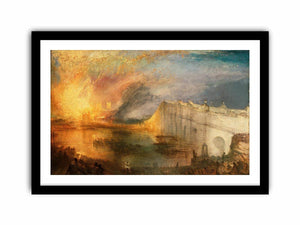
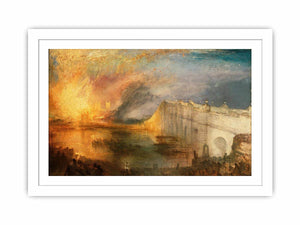
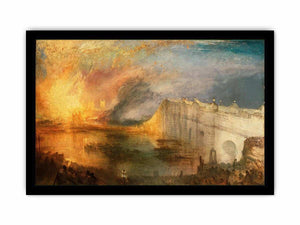
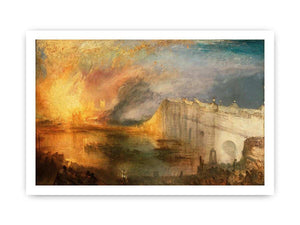
The subject is the destruction of the Houses of Parliament as seen from across the River Thames. Turner witnessed the fire firsthand, making sketches on the spot as flames engulfed one of Britain’s most symbolically charged buildings. Yet the finished painting transcends eyewitness reportage. The event becomes a theatre of light and motion, where fire, smoke, water, and sky interact in a volatile choreography. The familiar silhouette of Westminster is present only briefly before dissolving into incandescent color and vapor.
Compositionally, the painting is organized around sweeping diagonals and turbulent flow. The river acts as a dark, reflective plane in the foreground, mirroring the inferno above while anchoring the composition. Beyond it, the burning structures erupt into flame, their vertical thrust countered by the horizontal spread of smoke and reflection. Turner avoids rigid compositional balance. Instead, he embraces instability, allowing the painting to feel perpetually on the verge of collapse. This structural volatility mirrors the destruction unfolding within the scene.
Perspective situates the viewer at a distance, yet not at safety. We observe from across the river, separated from the fire by water, but still immersed in its glow and smoke. This vantage point allows Turner to encompass the full breadth of the spectacle while preserving a sense of vulnerability. The viewer is neither participant nor detached observer, but a witness caught within the event’s atmospheric reach.
Light is the dominant and transformative force of the painting. Fire becomes Turner’s primary subject, overwhelming architecture and redefining space. The flames blaze with intense yellows, oranges, and whites, tearing through the darkness and casting violent reflections across the Thames. Light here is not clarifying; it is consuming. It destroys form even as it reveals it, reducing solid stone to momentary brilliance before erasure.
Color is deployed with extraordinary daring. Turner abandons local color in favor of expressive intensity. The night sky is not black but charged with reds, purples, and smoky blues, each hue modulated to convey heat, movement, and depth. The river absorbs these colors, transforming them into trembling reflections that ripple across the surface. Color becomes an event rather than a property, embodying energy and transformation rather than description.
Turner’s brushwork is rapid, fluid, and unapologetically visible. Strokes surge and dissolve, refusing containment. This handling reinforces the painting’s sense of immediacy and impermanence. Edges blur, forms disintegrate, and the boundary between object and atmosphere collapses. The painting does not depict destruction from a stable distance; it enacts it through the instability of its own surface.
Emotionally, The Burning of the Houses of Parliament conveys awe rather than tragedy alone. While the event was a national disaster, Turner resists moralizing or lamentation. Instead, he confronts the viewer with the sublime—an overwhelming encounter with forces beyond human control. The fire is terrifying, yet mesmerizing. The painting compels the viewer to recognize the fragile contingency of human structures when faced with elemental power.
Psychologically, the work speaks to the instability of progress and authority. The Houses of Parliament, symbols of governance and continuity, are reduced to fuel for flame. Turner does not frame this as political critique, but as existential truth. Institutions, like landscapes, are subject to time, decay, and sudden transformation. The painting suggests that permanence is an illusion sustained only until light and circumstance intervene.
Symbolically, fire functions as both destroyer and illuminator. It erases the old while revealing new visual possibilities. In Turner’s hands, catastrophe becomes revelation. The burning building is not mourned as lost architecture, but transformed into pure visual energy. This ambiguity—between loss and creation—lies at the heart of the painting’s enduring power.
Within Turner’s broader body of work, The Burning of the Houses of Parliament marks a culmination of his lifelong engagement with light and atmosphere. Earlier works explored storms, shipwrecks, and sunsets; here, urban catastrophe replaces natural disaster, yet the underlying inquiry remains the same. Turner asks how painting can convey forces that resist containment, how vision itself fractures under intensity.
Culturally, the painting occupies a pivotal place in the history of modern art. It anticipates later developments in abstraction and expressionism by prioritizing sensation over structure. At the same time, it remains rooted in a specific historical moment, binding modern experimentation to lived experience. Few works achieve this balance with such authority.
In contemporary interiors across the United States, the United Kingdom, Canada, Australia, and Europe, The Burning of the Houses of Parliament carries formidable presence. In living rooms, it introduces drama, energy, and historical gravity. In studies and offices, it reflects intellectual boldness and engagement with transformative ideas. In galleries and luxury residences, it signals deep appreciation for one of the most radical achievements of Romantic painting.
The painting integrates powerfully into modern and minimalist interiors, where its dynamic composition and chromatic intensity provide a striking counterpoint to clean architectural lines. It also commands respect in traditional settings, where its historical subject and painterly authority resonate with established cultural narratives. In eclectic spaces, it becomes an undeniable focal point, anchoring diverse elements through sheer visual force.
The long-term artistic importance of The Burning of the Houses of Parliament lies in its redefinition of what historical painting can be. Turner demonstrates that history need not be narrated through figures and events alone. It can be felt through light, color, and atmosphere. The painting endures because it captures not just what happened, but how it felt to witness a world momentarily consumed by fire.
Today, the work remains profoundly relevant. In an era marked by instability, transformation, and spectacle, Turner’s vision of destruction as both terror and revelation speaks with renewed urgency. Through incandescent light, fluid form, and uncompromising intensity, Joseph Mallord William Turner created a painting that continues to challenge how we see history, power, and the impermanence of human achievement.
Buy museum qulaity 400- 450 canvas prints, framed prints, and 100% oil paintings of The Burning of the Houses of Parliament by Joseph Mallord William Turner at Alpha Art Gallery, where world-famous masterpieces are recreated with museum-quality detail, refined craftsmanship, and premium materials.
FAQS
What historical event does The Burning of the Houses of Parliament depict?
It depicts the fire of 1834 that destroyed the old Palace of Westminster in London.
Did Turner witness the event himself?
Yes, Turner observed the fire firsthand and made sketches during the event.
Why is the painting considered radical for its time?
It prioritizes light, color, and atmosphere over clear architectural detail, anticipating modern abstraction.
What emotion does the painting convey most strongly?
It conveys awe and sublimity rather than simple tragedy or documentation.
Where does this artwork work best in interior spaces?
It is ideal for living rooms, studies, offices, galleries, and statement luxury interiors.
Is this painting suitable for modern décor?
Yes, its dynamic energy and expressive color integrate powerfully into modern and minimalist spaces.
Does the painting have lasting artistic significance?
It is considered one of Turner’s masterpieces and a landmark in the transition toward modern painting.