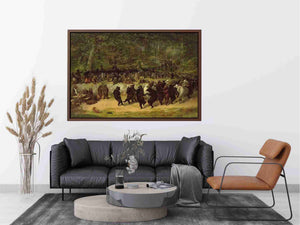
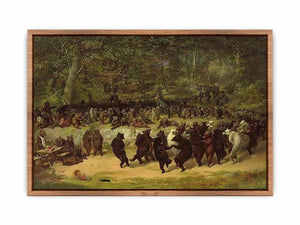
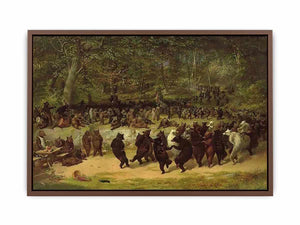
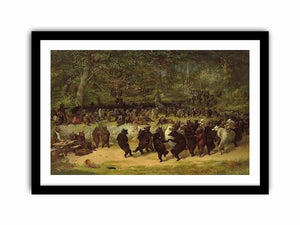
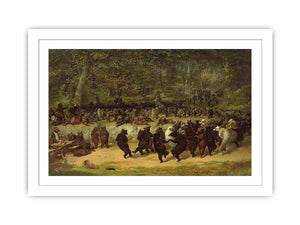
The Bear Dance Painting by William Holbrook Beard
The Bear Dance Painting by William Holbrook Beard is a singular and intellectually playful work that conceals sharp cultural insight beneath its surface humor. Painted in the nineteenth century, the work belongs to Beard’s celebrated series of anthropomorphic animal scenes, in which bears, clothed and posed as humans, enact recognizable social rituals. Yet to regard the painting merely as comic entertainment would be to miss its deeper resonance. Beard employs satire with discipline and intent, transforming the familiar spectacle of a dance into a pointed reflection on human behavior, social performance, and collective absurdity.
William Holbrook Beard occupies a distinctive position in American art history. Trained in both the United States and Europe, Beard possessed a firm grounding in academic technique, which he deliberately applied to unconventional subject matter. His choice to depict bears as stand-ins for people was not escapism, but critique. Through animal allegory, Beard was able to comment on social customs, pretensions, and follies with a freedom unavailable to more literal representation. The Bear Dance stands among his most effective works in this vein, balancing technical control with narrative wit.
The subject of the painting is deceptively simple: a group of bears engaged in a dance, their gestures exaggerated, their movements animated, their attention focused inward on the ritual itself. Yet this simplicity is carefully constructed. Each bear appears invested in the performance, absorbed in rhythm, posture, and interaction. The scene echoes the structure of human social gatherings, where participation often matters more than purpose. Beard captures not joy alone, but self-conscious display—the impulse to be seen engaging in communal activity.
Compositionally, the painting is organized with remarkable clarity. The bears are arranged to create a rhythmic flow across the canvas, their bodies forming arcs and counter-arcs that guide the viewer’s eye through the scene. There is no central heroic figure. Instead, attention circulates among the participants, reinforcing the collective nature of the event. Beard’s compositional balance ensures that the scene remains legible despite its liveliness, preventing chaos while preserving motion.
Perspective places the viewer at a comfortable distance, close enough to observe expression and gesture, yet removed enough to maintain the role of witness. This positioning is essential to the painting’s satirical effect. The viewer is invited to recognize familiar behaviors without being implicated directly. Beard constructs a space of observation where recognition precedes amusement, and amusement gives way to reflection.
The handling of the bear figures demonstrates Beard’s technical seriousness. Anatomy is carefully studied, proportions convincing, weight and balance rendered with precision. The bears do not move like caricatures; they move like physical beings adapted to human behavior. This realism grounds the satire. By ensuring that the animals feel materially present, Beard prevents the painting from drifting into fantasy. The humor arises precisely because the scene feels plausible within its own logic.
Gesture is central to the painting’s expressiveness. Raised paws, bent limbs, and shifting stances echo the language of human dance, where meaning is conveyed through posture as much as movement. Beard exaggerates just enough to make the behavior recognizable, but not so much that it collapses into parody. The bears’ engagement with one another suggests shared understanding and collective performance, reinforcing the social dimension of the scene.
Light in The Bear Dance is applied with restraint. Illumination is even and descriptive, revealing form and texture without dramatic emphasis. There is no spotlight or theatrical contrast. This neutrality supports the painting’s observational tone. Beard does not instruct the viewer where to look; he allows the scene to unfold naturally, trusting the composition to sustain attention.
Colour is handled with earthy moderation. Browns and muted tones dominate, reinforcing the physicality of the bears and grounding the scene in a natural palette. Any accents are carefully controlled, ensuring that colour supports structure rather than spectacle. The absence of flamboyant colour aligns with Beard’s intention to critique human behavior through familiarity rather than excess.
Texture is rendered with confident economy. Fur is suggested through layered brushwork that conveys mass and movement without excessive detail. The ground and surrounding space are treated with similar restraint, ensuring that the environment frames rather than competes with the figures. Beard’s surface handling reinforces the sense that this is a coherent social moment rather than a decorative vignette.
Emotionally, The Bear Dance operates on multiple levels. On first encounter, it invites amusement. The sight of bears engaged in dance is inherently playful. Yet sustained viewing reveals a more ambivalent tone. The bears appear absorbed, almost earnest, in their activity. There is little overt joy, little individuality. This seriousness beneath the humor suggests Beard’s deeper intent: to reflect how social rituals can become performative, habitual, and self-referential.
Symbolically, the bears function as surrogates for humanity. Their dance becomes a metaphor for social conformity, collective enthusiasm, and the pleasure of participation regardless of meaning. Beard does not mock cruelty or vice, but social mimicry itself—the tendency to engage in shared behavior because others do so. The absence of clear narrative outcome reinforces this reading. The dance exists for its own continuation.
Within Beard’s broader body of work, The Bear Dance exemplifies his mastery of allegorical genre painting. While many of his animal scenes address politics, class, or professional life, this work focuses on social ritual in its most universal form. It reveals Beard’s insight into the mechanics of group behavior, rendered without bitterness and without sentimentality.
Culturally, the painting reflects a nineteenth-century fascination with social observation and satire. In an era marked by expanding urban life and increasingly complex social structures, Beard’s anthropomorphic scenes offered viewers a mirror that softened critique through humor. Yet the painting’s relevance extends well beyond its period. The dynamics it depicts—performance, conformity, communal distraction—remain immediately recognizable.
In contemporary interiors across the United States, the United Kingdom, Canada, Australia, and Europe, The Bear Dance introduces narrative intelligence and character. In living rooms, it invites conversation and reflective humor. In studies and offices, it signals cultural literacy and appreciation for satire grounded in craft. In galleries and luxury residences, it demonstrates confidence in displaying art that is both accessible and intellectually layered.
The painting integrates naturally into eclectic interiors, where its wit complements varied influences. It also works effectively in traditional settings, where its academic technique aligns with classical tastes while its subject introduces levity. In modern spaces, it provides warmth and narrative contrast, softening minimal environments without undermining sophistication.
The long-term artistic importance of The Bear Dance lies in its fusion of humor and insight. Beard demonstrates that satire need not be harsh to be truthful, and that observation, when paired with technical discipline, can reveal enduring aspects of human behavior. The painting endures because it entertains without trivializing, and critiques without condemning.
Today, The Bear Dance remains compelling because it recognizes the absurdity of social life with generosity and clarity. Through controlled composition, expressive gesture, and symbolic restraint, William Holbrook Beard created a work that continues to delight while quietly provoking reflection. It stands as a testament to the power of allegory to illuminate human behavior with wit, balance, and lasting relevance.
Buy museum qulaity 400- 450 canvas prints, framed prints, and 100% oil paintings of The Bear Dance by William Holbrook Beard at Alpha Art Gallery, where world-famous masterpieces are recreated with museum-quality detail, refined craftsmanship, and premium materials.
FAQS
What is the subject of The Bear Dance by William Holbrook Beard?
It depicts bears engaged in a dance, using anthropomorphism to reflect human social behavior.
Is The Bear Dance meant to be humorous or symbolic?
It is both, combining visual humor with social satire and symbolic commentary.
Why did Beard use animals instead of human figures?
Animal figures allowed him to critique human behavior with greater freedom and universality.
Does the painting have a specific narrative meaning?
Rather than a fixed story, it suggests broader themes of social ritual and collective performance.
Where does this artwork work best in interior spaces?
It is ideal for living rooms, studies, offices, galleries, and eclectic or refined residential interiors.
Is The Bear Dance suitable for modern décor?
Yes, its narrative wit and balanced palette integrate well into modern, traditional, and eclectic spaces.
Does the painting have lasting cultural value?
Its blend of satire, craftsmanship, and insight into human behavior ensures enduring relevance.