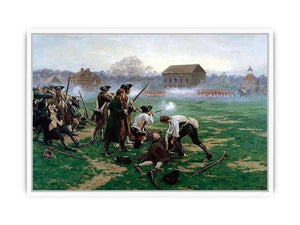
The Battle of Lexington, 19th April 1775 Painting by William Barnes Wollen
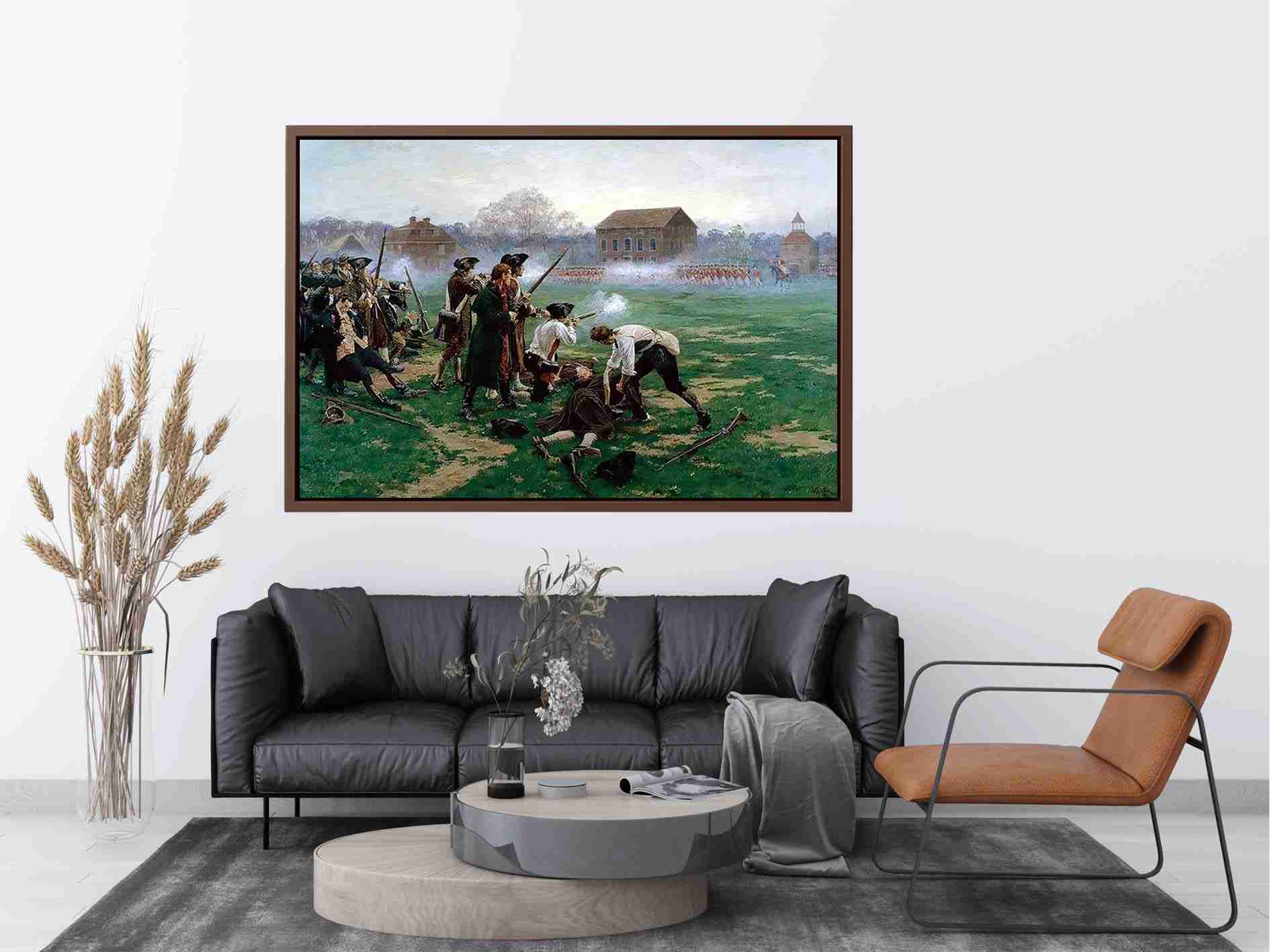
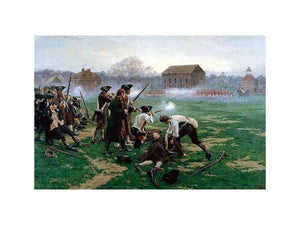
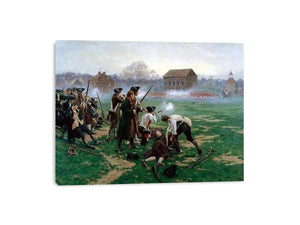
The Battle of Lexington, 19th April 1775 Painting by William Barnes Wollen is a sober and authoritative rendering of the moment traditionally understood as the opening clash of the American Revolutionary War. Painted with academic discipline and narrative clarity, the work transforms a brief, chaotic encounter into a structured historical meditation on resolve, uncertainty, and the irreversible passage from political tension to armed conflict. Wollen does not present Lexington as a triumphant beginning or a theatrical spectacle; instead, he frames it as a moment suspended between restraint and violence, where history pivots through human posture, collective discipline, and the charged stillness before action.
William Barnes Wollen was widely respected for his military and historical paintings, particularly those that demanded accuracy, compositional balance, and emotional control. Trained in the academic tradition, Wollen approached historical subjects with a documentary sensibility tempered by narrative intelligence. His work consistently avoids melodrama, favoring legibility and moral seriousness. In The Battle of Lexington, 19th April 1775, these qualities converge to produce a painting that functions simultaneously as historical record and reflective inquiry.
The subject depicts the confrontation between colonial militia and British regulars on Lexington Green, an encounter defined less by scale than by consequence. Wollen selects the moment of confrontation itself rather than the aftermath or broader campaign. This decision is central to the painting’s meaning. The scene captures men standing in formation, weapons present but not yet fully discharged, the atmosphere thick with anticipation and misunderstanding. History here is not enacted through sweeping maneuver, but through proximity, restraint, and the failure of negotiation.
Compositionally, the painting is arranged with deliberate clarity. The opposing forces are positioned in readable relation to one another, allowing the viewer to understand hierarchy, alignment, and tension at a glance. Wollen organizes the figures laterally across the canvas, reinforcing the sense of a line drawn—both physically and historically—between two sides that can no longer occupy the same political space. This compositional order reflects the discipline of both armies while emphasizing the fragile balance before violence erupts.
Perspective places the viewer at ground level, close enough to register individual expressions and gestures, yet far enough to grasp the collective formation. This vantage point reinforces the painting’s moral stance. The viewer is not elevated above the event as omniscient observer, nor embedded within it as partisan. Instead, one stands as witness to a moment whose significance exceeds the awareness of those involved. Wollen thus preserves historical distance while sustaining emotional immediacy.
Light is employed with restraint and realism. Illumination reveals uniforms, faces, and the open space of the green without dramatic contrast or symbolic spotlighting. There is no divine light favoring one side over the other. Light functions descriptively, underscoring the painting’s commitment to historical seriousness rather than interpretive bias. This neutrality allows the viewer to confront the scene without imposed judgment.
Colour is disciplined and historically grounded. The muted tones of uniforms, earth, and sky establish a sober atmosphere appropriate to the gravity of the moment. Red coats and colonial attire are differentiated clearly, yet never exaggerated for effect. Wollen uses colour to support legibility and structure rather than emotional manipulation. The palette reinforces the sense of inevitability rather than spectacle.
The handling of figures demonstrates Wollen’s academic control. Soldiers are rendered with attention to posture, equipment, and stance, conveying discipline and readiness. Facial expressions are restrained, avoiding caricature or overt emotion. This restraint is essential. By refusing to dramatize fear or heroism excessively, Wollen presents the participants as individuals bound by duty and circumstance rather than by personal ambition. The painting thus emphasizes collective action over individual narrative.
Emotionally, The Battle of Lexington, 19th April 1775 is defined by tension rather than action. The painting captures the psychological weight of anticipation—the awareness that once the first shot is fired, retreat will no longer be possible. This emotional focus distinguishes the work from more celebratory battle scenes. Wollen understands that the true drama of Lexington lies not in combat, but in decision and consequence.
Symbolically, the open green functions as more than a setting. It represents a civic space—public, communal, and shared—now transformed into a site of division. The confrontation on this ground signals the breakdown of imperial unity and the emergence of competing sovereignties. Wollen does not impose symbolism overtly, but allows it to arise through spatial arrangement and context.
Within William Barnes Wollen’s body of work, this painting exemplifies his capacity to treat foreign history with seriousness and respect. Though British by nationality, Wollen approaches the American subject without condescension or romantic distortion. His interest lies in the mechanics of historical turning points, wherever they occur. This impartiality enhances the painting’s credibility and enduring relevance.
Culturally, the painting occupies a significant place in the visual memory of the American Revolution. Created at a distance from the event itself, it reflects a later generation’s effort to understand origins with clarity rather than myth. Wollen’s Lexington is not yet a nation born, but a conflict begun—uncertain, tense, and irrevocable. This perspective allows the painting to resonate beyond national pride, addressing universal themes of resistance, authority, and the cost of political rupture.
In contemporary interiors across the United States, the United Kingdom, Canada, Australia, and Europe, The Battle of Lexington, 19th April 1775 carries historical gravitas and intellectual depth. In living rooms, it introduces narrative seriousness and cultural memory. In studies, libraries, and offices, it supports reflection on leadership, civic responsibility, and historical consequence. In galleries and luxury residences, it communicates connoisseurship and appreciation for disciplined history painting.
The painting integrates naturally into traditional interiors, where its academic style and historical subject align with classical décor. It also functions effectively in modern and minimalist spaces, where its compositional clarity and restrained palette provide intellectual contrast. In eclectic settings, it serves as a grounding historical presence, anchoring diverse elements through shared seriousness.
The long-term artistic importance of The Battle of Lexington, 19th April 1775 lies in its refusal to simplify history into triumph or tragedy alone. Wollen presents a moment defined by uncertainty, where outcomes were not yet known and choices carried irreversible weight. This honesty ensures the painting’s continued relevance.
Today, the work remains compelling because it reminds viewers that history often turns not through grand spectacle, but through moments of confrontation shaped by restraint, misunderstanding, and resolve. Through compositional discipline, emotional restraint, and historical intelligence, William Barnes Wollen created a painting that continues to inform and challenge our understanding of how nations begin—not with certainty, but with consequence.
Buy museum qulaity 400- 450 canvas prints, framed prints, and 100% oil paintings of The Battle of Lexington, 19th April 1775 by William Barnes Wollen at Alpha Art Gallery, where world-famous masterpieces are recreated with museum-quality detail, refined craftsmanship, and premium materials.
FAQS
What historical event does this painting depict?
It depicts the confrontation between colonial militia and British regulars at Lexington on 19 April 1775, marking the opening clash of the American Revolutionary War.
Does the painting show the battle itself or the moment before it?
It focuses on the tense confrontation before full combat, emphasizing anticipation and consequence rather than action.
How does William Barnes Wollen approach the subject emotionally?
He employs restraint and realism, avoiding melodrama in favor of historical seriousness and psychological tension.
Is the painting partisan in its portrayal?
No, it presents both sides with discipline and dignity, allowing viewers to reflect without imposed judgment.
Why is Lexington considered so important historically?
It represents the moment when political conflict escalated into armed resistance, setting the American Revolution in motion.
Where does this artwork work best in interior spaces?
It is well suited to living rooms, studies, libraries, offices, galleries, and refined residential interiors.
Does the painting have lasting historical and artistic value?
Yes, its clarity, restraint, and focus on consequence ensure enduring relevance across generations.