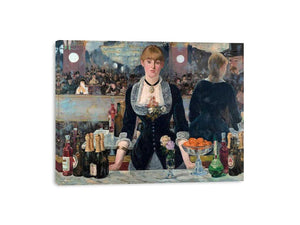
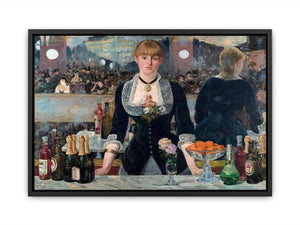
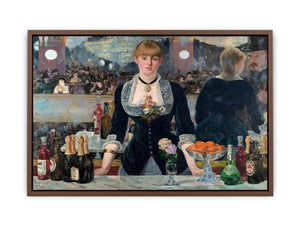
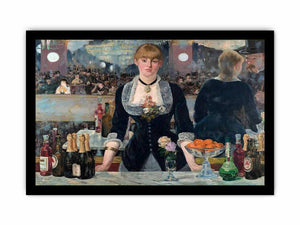
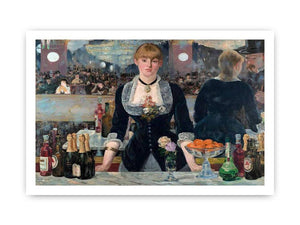
The Bar at the Folies-Bergère 1882 Painting by Édouard Manet
The Bar at the Folies-Bergère stands as one of the most intellectually provocative and psychologically layered paintings of the late nineteenth century, a work in which Édouard Manet confronted the complexities of modern urban life with unprecedented clarity. Painted in 1882, during the final year of Manet’s life, the painting operates simultaneously as portrait, social document, and philosophical inquiry. It captures not merely a scene from Parisian nightlife, but a condition of modern existence defined by spectacle, exchange, and emotional distance.
By the early 1880s, Manet had long established himself as a disruptive force within French art. Although often associated with the Impressionists, he maintained a deliberate independence, grounding his work in direct engagement with contemporary life while resisting the dissolution of form. The Bar at the Folies-Bergère reflects this position precisely. It is modern in subject and sensibility, yet formally rigorous and conceptually exacting. Here, Manet turns his attention to one of Paris’s most celebrated entertainment venues, the Folies-Bergère, a space emblematic of leisure, consumption, and performance.
At the centre of the composition stands a barmaid, facing the viewer directly. Her expression is restrained, her posture upright, her presence unmistakably solid. She is framed by a marble counter laden with bottles, fruit, and glassware—objects rendered with clarity and weight. Behind her stretches a vast mirror, reflecting the crowded interior of the music hall, with its chandeliers, performers, and patrons. This mirror is not a passive device; it is the painting’s conceptual engine, destabilising perception and challenging the viewer’s position.
The most striking feature of the painting is its deliberate ambiguity of perspective. The reflection in the mirror does not align neatly with the barmaid’s frontal position. Her reflected figure appears shifted, engaged with a male patron whose presence is implied rather than fully confirmed. This spatial inconsistency is not an error but a calculated disruption. Manet fractures conventional logic to emphasise psychological truth over optical correctness. The viewer becomes aware that seeing, in modern life, is never neutral or complete.
Compositionally, the painting is built on balance and tension. The barmaid anchors the foreground with solidity and stillness, while the reflected background dissolves into movement and noise. Vertical lines—bottles, columns, the figure herself—stabilise the surface, while the mirror introduces depth that is simultaneously expansive and unreliable. The viewer is caught between intimacy and detachment, invited close by the figure’s direct gaze yet held at a distance by the glassy barrier of reflection.
Light plays a crucial role in shaping this experience. Artificial illumination from chandeliers floods the scene, flattening shadows and creating a sheen across surfaces. Unlike natural light, this illumination reveals without warmth. Faces glow pale, objects gleam sharply, and the space feels exposed rather than comforting. Manet uses this light to strip away illusion, presenting nightlife not as romance, but as visibility without connection.
Colour is handled with remarkable restraint and intelligence. Muted blacks, creams, silvers, and soft flesh tones dominate the palette, punctuated by subtle accents of green and amber in the bottles. These colours reinforce the painting’s emotional coolness. There is no exuberant chromatic display. Instead, colour functions structurally, supporting form and atmosphere rather than expressionistic effect. The result is a surface that feels composed and detached, mirroring the emotional tenor of the scene.
Manet’s brushwork is economical and assured. Objects are described with just enough specificity to establish presence, while peripheral figures dissolve into suggestion. This hierarchy of attention mirrors the experience of urban life, where some things demand focus while others pass by indistinctly. The barmaid herself is rendered with particular solidity, reinforcing her role as the painting’s psychological centre.
Symbolically, The Bar at the Folies-Bergère operates as a meditation on modern exchange. The barmaid stands between consumer and commodity, presence and performance. She is both an individual and a function, her role defined by service and display. Yet Manet refuses to reduce her to type. Her expression resists easy interpretation. She appears neither inviting nor rejecting, neither content nor overtly discontented. This ambiguity grants her dignity, allowing her interiority to remain intact rather than consumed by spectacle.
Emotionally, the painting is restrained but unsettling. Viewers often sense a quiet tension beneath its polished surface. The crowd behind the barmaid is lively, yet she remains isolated. The mirror multiplies images but does not create intimacy. Manet captures the paradox of modern social life: proximity without closeness, visibility without understanding. The painting does not judge this condition; it presents it with unflinching honesty.
Within Manet’s career, The Bar at the Folies-Bergère represents a culminating statement. It synthesises his lifelong engagement with modernity, his challenge to pictorial conventions, and his commitment to psychological truth. Painted as his health declined, the work carries a sense of final clarity, as though Manet were distilling his vision into a single, uncompromising image.
Culturally, the painting stands as a cornerstone of modern art. It anticipates twentieth-century concerns with alienation, representation, and the instability of perception. Its influence extends beyond painting into broader cultural discourse, shaping how artists and thinkers understood the relationship between individual and society in an age of mass entertainment.
In contemporary interiors, The Bar at the Folies-Bergère offers exceptional intellectual and visual presence. In living rooms, it functions as a focal point that invites sustained engagement and conversation. In studies and offices, it communicates cultural depth and critical awareness. In galleries and refined residences across the United States, United Kingdom, Canada, Australia, and Europe, the painting integrates seamlessly with modern, minimalist, and eclectic décor. Its restrained palette complements contemporary spaces, while its conceptual richness anchors them with authority.
The enduring relevance of The Bar at the Folies-Bergère lies in its clarity. Manet presents modern life without embellishment, revealing its surfaces, reflections, and quiet distances. The painting reminds viewers that beneath spectacle lies complexity, and beneath visibility lies uncertainty. In confronting these truths with compositional discipline and psychological insight, Manet created a work that continues to define what it means to paint modernity.
Buy museum qulaity 400- 450 canvas prints, framed prints, and 100% oil paintings of The Bar at the Folies-Bergere 1882 by Edouard Manet at Alpha Art Gallery, where world-famous masterpieces are recreated with museum-quality detail, refined craftsmanship, and premium materials.
FAQS
What does The Bar at the Folies-Bergère depict?
It depicts a barmaid standing before a mirror in a Parisian music hall, presenting both her direct presence and a complex reflected scene of nightlife.
Why is the mirror so important in this painting?
The mirror disrupts perspective and challenges perception, highlighting emotional distance and the instability of modern experience.
Who is the central figure in the painting?
The central figure is a barmaid, portrayed with dignity and psychological ambiguity rather than as a decorative type.
Why does the perspective feel unsettling?
Manet deliberately altered spatial logic to prioritise psychological truth over optical accuracy.
What themes does the painting explore?
It explores modernity, spectacle, alienation, and the tension between visibility and intimacy.
Is this painting considered one of Manet’s final works?
Yes, it was painted in 1882, the year of Manet’s death, and is often seen as a summative statement of his art.
Is The Bar at the Folies-Bergère suitable for contemporary interiors?
Yes, its restrained palette and conceptual depth make it ideal for modern and intellectually curated spaces.
Why does the painting remain relevant today?
Its examination of social interaction, performance, and emotional distance continues to resonate in contemporary culture.