The Awakening of Adonis 1900 Painting by John William Waterhouse
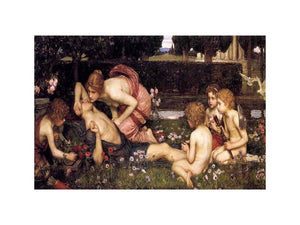
The Awakening of Adonis 1900 Painting by John William Waterhouse is a luminous meditation on desire, rebirth, and the fragile boundary between mortality and eternal love. Painted at the turn of the twentieth century, the work draws upon classical mythology to explore themes that preoccupied Waterhouse throughout his career: the tension between passion and fate, the beauty of youthful vitality, and the poignancy of love shaped by inevitable loss. In this painting, myth is not distant or monumental; it is intimate, tender, and profoundly human.
The artist, John William Waterhouse, belonged to the late Pre-Raphaelite tradition, yet his work resists strict categorisation. By 1900, Waterhouse had forged a personal synthesis of classical mythology, Romantic emotion, and a distinctly modern psychological sensitivity. The Awakening of Adonis emerges from this mature phase, when narrative clarity gave way to emotional atmosphere and mythological subjects became vessels for inner states rather than moral lessons.
The subject is drawn from Greek mythology. Adonis, a figure of extraordinary beauty loved by Aphrodite, embodies the cycle of life, death, and renewal. In myth, his life is tragically short, yet his return from death symbolises rebirth and the persistence of desire beyond loss. Waterhouse chooses not to depict Adonis in heroic action or divine transformation. Instead, he focuses on a moment of awakening—Adonis rising gently from sleep or death, stirred by love rather than command. This choice reframes myth as emotional experience rather than epic narrative.
Compositionally, the painting is serene and concentrated. Adonis reclines in the foreground, his youthful body rendered with soft naturalism, while a female figure—often interpreted as Aphrodite or a nymph-like embodiment of love—leans toward him with quiet intensity. Their closeness forms the emotional core of the composition. There is no dramatic gesture, no violent interruption. The scene unfolds slowly, as if time itself has softened in deference to intimacy.
Perspective reinforces this tenderness. The figures occupy a shallow, enclosed space that brings the viewer into close proximity with the moment. There is little sense of expansive landscape or mythic distance. Instead, Waterhouse creates a private world, encouraging contemplation rather than spectacle. The viewer becomes witness to a moment that feels almost sacred in its quietness.
Light in The Awakening of Adonis is diffused and caressing. It falls gently across flesh, fabric, and foliage, creating a dreamlike atmosphere that blurs the boundary between sleep and wakefulness, life and death. There is no harsh contrast, no dramatic chiaroscuro. Light functions as emotional temperature, warming the scene and suggesting renewal without proclamation.
The color palette is characteristically Waterhouse: soft greens, muted earth tones, and delicate flesh hues harmonised with subtle floral accents. These colors evoke springtime and regeneration, reinforcing the mythological theme without literal symbolism. The environment feels alive yet restrained, echoing the idea of awakening as gradual emergence rather than sudden transformation.
Waterhouse’s technique is fluid and controlled. Brushwork is smooth, with particular attention given to the modeling of the human body and the tactile quality of skin and fabric. The figures are idealised but not abstracted; they retain physical weight and emotional presence. Surrounding natural elements—leaves, flowers, and ground—are suggested rather than meticulously detailed, ensuring that attention remains focused on the human exchange at the heart of the work.
Symbolically, the painting operates on multiple levels. Adonis represents youth, beauty, and the vulnerability of life itself. His awakening is both literal and metaphorical: a return from death, a resurgence of desire, and a reaffirmation of love’s power over oblivion. The female figure embodies not dominance but devotion. Love here is restorative rather than possessive. Waterhouse avoids the fatalism often associated with the Adonis myth, choosing instead to dwell in the fragile moment before loss reasserts itself.
Psychologically, the painting is marked by stillness and anticipation. There is no certainty about what follows this awakening. The viewer is aware of Adonis’s fate, yet Waterhouse suspends that knowledge, allowing the present moment to exist fully. This suspension creates emotional poignancy. The painting is not about tragedy itself, but about the fleeting grace that precedes it.
Within Waterhouse’s broader oeuvre, The Awakening of Adonis aligns with his sustained engagement with mythological lovers and transitional states. Like Echo and Narcissus, Psyche Opening the Golden Box, and The Lady of Shalott, it explores moments where destiny pauses and consciousness shifts. Yet this work is gentler than many of his others. It lacks overt drama, favouring intimacy and emotional quietude, revealing Waterhouse’s increasing interest in inward states at the dawn of the twentieth century.
Culturally, the painting reflects fin-de-siècle fascination with myth as psychological metaphor. At a time when classical narratives were being reinterpreted through symbolism and emerging ideas about the unconscious, Waterhouse’s Adonis becomes less a mythic hero and more an emblem of human vulnerability and longing. The painting resonates not through narrative resolution, but through emotional recognition.
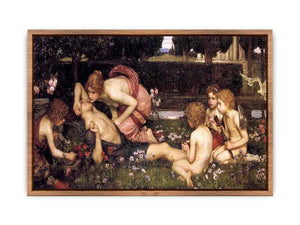
In contemporary interiors across the United States, the United Kingdom, Canada, Australia, and Europe, The Awakening of Adonis integrates with exceptional sensitivity and elegance. In living rooms, it introduces warmth, romance, and contemplative beauty. In bedrooms and private studies, it resonates with themes of intimacy and renewal. In galleries and luxury residences, it anchors space with poetic calm, harmonising effortlessly with traditional, modern, minimalist, and eclectic décor through its balanced composition and subdued palette.
The painting remains meaningful today because it speaks to universal human experience. Awakening—whether emotional, spiritual, or physical—is rarely dramatic. It is often quiet, uncertain, and deeply personal. Waterhouse captures this truth with rare empathy. The Awakening of Adonis does not assert mythological grandeur. It honours tenderness.
The Awakening of Adonis 1900 Painting by John William Waterhouse endures as a refined expression of love’s restorative power and the beauty of transitional moments. Through lyrical composition, gentle light, and emotional restraint, Waterhouse transforms ancient myth into a timeless meditation on renewal, desire, and fragile grace. The painting does not resolve the story. It preserves the moment.
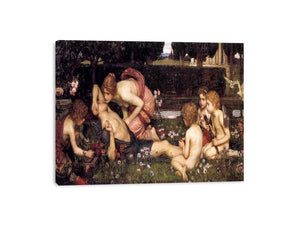
Buy museum qulaity 400- 450 canvas prints, framed prints, and 100% oil paintings of The Awakening of Adonis by John William Waterhouse at Alpha Art Gallery, where world-famous masterpieces are recreated with museum-quality detail, refined craftsmanship, and premium materials.
FAQs
What mythological story does The Awakening of Adonis depict?
It depicts a moment inspired by the myth of Adonis, focusing on his awakening and symbolic return to life through love.
Who is the female figure beside Adonis?
She is commonly interpreted as Aphrodite or a symbolic embodiment of love and devotion.
Why is the painting so calm and intimate?
Waterhouse chose to emphasise emotional awakening rather than dramatic mythological action.
What themes does the painting explore?
It explores renewal, desire, vulnerability, and the transient nature of life and love.
How does this work fit into Waterhouse’s career?
It belongs to his mature period, marked by psychological subtlety and lyrical treatment of myth.
Is the painting tragic or hopeful?
It is quietly hopeful, focusing on renewal while acknowledging underlying fragility.
Why does the painting remain relevant today?
Its meditation on awakening and emotional connection resonates across cultures and eras.
Where does this artwork work best in interiors?
It is ideal for living rooms, bedrooms, studies, galleries, and spaces seeking romance and contemplative beauty.