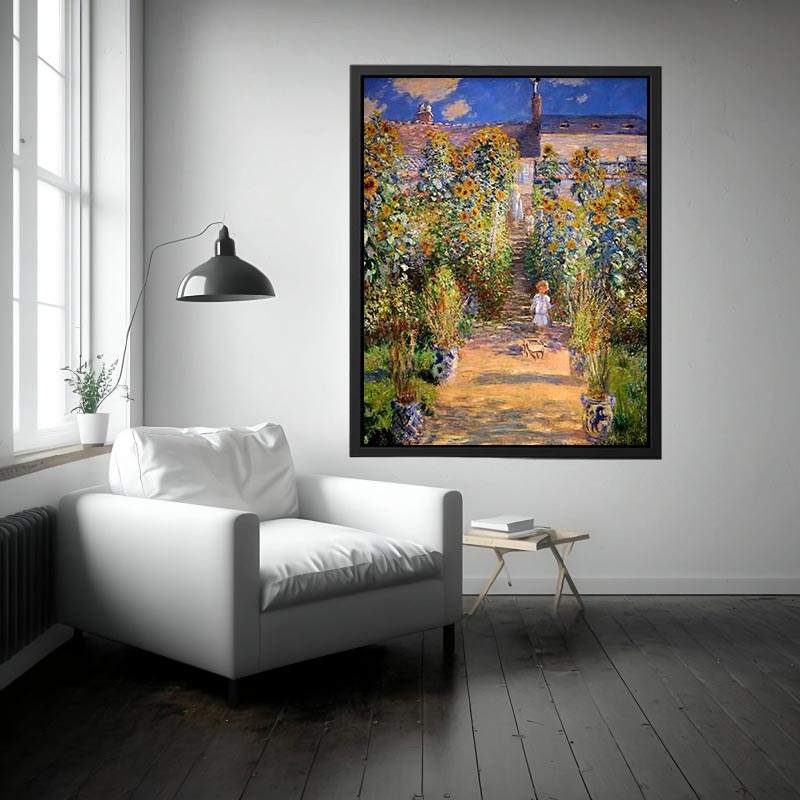
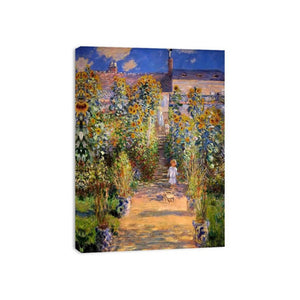
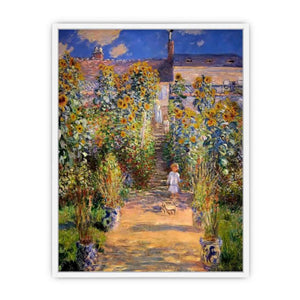
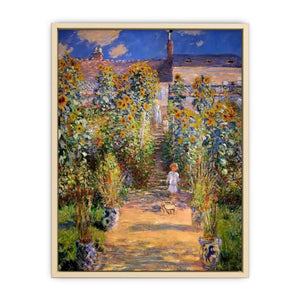
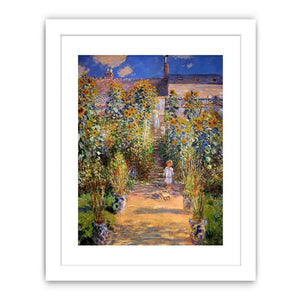
The Artist’s Garden at Vétheuil 1880 Painting by Claude Monet
The Artist’s Garden at Vétheuil stands as one of Claude Monet’s most introspective and quietly resilient works, a painting in which cultivated nature becomes both refuge and field of perceptual inquiry. Painted in 1880, during a period marked by personal hardship and artistic determination, the work reveals Monet’s deepening commitment to observation as a means of coherence. Here, the garden is neither a decorative motif nor a symbol of ease. It is a lived environment—shaped by care, attention, and time—translated into paint through colour, light, and rhythmic structure.
Vétheuil, a village on the Seine northwest of Paris, became Monet’s home during years of financial instability and emotional strain. Unlike the later garden at Giverny, designed with deliberate artistic intent, the garden at Vétheuil was modest and practical, cultivated under constraint. Yet it offered Monet something essential: a stable subject close at hand, one that changed with the seasons and responded sensitively to light. In The Artist’s Garden at Vétheuil, Monet turns inward, allowing the immediate surroundings of daily life to sustain sustained visual exploration.
The composition is dense yet ordered. Flower beds occupy much of the pictorial field, their abundance arranged without rigid symmetry. Paths and patches of foliage guide the eye gently through the scene, creating a sense of movement without imposing direction. Monet avoids centring a single focal point, encouraging the viewer to move across the surface in a manner akin to walking through the garden itself. The painting feels inhabited rather than staged, its structure emerging organically from observation.
Perspective is intimate and grounded. Monet positions the viewer at garden level, close enough to register texture and variation without losing overall coherence. Depth is suggested through overlapping forms and tonal modulation rather than through linear recession. Flowers in the foreground assert colour and presence, while those further back soften into atmosphere. Space unfolds through proximity rather than distance, reinforcing the sense of immersion.
Light plays a unifying and stabilising role. Sunlight filters across foliage and blossoms without dramatic contrast, allowing colour to remain the primary vehicle of form. Monet resists strong shadow, favouring diffuse illumination that binds elements together. The garden appears fully present within a single luminous condition, as though observed during a sustained moment of attention rather than a fleeting effect. Light here clarifies relationships rather than isolating objects.
Colour is handled with sensitivity and restraint despite the garden’s natural abundance. Greens dominate the palette, modulated through countless variations that suggest leaf density, reflected light, and depth. Accents of red, pink, yellow, and white emerge among the flowers, punctuating the field without overwhelming it. Monet allows colours to interact relationally, ensuring harmony through balance rather than contrast. The result is richness without excess, vitality contained within structure.
Monet’s brushwork is open and responsive. Individual strokes remain visible, particularly in foliage and blossoms, where short, broken touches convey growth and movement. Flowers are suggested rather than described, their forms emerging through clustered colour rather than detailed outline. This approach preserves immediacy, aligning the painting’s surface with the act of looking. The garden appears alive because it resists completion.
Symbolically, The Artist’s Garden at Vétheuil avoids allegory. While gardens have often served as emblems of order or retreat, Monet does not frame this space as an idealised sanctuary. Instead, the garden is presented as work and presence—something tended, observed, and lived within. Meaning arises through continuity rather than symbolism. The painting suggests persistence: the daily act of attention sustained through difficulty.
Emotionally, the work conveys quiet resolve. There is no overt joy or melancholy, but a steady attentiveness that feels grounding. Viewers often experience the painting as intimate and stabilising, drawn into its rhythm rather than its narrative. The absence of figures heightens this effect, allowing the viewer’s own presence to enter the scene. The garden becomes a place of looking rather than a scene to interpret.
Within Monet’s artistic evolution, this painting marks an important transition. It anticipates his later, more deliberate garden studies at Giverny while retaining the immediacy and modest scale of his earlier domestic subjects. The Artist’s Garden at Vétheuil demonstrates Monet’s growing reliance on serial observation and cultivated motifs as means of sustained inquiry. It shows him refining a language capable of turning continuity itself into subject.
Culturally, the work reflects a broader shift in modern art toward the everyday as a site of seriousness. By treating his own garden as worthy of sustained attention, Monet challenged inherited hierarchies that privileged grand landscapes or historical themes. The painting aligns art with lived experience, asserting that meaning emerges through attention rather than through exceptional events.
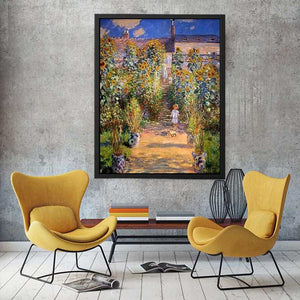
In contemporary interiors, The Artist’s Garden at Vétheuil integrates with exceptional warmth and adaptability. In living rooms, it introduces colour and depth without visual weight. In bedrooms and private spaces, it fosters calm and continuity. In studies and offices, it offers visual richness tempered by balance, encouraging sustained focus. Across interiors in the United States, United Kingdom, Canada, Australia, and Europe, the painting complements traditional, modern, minimalist, and eclectic décor alike. Its natural palette harmonises easily with contemporary materials, while its density rewards close viewing.
The enduring relevance of The Artist’s Garden at Vétheuil lies in its affirmation of attention as endurance. Monet demonstrates that care—given daily, quietly—can yield profound visual coherence. The painting endures not because it depicts an ideal garden, but because it embodies a way of seeing rooted in persistence and presence. In observing a cultivated space shaped by necessity and care, Monet offers a work that continues to resonate as a meditation on continuity, resilience, and the quiet intelligence of looking.
Buy museum qulaity 400- 450 canvas prints, framed prints, and 100% oil paintings of The Artist’s Garden at Vétheuil 1880 by Claude Monet at Alpha Art Gallery, where world-famous masterpieces are recreated with museum-quality detail, refined craftsmanship, and premium materials.
FAQS
What does The Artist’s Garden at Vétheuil by Claude Monet depict?
It depicts Monet’s garden at his home in Vétheuil, observed as a lived, cultivated space shaped by light and colour.
Why is Vétheuil significant in Monet’s life?
Vétheuil was Monet’s home during a period of personal and financial hardship, making the garden a central, accessible subject.
Is this painting symbolic of retreat or escape?
No, it is primarily observational, presenting the garden as a space of daily attention rather than idealised refuge.
How does Monet organise the composition?
Through overlapping flower beds and paths that guide the eye organically rather than through strict symmetry.
What role does light play in the painting?
Light is diffuse and unifying, allowing colour relationships to define form without strong shadow.
Are individual flowers meant to be identified?
No, Monet suggests flowers collectively through colour and brushwork rather than botanical detail.
Is The Artist’s Garden at Vétheuil representative of Monet’s mature style?
It represents a transitional moment, anticipating his later garden-focused work while retaining early intimacy.
Is this artwork suitable for contemporary interiors?
Yes, its balanced composition and natural palette suit a wide range of modern and traditional spaces.
Why does The Artist’s Garden at Vétheuil remain relevant today?
Its focus on everyday care, continuity, and attentive seeing continues to resonate with modern viewers.