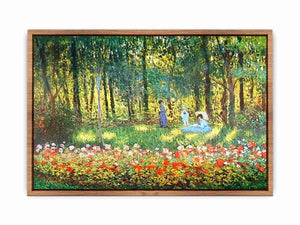
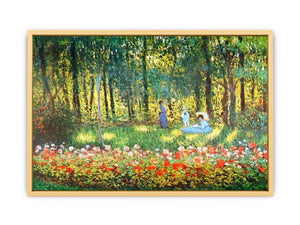
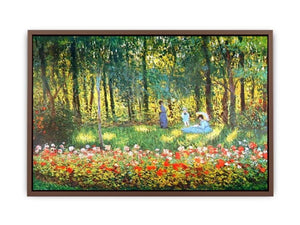
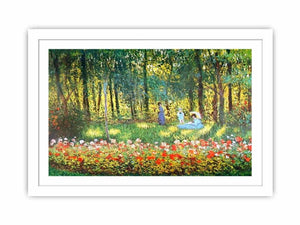
The Artist’s Family in the Garden Painting by Claude Monet
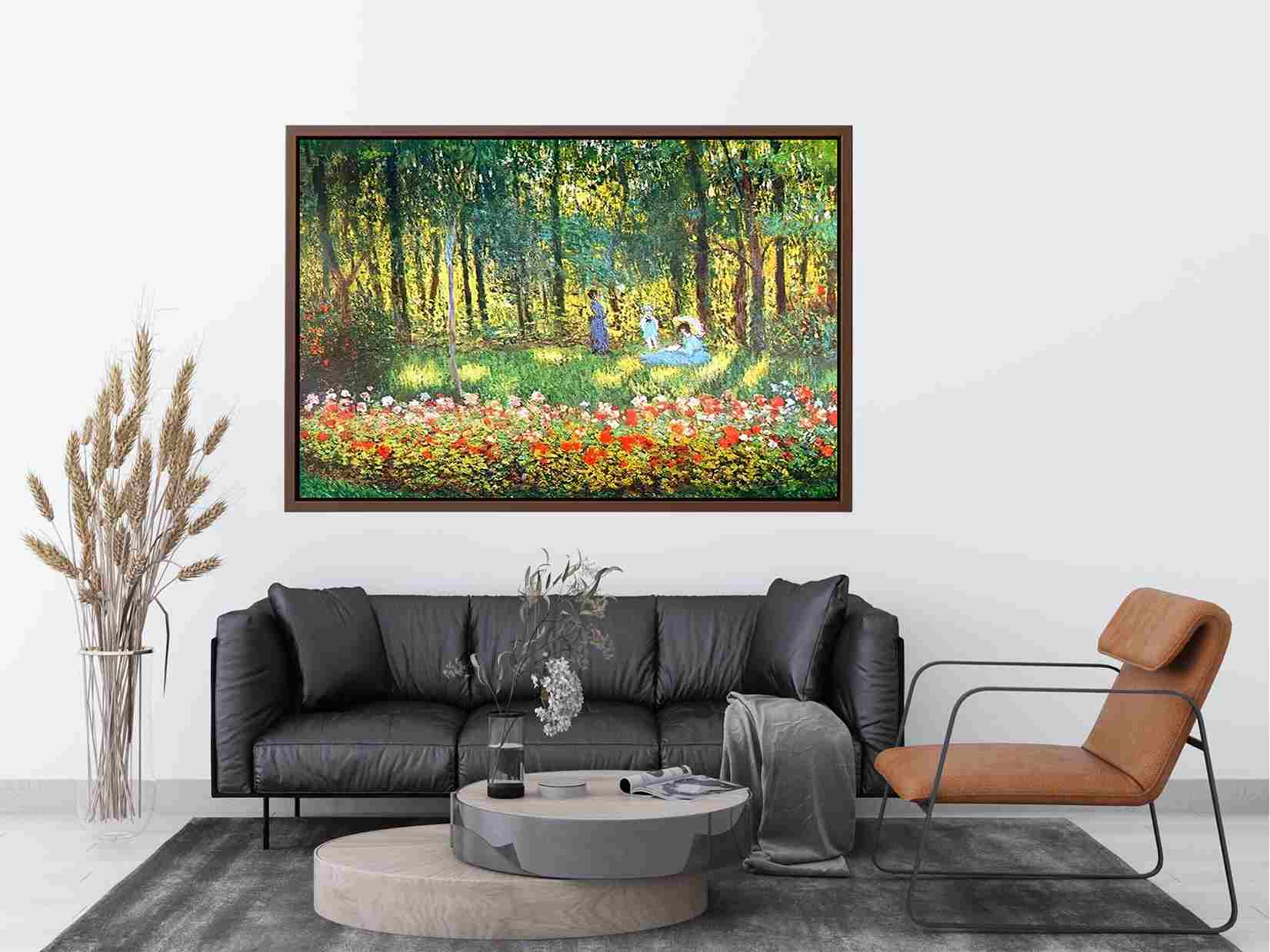
The Artist’s Family in the Garden stands as one of Claude Monet’s most intimate and quietly radical works, a painting in which domestic life, landscape, and modern perception converge into a unified visual experience. Painted in 1874, at a moment when Monet was actively redefining both his art and his personal circumstances, the work reflects a decisive shift in how family, environment, and everyday life could be treated within serious painting. Rather than presenting a formal portrait or a staged scene, Monet offers a lived moment—unposed, temporal, and inseparable from light and atmosphere.
By the early 1870s, Monet had committed fully to the principles that would soon be recognised as Impressionism. He rejected studio-bound idealisation in favour of direct observation, visible brushwork, and contemporary subject matter. The garden, particularly when inhabited by his own family, offered a setting where these commitments could coexist naturally. In The Artist’s Family in the Garden, Monet does not elevate domestic life through symbolism or sentiment. He observes it as part of the natural world, subject to the same conditions of light, movement, and change as trees, grass, and sky.
The composition is structured yet fluid. Figures are distributed across the garden space without hierarchical emphasis, integrated into the surrounding greenery rather than isolated from it. Monet avoids central focus, allowing the viewer’s eye to move freely across the canvas, guided by colour and rhythm rather than narrative. The garden itself occupies as much visual importance as the people within it, reinforcing the idea that human presence is one element among many in the field of perception.
Perspective is informal and experiential. Monet situates the viewer within the garden rather than at a distance, encouraging a sense of participation rather than observation. Depth is created through overlapping forms, tonal variation, and the placement of figures at different distances, not through rigid linear construction. Space unfolds naturally, mirroring how vision operates when moving through a familiar outdoor environment. The scene feels entered rather than framed.
Light plays a central, unifying role. Sunlight filters gently through foliage and across figures, clarifying form without dramatic contrast. There are no sharp shadows or theatrical effects. Instead, light operates as a condition that binds everything together, softening edges and dissolving boundaries between figure and ground. Monet captures the sensation of a bright day not through intensity, but through coherence—everything appears visible, yet nothing is rigidly defined.
Colour is handled with sensitivity and restraint. Greens dominate the palette, modulated through countless variations that suggest depth, texture, and reflected light. Clothing introduces subtle notes of colour that punctuate the scene without asserting dominance. Monet avoids strong contrasts, allowing harmony to arise through proximity and repetition. Colour functions relationally, ensuring that figures remain part of the garden rather than standing apart from it.
Monet’s brushwork is open, confident, and visibly present. Individual strokes remain legible, particularly in foliage and grass, where short, broken touches suggest movement and growth. Figures are rendered with economy, their forms suggested rather than detailed. This refusal of finish aligns with Monet’s commitment to immediacy. The painting records the act of looking as much as it records what is seen. It feels alive because it resists closure.
Symbolically, The Artist’s Family in the Garden resists traditional interpretations of domestic life. There is no overt narrative of intimacy, hierarchy, or sentiment. Instead, Monet presents family as part of the environment—present, active, yet unremarked. The painting suggests a modern understanding of family life as integrated into daily rhythms rather than idealised apart from them. Meaning arises through coexistence rather than allegory.
Emotionally, the work conveys calm attentiveness. There is no dramatic interaction, no posed gesture inviting interpretation. The figures occupy themselves quietly, absorbed in their surroundings. This restraint allows the painting to feel genuine rather than staged. Viewers often experience a sense of ease and familiarity, as though witnessing a moment that continues beyond the frame rather than one arranged for display.
Within Monet’s artistic evolution, this painting occupies a significant place. Created in the same year as the first Impressionist exhibition, it demonstrates how radically Monet had redefined the possibilities of subject matter and technique. Domestic life, once reserved for genre painting or portraiture, becomes here a site of perceptual inquiry. The painting shows Monet extending Impressionist principles beyond landscape into the fabric of everyday existence.
Culturally, The Artist’s Family in the Garden reflects a broader transformation in nineteenth-century art. It challenges inherited hierarchies that separated private life from serious artistic consideration. By treating his own family and garden as worthy subjects, Monet aligned art with modern experience—personal, immediate, and unidealised. The work anticipates later developments in modern art that would further dissolve distinctions between public and private, subject and environment.
In contemporary interiors, The Artist’s Family in the Garden integrates with exceptional warmth and sophistication. In living rooms, it introduces a sense of life and continuity without visual intrusion. In dining areas and shared spaces, it reinforces openness and quiet sociability. In studies and offices, it offers visual balance and calm, encouraging sustained attention rather than distraction. Across interiors in the United States, United Kingdom, Canada, Australia, and Europe, the painting complements traditional, modern, minimalist, and eclectic décor alike. Its natural palette and human presence create a sense of inhabitation rather than display.
The enduring relevance of The Artist’s Family in the Garden lies in its affirmation of the everyday as meaningful. Monet demonstrates that intimacy does not require emphasis, and that modern life, when observed with patience and clarity, carries its own quiet depth. The painting endures not because it records a specific family moment, but because it captures a way of seeing—one in which human presence and natural environment exist in continuous dialogue. In doing so, Monet created a work that continues to resonate as a meditation on perception, domestic life, and the gentle intelligence of attention.
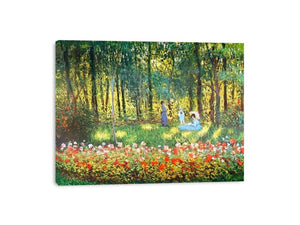
Buy museum qulaity 400- 450 canvas prints, framed prints, and 100% oil paintings of The Artist’s Family in the Garden by Claude Monet at Alpha Art Gallery, where world-famous masterpieces are recreated with museum-quality detail, refined craftsmanship, and premium materials.
FAQS
What does The Artist’s Family in the Garden by Claude Monet depict?
It depicts Monet’s family within a garden setting, integrated naturally into the surrounding landscape.
Why is this painting considered important in Monet’s career?
It shows Monet applying Impressionist principles to domestic life, expanding the scope of modern subject matter.
Is the painting a formal family portrait?
No, it avoids posed portraiture, presenting family members as part of everyday life and environment.
How does Monet use light in this work?
Light is diffuse and unifying, softening boundaries between figures and garden rather than creating contrast.
What role does the garden play in the composition?
The garden functions as an equal presence to the figures, shaping rhythm, space, and perception.
Is the painting symbolic or observational?
It is primarily observational, with meaning arising from attention rather than allegory.
Is The Artist’s Family in the Garden suitable for contemporary interiors?
Yes, its balanced composition and natural palette suit a wide range of modern and traditional spaces.
Why does The Artist’s Family in the Garden remain relevant today?
Its portrayal of everyday life, intimacy, and perceptual attentiveness continues to resonate with modern viewers.