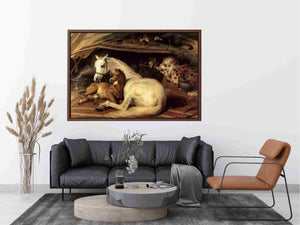
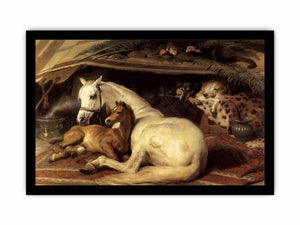
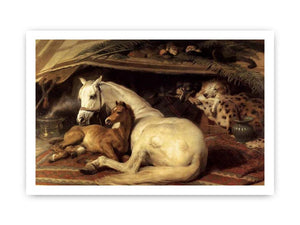
The Arab Tent 1866 Painting by Sir Edwin Henry Landseer
The Arab Tent stands as one of Sir Edwin Henry Landseer’s most evocative and quietly contemplative works, a painting in which cultural encounter, dignity, and restrained observation replace spectacle and theatricality. Completed in 1866, the work belongs to Landseer’s later period, when his technical assurance was matched by an increasing sensitivity to atmosphere, character, and the ethical responsibilities of representation. Known widely for his mastery of animal subjects and for works steeped in British identity, Landseer here turns his attention to a setting beyond Europe, approaching it not as exotic display but as a space of ordered calm and human presence.
By the mid-nineteenth century, Sir Edwin Henry Landseer had achieved extraordinary prominence in British art. His reputation rested on his ability to convey intelligence, emotion, and moral gravity through composition and gesture. In The Arab Tent, these qualities are redirected toward an unfamiliar cultural environment. Rather than dramatise difference, Landseer emphasises composure and structure, presenting the tent not as a theatrical backdrop but as a lived space governed by its own logic and dignity.
The tent itself forms the compositional anchor of the painting. Its fabric enclosure creates an interior defined by shelter and order, a temporary architecture that stands in contrast to the vast openness often associated with desert imagery. Landseer treats this structure with respect, allowing its form to guide the organisation of figures and objects within. The tent is neither romanticised nor diminished; it is presented as functional, grounded, and quietly authoritative.
Human figures within the scene are rendered with restraint. They are not posed for narrative effect, nor do they perform for the viewer’s gaze. Instead, they appear absorbed in their own presence, inhabiting the space naturally. Landseer avoids overt storytelling, choosing instead to capture a moment of stillness. This choice is crucial to the painting’s tone. The absence of dramatic action allows the viewer to attend to posture, proximity, and atmosphere rather than incident.
Animals, a subject central to Landseer’s artistic identity, are integrated seamlessly into the composition. They are not symbols or accessories, but participants in the environment. Their placement reinforces the sense of continuity between human and animal life, a theme Landseer explored throughout his career. Here, that continuity takes on a cross-cultural dimension, suggesting shared rhythms of care, rest, and attentiveness.
Compositionally, The Arab Tent is balanced and contained. Landseer resists the temptation to open the scene outward toward expansive vistas. Instead, he draws the viewer inward, into the shaded interior of the tent. This inward focus fosters intimacy and concentration. The viewer is positioned not as a distant observer of a foreign scene, but as a respectful witness to a moment of quiet habitation.
Light plays a central role in shaping the painting’s emotional register. Illumination enters the tent softly, filtering across surfaces rather than striking them directly. This diffused light creates gentle transitions between shadow and form, reinforcing the sense of shelter and repose. The contrast between interior shade and exterior brightness is suggested rather than emphasised, allowing the painting to maintain tonal harmony.
Colour is subdued and naturalistic. Landseer employs a restrained palette of earth tones, muted fabrics, warm browns, and softened highlights. These colours do not assert themselves individually; they work collectively to establish atmosphere. The absence of vivid contrast or decorative excess reinforces the painting’s seriousness and respect. Colour here serves observation rather than embellishment.
Landseer’s brushwork is controlled and precise, yet never rigid. Textures are carefully differentiated: fabric appears pliant and worn, animal forms possess weight and presence, and ground surfaces feel solid underfoot. This technical sensitivity contributes to the painting’s realism without pushing it toward documentary literalism. The surface invites close looking, rewarding attention with nuance rather than spectacle.
Symbolically, The Arab Tent can be understood as a meditation on encounter without domination. In an era when representations of non-European cultures were often filtered through imperial spectacle, Landseer adopts a notably restrained approach. He neither idealises nor diminishes his subject. Instead, he presents a space governed by its own order, suggesting stability, continuity, and self-sufficiency. The tent becomes a symbol not of transience alone, but of adaptive permanence.
Emotionally, the painting conveys calm and attentiveness. There is no tension, no implied conflict, no dramatic exchange. This emotional restraint is deliberate. Landseer invites the viewer to slow perception, to observe rather than interpret hastily. The result is an image that feels grounded and humane, resisting both sentimentality and distance.
Within Landseer’s broader body of work, The Arab Tent represents an extension of his ethical realism into a broader cultural field. While his animal paintings often explored loyalty, intelligence, and moral presence, this work applies similar values to a human environment shaped by different traditions. It reflects an artist confident enough to allow unfamiliar subjects to remain dignified without explanation.
The painting’s relevance today is significant. In a contemporary world increasingly attentive to questions of representation, cultural respect, and shared humanity, The Arab Tent offers a model of quiet observation. Viewers across the United States, the United Kingdom, Canada, Australia, and Europe continue to respond to its refusal to sensationalise difference. The work speaks through atmosphere rather than assertion, encouraging empathy grounded in attentiveness.
In interior settings, The Arab Tent brings composure and depth. In living rooms, it establishes a mood of calm reflection and cultural curiosity. In studies and offices, it reinforces values of observation, restraint, and respect. In galleries and luxury residences, it communicates discernment and an appreciation for nineteenth-century works that transcend their historical moment through ethical clarity.
The painting integrates naturally into traditional, modern, minimalist, and eclectic décor. Traditional interiors resonate with its painterly discipline and historical gravity. Modern spaces benefit from its subdued palette and compositional containment, which introduce warmth without clutter. Minimalist environments find contrast in its textural richness, while eclectic settings draw coherence from its measured tone.
The enduring importance of The Arab Tent lies in its quiet authority. Landseer does not seek to define or explain the culture he depicts. He allows presence to speak for itself. This refusal to overdetermine meaning gives the painting its lasting strength. It remains meaningful because it models a way of seeing grounded in respect rather than appropriation.
To live with The Arab Tent is to engage daily with a work that honours stillness, dignity, and attentive observation. Through its balanced composition, subdued colour, and humane restraint, Sir Edwin Henry Landseer created a painting that transcends its moment. It stands as a testament to the power of art to bridge cultures not through spectacle, but through care and clarity of vision.
Buy museum qulaity 400- 450 canvas prints, framed prints, and 100% oil paintings of The Arab Tent by Sir Edwin Henry Landseer at Alpha Art Gallery, where world-famous masterpieces are recreated with museum-quality detail, refined craftsmanship, and premium materials.
FAQS
What is the central theme of The Arab Tent?
The painting explores dignity, restraint, and attentive observation, presenting cultural encounter through calm presence rather than spectacle.
How does this work differ from more exoticised nineteenth-century scenes?
Landseer avoids dramatization and idealisation, focusing instead on atmosphere, order, and lived space.
Why is the tent such an important element in the composition?
The tent creates a contained, ordered interior that anchors the scene and emphasises shelter, continuity, and habitation.
Are animals symbolically important in this painting?
They reinforce continuity between human and animal life, a recurring theme in Landseer’s work, without becoming allegorical excess.
Is The Arab Tent suitable for contemporary interiors?
Yes. Its subdued palette and composed atmosphere integrate seamlessly into modern, traditional, and minimalist spaces.
What emotional atmosphere does the painting create?
It conveys calm, attentiveness, and quiet dignity rather than drama or tension.
Does this artwork have lasting cultural value?
As a thoughtful late work by Landseer, it holds enduring artistic and cultural significance.
Where is the best place to display this painting?
It is especially effective in living rooms, studies, offices, and gallery environments where reflection and cultural sensitivity are valued.