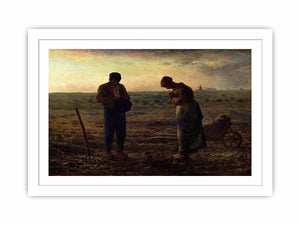
The Angelus, 1857–59 Painting by Jean François Millet
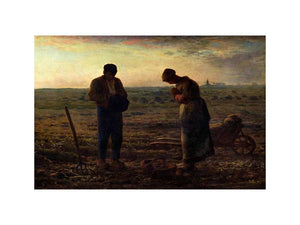
The Angelus, 1857–59 Painting by Jean François Millet is one of the most quietly profound images in nineteenth-century art, a painting in which labor, faith, humility, and time are distilled into a single moment of shared silence. Created during the artist’s mature period at Barbizon, the work transcends genre painting to become a meditation on human dignity and spiritual consciousness embedded within everyday life. Rather than dramatizing belief or elevating rural existence into sentimentality, Millet presents a moment of stillness so restrained and sincere that it achieves monumental gravity through simplicity alone.
The artist behind this enduring vision, Jean François Millet, was among the most significant figures of the Barbizon School, a movement committed to representing rural life with honesty and moral seriousness. Millet’s work consistently focused on peasants and agricultural laborers, not as picturesque subjects, but as embodiments of endurance, humility, and continuity. In The Angelus, these values reach their most distilled expression. The painting does not narrate an event; it suspends time, allowing the viewer to witness a moment in which work and belief coexist without hierarchy.
The scene depicts two peasants—a man and a woman—standing in a harvested field at dusk. Their tools rest beside them, the soil bears the marks of labor, and the distant church bell has called them to prayer. They pause, bow their heads, and stand in silent devotion as the Angelus prayer is traditionally recited at evening. There is no overt gesture of drama or piety. Faith here is habitual, internal, and inseparable from daily existence. Millet presents belief not as spectacle, but as rhythm.
Compositionally, the painting is remarkably restrained and stable. The two figures are placed centrally yet modestly within the landscape, their vertical forms echoed by the upright pitchfork and basket. This subtle symmetry creates balance without rigidity. The horizon line sits low, allowing the vast sky to occupy much of the canvas, reinforcing the sense of openness and quiet infinity. The figures do not dominate the land; they belong to it. Scale is handled with humility, underscoring human smallness without insignificance.
Perspective is naturalistic and unforced. Millet does not manipulate space to elevate the figures or dramatize the setting. The field stretches gently into the distance, dissolving into soft atmospheric haze. This recession creates a sense of continuity rather than separation, suggesting that the figures’ moment of prayer is part of an ongoing cycle rather than an isolated act. The viewer is positioned at a respectful distance, neither intruding nor detached, invited to observe without interruption.
Light plays a crucial emotional role in The Angelus. The scene is bathed in the subdued glow of twilight, a transitional hour between labor and rest, day and night. Millet uses soft, diffused illumination to unify sky, land, and figures. There are no sharp contrasts or theatrical shadows. Light functions as atmosphere rather than emphasis, enveloping the scene in quiet reverence. The fading day reinforces the painting’s contemplative tone, aligning natural cycles with spiritual rhythm.
The color palette is deliberately muted and earthy. Browns, ochres, grays, and soft blues dominate the composition, reflecting the material reality of rural life. Color is never decorative. It is structural and emotional, grounding the figures within their environment. The subdued tones enhance the painting’s seriousness and timelessness, ensuring that nothing distracts from the act of pause and reflection at its core.
Millet’s technique is direct and purposeful. Brushwork is visible yet controlled, particularly in the rendering of soil and sky. The figures are modeled with solidity rather than refinement, their forms shaped by labor rather than elegance. Faces are not individualized through detailed features but through posture and gesture. This restraint reinforces the painting’s universal quality. The figures are specific yet archetypal, representing countless lives shaped by work and belief.
Symbolically, The Angelus operates with extraordinary economy. The church bell is unseen but powerfully present, its sound implied rather than depicted. The tools resting on the ground signify labor temporarily suspended, not abandoned. The bowed heads suggest humility without submission. Even the empty basket has been read as a quiet emblem of need and perseverance. Millet does not insist on interpretation; he allows meaning to accumulate naturally through association and context.
Psychologically, the painting is defined by calm and inwardness. The figures do not interact with one another overtly, yet their shared posture establishes a profound sense of unity. This is not private devotion performed side by side; it is collective consciousness enacted in silence. Millet captures a moment in which individuals are momentarily released from labor without escaping it, affirming a balance between duty and reflection.
Within Millet’s broader body of work, The Angelus represents a refinement rather than a departure. Earlier paintings such as The Gleaners emphasize physical endurance and social reality. Here, Millet extends that focus into the spiritual dimension without abandoning realism. The painting asserts that faith and labor are not opposing forces, but intertwined aspects of rural existence. This synthesis elevates the work beyond social commentary into philosophical reflection.
Culturally, The Angelus has assumed iconic status, interpreted variously as a symbol of rural piety, social humility, national identity, and existential contemplation. Its influence extends across art, literature, and philosophy, inspiring responses that range from reverence to critical analysis. Yet the painting itself remains resolutely quiet. It does not declare ideology. It observes a moment that feels both deeply specific and universally human.
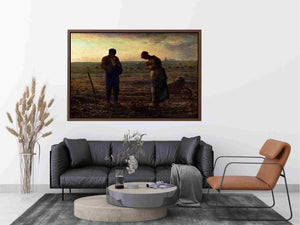
In contemporary interiors across the United States, the United Kingdom, Canada, Australia, and Europe, The Angelus brings exceptional calm, gravity, and emotional resonance. In living rooms, it introduces a sense of grounding and reflection. In studies and offices, it communicates discipline, humility, and continuity. In galleries and luxury residences, it anchors space with moral seriousness and historical depth. Its restrained palette and balanced composition allow it to integrate seamlessly into traditional, modern, minimalist, and eclectic décor.
The painting remains meaningful today because it speaks to enduring human needs: the need to pause, to acknowledge forces greater than oneself, and to find dignity within work rather than escape from it. In a world defined by speed and constant output, The Angelus offers a counterpoint—a reminder that stillness can carry as much meaning as action. Millet does not idealize hardship. He honors endurance.
The Angelus, 1857–59 Painting by Jean François Millet endures as one of the most quietly powerful works in Western art. Through compositional restraint, atmospheric subtlety, and moral clarity, Millet transformed a fleeting rural ritual into a timeless meditation on labor, faith, and human presence. The painting does not instruct. It pauses—and invites the viewer to do the same.
Buy museum qulaity 400- 450 canvas prints, framed prints, and 100% oil paintings of The Angelus by Jean François Millet at Alpha Art Gallery, where world-famous masterpieces are recreated with museum-quality detail, refined craftsmanship, and premium materials.
FAQS
What moment does The Angelus depict?
It depicts two peasants pausing their fieldwork at dusk to pray the Angelus, marking a moment of spiritual reflection within daily labor.
Why is this painting considered so important?
It elevates ordinary rural life into a universal meditation on dignity, faith, and time without sentimentality.
Is The Angelus a religious painting or a social one?
It is both, presenting faith as an integral part of everyday existence rather than a separate religious spectacle.
Why are the figures shown so simply?
Millet avoids idealization to emphasize humility, endurance, and universality rather than individual identity.
What role does the landscape play in the painting?
The open field and expansive sky reinforce continuity, stillness, and the rhythm of rural life.
Why does the painting feel so calm?
The subdued light, muted palette, and restrained composition create a mood of silence and reflection.
How does The Angelus fit into Millet’s career?
It represents the mature synthesis of his focus on labor, realism, and moral seriousness.
Where does this artwork work best in interiors?
It is ideal for living rooms, studies, offices, galleries, and spaces seeking calm, dignity, and timeless meaning.