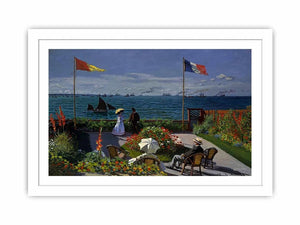
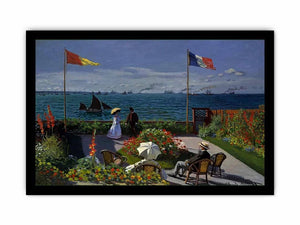
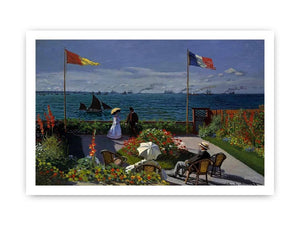
Terrace at the Seaside, Sainte-Adresse Painting by Claude Monet
Terrace at the Seaside, Sainte-Adresse stands as one of Claude Monet’s most lucid early declarations of modern vision, a painting in which landscape, leisure, and social presence are organised through light, colour, and carefully calibrated perception. Painted in 1867, before the formal emergence of Impressionism, the work reveals an artist already dismantling academic conventions and replacing them with an experiential understanding of how the world is seen. Here, Monet does not dramatise the seaside or romanticise the coast; he presents a cultivated terrace overlooking the English Channel as a site where nature, modern leisure, and visual order converge.
Sainte-Adresse, a fashionable seaside resort near Le Havre, was closely connected to Monet’s personal life. His family maintained a residence there, and the location offered a vantage point over the open sea that differed markedly from the rural and riverine environments he would later explore. In Terrace at the Seaside, Sainte-Adresse, Monet engages with a social space shaped by bourgeois leisure and order. Yet he approaches it without narrative emphasis or moral commentary. The painting is not about who the figures are or what they represent socially; it is about how colour, space, and light articulate a modern environment.
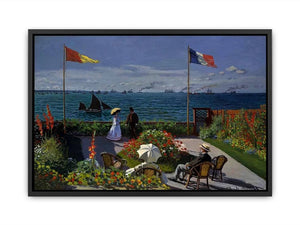
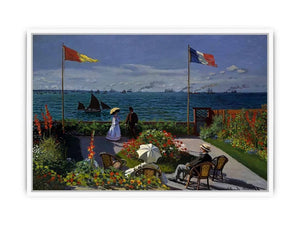
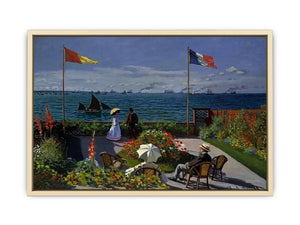
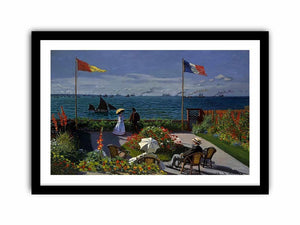
The composition is strikingly structured. The terrace occupies the foreground, its geometric order defined by railings, flowerbeds, and carefully placed figures. Beyond this constructed space, the sea stretches outward in horizontal bands of colour, meeting the sky at a distant horizon. Monet establishes a clear contrast between cultivated foreground and open expanse, yet he binds them visually through rhythm and chromatic harmony. The viewer’s eye moves from the solidity of the terrace to the fluidity of the sea without rupture, guided by colour rather than line.
Perspective is deliberate and controlled. Monet situates the viewer slightly above the terrace, offering a commanding but not dominating view. Depth is organised through horizontal layering rather than linear recession. The terrace, the sea, and the sky each occupy distinct zones, yet none overwhelms the others. This clarity of spatial organisation reflects Monet’s early engagement with structure, even as he moves away from academic finish toward perceptual immediacy.
Light plays a central role in defining the painting’s atmosphere. Sunlight is clear and even, illuminating figures, flowers, and sea without dramatic shadow. Monet avoids theatrical contrasts, allowing light to articulate form gently. The brightness of the day is conveyed through colour relationships rather than intensity. Everything appears visible, ordered, and open, reinforcing the sense of calm leisure that defines the scene.
Colour is handled with exceptional intelligence. The vivid reds of the flowers in the foreground provide strong chromatic anchors, counterbalanced by the blues and greens of the sea and sky. Monet uses these colours structurally, not decoratively. Reds intensify surrounding greens, while cool blues stabilise the composition and extend visual depth. The palette is fresh and confident, revealing Monet’s early understanding that colour could organise space as effectively as line.
Monet’s brushwork, while more restrained than in his later Impressionist works, already signals a break from academic polish. Strokes remain visible, particularly in the foliage and sea, preserving the sense of immediacy. The water is rendered through horizontal touches that suggest movement and depth without detailed description. Figures are painted with clarity but without psychological emphasis, their presence contributing to scale and rhythm rather than narrative focus.
Symbolically, Terrace at the Seaside, Sainte-Adresse resists allegorical interpretation. The figures—often identified as members of Monet’s family—are not portrayed as characters in a story. They are elements within a visual system, participating in the composition as much as the flowers or the sea. The painting’s significance lies in its articulation of modern leisure as a condition of space and perception rather than a social statement.
Emotionally, the work conveys composure and clarity. There is no sense of urgency, no dramatic tension. The scene feels stable and self-contained, yet open to the vastness beyond the terrace. Viewers often experience the painting as orderly and refreshing, its balance offering visual reassurance without rigidity. This emotional tone distinguishes the work from later Impressionist scenes that emphasise flux and transience.
Within Monet’s artistic evolution, Terrace at the Seaside, Sainte-Adresse occupies a crucial transitional position. It demonstrates his early mastery of colour and composition while pointing toward his later commitment to painting light and atmosphere directly from observation. The painting shows Monet negotiating between inherited structure and emerging perceptual freedom, a negotiation that would soon resolve decisively in favour of Impressionism.
Culturally, the painting reflects a moment when seaside leisure became an integral part of modern life. Coastal resorts symbolised new relationships between work, rest, and environment. Monet’s treatment avoids both celebration and critique. He observes the scene with neutrality, allowing the visual organisation itself to carry meaning. In doing so, he aligns painting with modern experience as lived rather than as narrated.
In contemporary interiors, Terrace at the Seaside, Sainte-Adresse integrates with exceptional elegance and authority. In living rooms, it introduces structure, colour, and openness without visual heaviness. In dining areas and shared spaces, it reinforces calm sociability and visual order. In studies and offices, it offers clarity and balance, supporting focus and reflection. Across interiors in the United States, United Kingdom, Canada, Australia, and Europe, the painting complements traditional, modern, minimalist, and eclectic décor alike. Its strong composition anchors space, while its luminous palette ensures enduring appeal.
The enduring relevance of Terrace at the Seaside, Sainte-Adresse lies in its affirmation of order without rigidity and leisure without spectacle. Monet demonstrates that modern life can be rendered with seriousness and beauty through attention to colour, space, and light. The painting endures not because it depicts a particular terrace or family, but because it captures a way of seeing—one that recognises harmony between constructed space and open horizon. In doing so, Monet created a work that continues to resonate as a meditation on balance, modernity, and the quiet intelligence of perception.
Buy museum qulaity 400- 450 canvas prints, framed prints, and 100% oil paintings of Terrace at the Seaside, Sainte-Adresse by Claude Monet at Alpha Art Gallery, where world-famous masterpieces are recreated with museum-quality detail, refined craftsmanship, and premium materials.
FAQS
What does Terrace at the Seaside, Sainte-Adresse by Claude Monet depict?
It depicts a cultivated seaside terrace overlooking the English Channel, combining figures, flowers, sea, and sky into a balanced modern scene.
Why is Sainte-Adresse significant in Monet’s life?
It was closely connected to his family and provided early opportunities to explore coastal light and space.
Is this painting considered Impressionist?
It predates full Impressionism but clearly anticipates its principles through colour, light, and perceptual focus.
How does Monet organise space in this work?
Through horizontal layering and strong colour relationships rather than dramatic linear perspective.
What role do the flowers play in the composition?
They provide vivid colour anchors that structure the foreground and balance the expansive sea beyond.
Are the figures central to the painting’s meaning?
They provide scale and rhythm but are integrated into the composition rather than treated narratively.
Is Terrace at the Seaside, Sainte-Adresse suitable for contemporary interiors?
Yes, its clarity, structure, and luminous palette suit a wide range of modern and traditional spaces.
Why does this painting remain relevant today?
Its balance of order, openness, and perceptual clarity continues to resonate with modern ways of seeing.