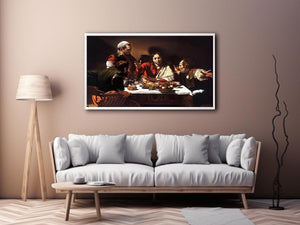
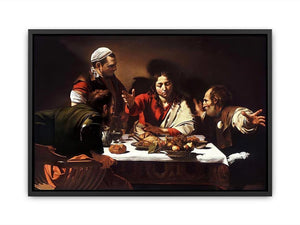
Supper at Emmaus 1601–02 Painting by Caravaggio
Supper at Emmaus stands as one of the most theatrically immediate and psychologically charged interpretations of resurrection in Western art, a painting in which Caravaggio transforms a moment of recognition into a visceral encounter between belief, doubt, and sudden revelation. Painted in 1601–1602, the work belongs to the most innovative phase of Caravaggio’s Roman career, when his mastery of chiaroscuro, radical naturalism, and narrative compression reached a point of unprecedented force. In this painting, the sacred does not announce itself with celestial grandeur; it erupts into ordinary space, startling both the figures within the scene and the viewer who stands before it.
Caravaggio chose the moment described in the Gospel of Luke when the resurrected Christ reveals himself to two disciples during a meal at Emmaus. Rather than depicting the journey, the conversation, or the miracle in abstract terms, he focuses on the instant of recognition—when Christ breaks the bread and is suddenly known. This narrative decision allows Caravaggio to explore revelation not as a gradual understanding, but as a shock that fractures routine and reorders perception. Faith arrives here not as doctrine remembered, but as truth recognised too late to be grasped again.
The composition is tightly staged, as if unfolding on a shallow proscenium. Christ sits at the centre of a modest table, his youthful face calm and composed, his gesture restrained yet decisive. On either side, the disciples react with explosive immediacy. One flings his arms outward, elbows projecting beyond the picture plane, while the other rises abruptly from his seat, his body twisted in astonishment. These gestures are not decorative; they are spatial interventions that collapse the distance between painting and viewer. Caravaggio deliberately breaks the frame, making the moment spill outward into the viewer’s space.
Perspective intensifies this effect. The table is pushed forward, its edge aligned close to the picture plane, creating the illusion that the still life of bread, fruit, and wine might topple into the room. This compositional strategy implicates the viewer directly. The miracle does not occur behind a barrier of pictorial distance; it unfolds at arm’s length. Caravaggio invites the viewer to share the disciples’ shock, to occupy the same physical and psychological space where recognition becomes unavoidable.
Light serves as the painting’s primary narrative engine. A strong, directional illumination falls across Christ and the reacting figures, carving them out of the surrounding darkness. This light does not merely model form; it reveals meaning. Christ’s face and hands are bathed in clarity, while the disciples’ features register surprise, disbelief, and dawning awareness. The background recedes into shadow, eliminating contextual distraction and concentrating attention on the human drama at the table. Light here functions as revelation made visible.
Colour is restrained and grounded, reinforcing the painting’s material immediacy. Earthy reds, muted greens, warm flesh tones, and deep browns dominate the palette. The garments are not idealised; they are worn, textured, and heavy. Christ’s red and white clothing anchors the composition symbolically and visually, yet it remains integrated into the physical world rather than elevated above it. Colour serves realism and emphasis without ornamental excess, aligning sacred narrative with lived experience.
Caravaggio’s handling of paint intensifies the sense of presence. Forms emerge from darkness with sculptural solidity, defined by light rather than line. The still-life elements on the table—bread, poultry, fruit—are rendered with startling tactility. Their abundance contrasts with the spiritual scarcity experienced by the disciples moments before recognition. The basket of fruit, precariously balanced at the table’s edge, functions as both compositional device and symbolic threshold, suggesting the fragility of understanding and the ease with which meaning can be lost.
Symbolically, Supper at Emmaus is rich without becoming allegorical. The act of breaking bread signifies communion and recognition, yet Caravaggio avoids overt symbolism in favour of embodied experience. Christ appears younger than expected, subtly challenging assumptions and reinforcing the theme of unrecognised presence. The innkeeper, often interpreted as oblivious to the miracle, remains composed and detached, underscoring the painting’s central tension: revelation is not universal; it is perceived only by those prepared to see.
Emotionally, the painting oscillates between stillness and eruption. Christ’s calm contrasts sharply with the disciples’ dramatic reactions, creating a charged equilibrium at the heart of the composition. This contrast heightens the psychological realism of the scene. Recognition is not portrayed as serene acceptance, but as disorienting shock. The painting captures the instant when certainty collapses and truth demands reorientation.
Within Caravaggio’s career, Supper at Emmaus represents a definitive articulation of his artistic philosophy. It unites his commitment to naturalism, his revolutionary use of light, and his insistence that sacred history must be rendered as lived experience. Unlike earlier Renaissance interpretations that emphasised ideal beauty or narrative clarity, Caravaggio offers immediacy and confrontation. The miracle is not explained; it is enacted.
Culturally, the painting stands as a cornerstone of Baroque art, exemplifying the movement’s emphasis on emotional engagement and sensory immediacy. Yet Caravaggio’s approach remains singular. He does not overwhelm with ornament or theatrical excess. Instead, he distils drama to its essentials, trusting gesture, light, and proximity to carry meaning. This restraint amplifies impact, allowing the painting to resonate across centuries and belief systems.
In contemporary interiors, Supper at Emmaus commands extraordinary presence. In living rooms, it functions as a powerful focal point that invites sustained attention and conversation. In studies and offices, it communicates intellectual depth, narrative gravity, and cultural literacy. In galleries and refined residences across the United States, United Kingdom, Canada, Australia, and Europe, the painting integrates seamlessly with traditional, modern, and minimalist décor. Its dark ground and concentrated light create visual focus without excess, anchoring space through meaning rather than decoration.
The enduring relevance of Supper at Emmaus lies in its understanding of recognition as fleeting and transformative. Caravaggio reminds viewers that truth often appears unannounced, that understanding can arrive in ordinary settings, and that the moment of knowing may pass as quickly as it comes. The painting does not comfort; it awakens. In rendering revelation as a sudden interruption of the everyday, Caravaggio created an image that continues to confront viewers with the unsettling possibility that meaning may already be present—waiting only to be recognised.
Buy museum qulaity 400- 450 canvas prints, framed prints, and 100% oil paintings of Supper at Emmaus 1601–02 by Caravaggio at Alpha Art Gallery, where world-famous masterpieces are recreated with museum-quality detail, refined craftsmanship, and premium materials.
FAQS
What moment does Supper at Emmaus by Caravaggio depict?
It depicts the instant when the resurrected Christ is recognised by his disciples during the breaking of bread.
Why are the disciples’ gestures so dramatic?
Their exaggerated reactions convey the shock and immediacy of sudden recognition.
What role does light play in the painting?
Light isolates the moment of revelation, guiding attention to Christ and the disciples’ responses.
Why is Christ shown as youthful and calm?
Caravaggio challenges expectations to reinforce the theme of unrecognised presence.
What is the significance of the still-life elements on the table?
They ground the miracle in everyday reality while symbolising abundance and fragility.
Who is the innkeeper, and why does he seem unaware?
The innkeeper represents those who witness events without perceiving their deeper meaning.
Is Supper at Emmaus suitable for contemporary interiors?
Yes, its dramatic focus and restrained palette suit both modern and traditional spaces.
Why does Supper at Emmaus remain relevant today?
Its exploration of recognition, doubt, and sudden understanding continues to resonate across cultures and eras.