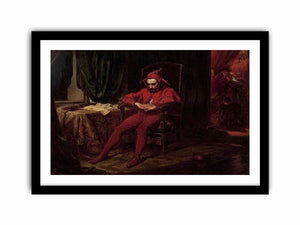
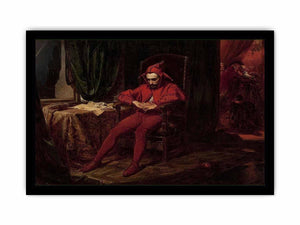
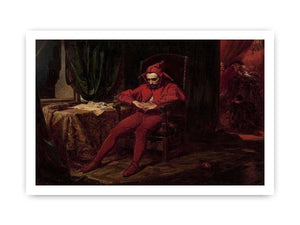
Stańczyk during a Ball at the Court of Queen Bona after the Loss of Smolensk Painting by Jan Matejko
Stańczyk during a Ball at the Court of Queen Bona after the Loss of Smolensk Painting by Jan Matejko is one of the most psychologically penetrating and morally demanding works in the history of European painting. Created in 1862, the work stands as a defining statement of Matejko’s artistic philosophy: that history painting is not merely the depiction of past events, but a vehicle for ethical judgment, national introspection, and intellectual responsibility. Through the solitary figure of a court jester burdened with knowledge, Matejko transforms a historical episode into a universal meditation on conscience, power, and the tragedy of ignored truth.
At the moment of its creation, Jan Matejko was beginning to emerge as the preeminent visual historian of Poland. Living in a country that had ceased to exist as an independent state, Matejko understood history as something urgently present rather than safely distant. His paintings were conceived as acts of remembrance and warning, intended to preserve cultural identity and provoke moral reflection. Stańczyk during a Ball at the Court of Queen Bona after the Loss of Smolensk is the earliest and most distilled expression of this mission.
The historical context of the painting refers to the year 1514, when Smolensk—a strategically vital fortress of the Polish–Lithuanian state—was lost to Muscovite forces. While the loss represented a major political and military failure, the royal court continued its celebrations, detached from the gravity of the event. Matejko deliberately avoids depicting the battlefield or the moment of defeat. Instead, he focuses on the psychological and moral aftermath: the catastrophic cost of indifference among those in power.
The central figure, Stańczyk, was a real historical court jester renowned not for buffoonery, but for sharp intellect and fearless commentary. In Polish cultural memory, Stańczyk evolved into a symbol of wisdom concealed beneath the mask of folly. Matejko elevates him into an archetype of national conscience. Seated alone in the foreground, motionless and withdrawn, Stańczyk becomes the sole figure capable of comprehending the magnitude of loss while the court behind him remains oblivious.
Compositionally, the painting is constructed around isolation and contrast. Stańczyk occupies the foreground, rendered with clarity and gravity, while the background opens onto a brightly lit ballroom where dancers move in celebration. This spatial division is not merely compositional but ethical. The foreground embodies awareness, responsibility, and grief; the background represents distraction, privilege, and denial. Matejko uses architectural depth to separate moral vision from moral blindness.
Perspective places the viewer in close proximity to Stańczyk, compelling an intimate encounter with his inner turmoil. The viewer is not invited to join the festivities, but to share the burden of knowledge. This forced alignment with the jester reverses social hierarchy: the lowest-ranking court figure becomes the highest moral authority. Matejko thus subverts traditional power structures, asserting that truth often resides outside formal authority.
Light functions as a psychological instrument rather than a decorative element. Stańczyk is illuminated with cool, focused clarity, revealing the tension in his posture and the gravity of his expression. The ballroom behind him glows with warm, diffused light, yet this brightness feels hollow and superficial. Illumination here does not signal truth; it exposes moral imbalance. The brightest space is the most ignorant, while understanding resides in shadowed solitude.
Color is employed with symbolic precision. Stańczyk’s red costume dominates the composition, saturated and intense. Red here signifies alarm, sacrifice, blood, and moral urgency. It isolates him visually and conceptually from the pastel elegance of the background figures. The court’s muted golds and creams suggest refinement and comfort, reinforcing the contrast between aesthetic pleasure and ethical failure.
Matejko’s technical execution is controlled and deliberate. Stańczyk’s figure is rendered with sculptural solidity, emphasizing physical and psychological weight. Surrounding objects are carefully chosen and meaning-laden. A letter bearing news of Smolensk’s loss lies discarded on the table, its presence quietly devastating. A globe nearby underscores the geopolitical implications of the event, reminding the viewer that this is not personal sorrow but national catastrophe.
Symbolism in the painting is understated yet relentless. There is no need for overt allegory. The entire scene functions as a moral equation: knowledge without power versus power without awareness. Stańczyk does not gesture or protest. His stillness is the painting’s most powerful accusation. Matejko suggests that the most dangerous failures in history are not caused by malice alone, but by indifference.
Psychologically, the painting is devastating in its restraint. Stańczyk’s despair is internalized, heavy, and solitary. He does not weep or rage. His sorrow is reflective, the sorrow of foresight unheeded. This emotional economy grants the painting its timeless quality. The viewer recognizes this condition across eras: the loneliness of understanding, the burden of being awake while others celebrate.
Within Matejko’s broader oeuvre, this work occupies a foundational position. While later paintings such as Battle of Grunwald would expand his vision to monumental scale, Stańczyk demonstrates his mastery of concentration and moral clarity. It proves that history painting can achieve profound impact without spectacle, relying instead on psychological truth.
The cultural importance of the painting within Poland is immense. Stańczyk became an enduring symbol of national conscience, referenced in literature, political thought, and public discourse. The painting established Matejko’s role not merely as an artist, but as a moral historian—someone who painted not what was comforting, but what was necessary.
In contemporary interiors across the United States, the United Kingdom, Canada, Australia, and Europe, Stańczyk during a Ball at the Court of Queen Bona after the Loss of Smolensk carries exceptional gravitas. In studies, libraries, and offices, it communicates ethical seriousness, historical awareness, and intellectual courage. In galleries and refined private residences, it anchors interiors with depth and psychological authority, integrating seamlessly with traditional, modern, minimalist, and eclectic décor.
The painting remains profoundly relevant today because its warning is universal. Societies continue to face moments when spectacle obscures consequence and leadership fails to listen. Matejko’s vision insists that awareness itself is a moral duty, and that silence in the face of loss is never neutral.
Stańczyk during a Ball at the Court of Queen Bona after the Loss of Smolensk Painting by Jan Matejko endures as one of the most intellectually courageous works in Western art. Through compositional rigor, symbolic discipline, and unparalleled psychological insight, Matejko transformed a historical episode into a timeless indictment of complacency. The painting does not shout. It sits, waits, and remembers.
Buy museum qulaity 400- 450 canvas prints, framed prints, and 100% oil paintings of Stańczyk during a Ball at the Court of Queen Bona after the Loss of Smolensk by Jan Matejko at Alpha Art Gallery, where world-famous masterpieces are recreated with museum-quality detail, refined craftsmanship, and premium materials.
FAQs
What historical event does this painting reference?
It references the 1514 loss of Smolensk, a major political and military defeat for the Polish–Lithuanian state.
Who was Stańczyk?
Stańczyk was a real court jester known for intelligence and moral insight, later symbolizing national conscience.
Why is Stańczyk shown alone?
His isolation represents the loneliness of awareness and responsibility amid widespread indifference.
What does the red costume symbolize?
It symbolizes warning, sacrifice, urgency, and moral alarm.
Why is the ball shown in the background?
The festivities represent political complacency and moral blindness among those in power.
Is this painting a political critique?
Yes, it is a powerful allegory criticizing leadership failure and ethical negligence.
Why does the painting remain relevant today?
Its themes of ignored warnings and moral responsibility are universal and timeless.
Where does this artwork work best in interiors?
It is ideal for studies, libraries, offices, galleries, and serious private collections.