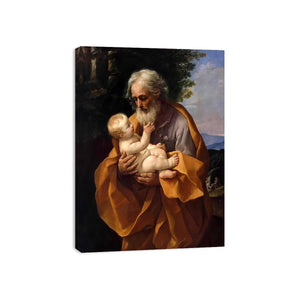
St Joseph with the Infant Jesus c. 1635 Painting by Guido Reni
St Joseph with the Infant Jesus c. 1635 Painting by Guido Reni is one of the most tender and spiritually lucid images of paternal devotion in seventeenth-century Italian painting, a work in which humility, care, and quiet authority are rendered with extraordinary refinement. Created during Reni’s mature period, the painting departs decisively from dramatic Baroque excess in favor of grace, balance, and emotional restraint. Rather than presenting sanctity through spectacle, Reni reveals it through intimacy, presenting Saint Joseph not as a distant patriarch but as a fully human figure whose strength lies in attentiveness and love.
The painter responsible for this luminous vision, Guido Reni, was widely celebrated in his lifetime for the purity and nobility of his style. Educated in Bologna and profoundly influenced by classical antiquity and Raphael, Reni developed an approach to sacred art that privileged harmony, idealized beauty, and moral clarity. By the 1630s, his work had evolved toward increasing serenity and spiritual concentration. St Joseph with the Infant Jesus stands as a quintessential expression of this late style, where emotional depth is achieved without theatrical display.
The subject reflects a growing devotional emphasis in Counter-Reformation Italy on Saint Joseph as a model of quiet virtue and responsible fatherhood. Earlier traditions had often relegated Joseph to the margins of the Holy Family, portraying him as aged or passive. Reni, by contrast, places him at the emotional center of the composition. Joseph is shown holding the Christ Child with gentle assurance, his posture protective yet unassuming. The scene does not narrate a specific biblical event. Instead, it offers a timeless meditation on care, trust, and guardianship.
Compositionally, the painting is intimate and concentrated. The figures are arranged closely, forming a compact, triangular structure that reinforces unity and stability. Joseph’s body inclines slightly toward the child, creating a visual and emotional bond that anchors the composition. There is no elaborate setting, no architectural framing, no narrative distraction. Reni strips the scene to its essence, allowing gesture and expression to carry meaning.
Perspective places the viewer at a respectful yet close distance, inviting contemplation rather than awe. The shallow space draws attention inward, focusing on the exchange between Joseph and the infant. This proximity fosters emotional immediacy while maintaining reverence. The viewer does not intrude upon the scene but witnesses it quietly, as one might observe a moment of private devotion.
Light is soft, enveloping, and deliberate. Reni avoids dramatic chiaroscuro, instead bathing the figures in a gentle illumination that enhances serenity. Joseph’s face and hands are rendered with particular clarity, emphasizing care and intention. The Christ Child’s flesh glows subtly, suggesting divinity through purity rather than spectacle. Light here signifies presence and understanding, not miraculous interruption.
The color palette is restrained and harmonious. Warm earth tones, gentle reds, and soft whites dominate the canvas, creating an atmosphere of calm and warmth. Joseph’s garments are dignified yet modest, reinforcing his role as humble guardian rather than exalted authority. Color functions as emotional support, reinforcing tenderness without sentimentality.
Reni’s technique is exemplary in its control and elegance. Brushwork is smooth and refined, suppressing visible gesture in favor of idealized form. Flesh is rendered with softness and restraint, avoiding dramatic emphasis. The figures possess a sculptural clarity that recalls classical statuary while remaining fully alive. This balance between idealization and humanity is central to the painting’s enduring appeal.
Symbolically, St Joseph with the Infant Jesus articulates a theology of care rooted in responsibility rather than power. Joseph does not command or instruct. He protects and supports. His authority is moral, not hierarchical. The Christ Child, calm and trusting, reinforces this vision of divine vulnerability entrusted to human care. Reni thus elevates ordinary virtues—patience, gentleness, vigilance—into sacred ideals.
Psychologically, the painting is marked by composure and affection. Joseph’s expression conveys attentiveness rather than exaltation. There is no dramatic emotion, no visible anxiety. The moment feels suspended, as if time itself has slowed to accommodate care. Reni’s restraint allows the viewer to experience sanctity as quiet presence rather than overwhelming force.
Within Reni’s broader oeuvre, this work exemplifies his mature devotional language, one that increasingly favored inwardness and purity over narrative drama. Compared to the dynamic martyrdoms and heroic saints of earlier Baroque painting, St Joseph with the Infant Jesus offers a vision of holiness grounded in everyday virtue. It reflects Reni’s belief that beauty, when disciplined and serene, could guide moral contemplation.
Culturally, the painting aligns with Counter-Reformation efforts to present sacred figures as accessible models of Christian life. Saint Joseph’s role as protector of the family resonated deeply in a period concerned with order, responsibility, and moral clarity. Reni’s image communicates these values without didactic symbolism, relying instead on emotional intelligibility.
In contemporary interiors across the United States, the United Kingdom, Canada, Australia, and Europe, St Joseph with the Infant Jesus brings warmth, balance, and contemplative depth. In living rooms, it introduces serenity and human connection. In studies and offices, it conveys responsibility, patience, and ethical steadiness. In galleries and luxury residences, it anchors space with classical refinement, integrating seamlessly into traditional, neoclassical, modern, and minimalist décor through its gentle palette and harmonious composition.
The painting remains meaningful today because it offers a vision of strength defined by care rather than dominance. In a world still negotiating the nature of authority and responsibility, Reni’s portrayal of Joseph presents a timeless alternative—one rooted in attentiveness, humility, and love. The painting does not instruct through command. It persuades through presence.
St Joseph with the Infant Jesus c. 1635 Painting by Guido Reni endures as one of the most tender and ethically resonant images of sacred fatherhood in Western art. Through compositional restraint, luminous calm, and psychological insight, Reni transformed a devotional subject into a timeless meditation on care, trust, and moral strength. The painting does not proclaim sanctity. It embodies it.
Buy museum qulaity 400- 450 canvas prints, framed prints, and 100% oil paintings of St Joseph with the Infant Jesus by Guido Reni at Alpha Art Gallery, where world-famous masterpieces are recreated with museum-quality detail, refined craftsmanship, and premium materials.
FAQs
What does St Joseph with the Infant Jesus depict?
It depicts Saint Joseph gently holding the Christ Child, emphasizing care, protection, and quiet devotion.
Why is this painting considered serene rather than dramatic?
Guido Reni deliberately avoids theatrical Baroque effects, favoring balance, softness, and clarity.
How is Saint Joseph characterized in this work?
He is portrayed as attentive, humble, and morally strong rather than authoritative or imposing.
What role does light play in the painting?
Soft, even light reinforces calm, understanding, and intimate presence.
How does this work reflect Counter-Reformation ideals?
It presents sacred figures as accessible moral models through clarity and emotional restraint.
Is the scene based on a specific biblical moment?
No, it is a timeless devotional image rather than a narrative episode.
Why does the painting remain relevant today?
Its vision of strength through care and responsibility resonates across cultures and eras.
Where does this artwork work best in interiors?
It is ideal for living rooms, studies, offices, galleries, and spaces seeking warmth and contemplative calm.