Spanish Dancer Painting by John Singer Sargent
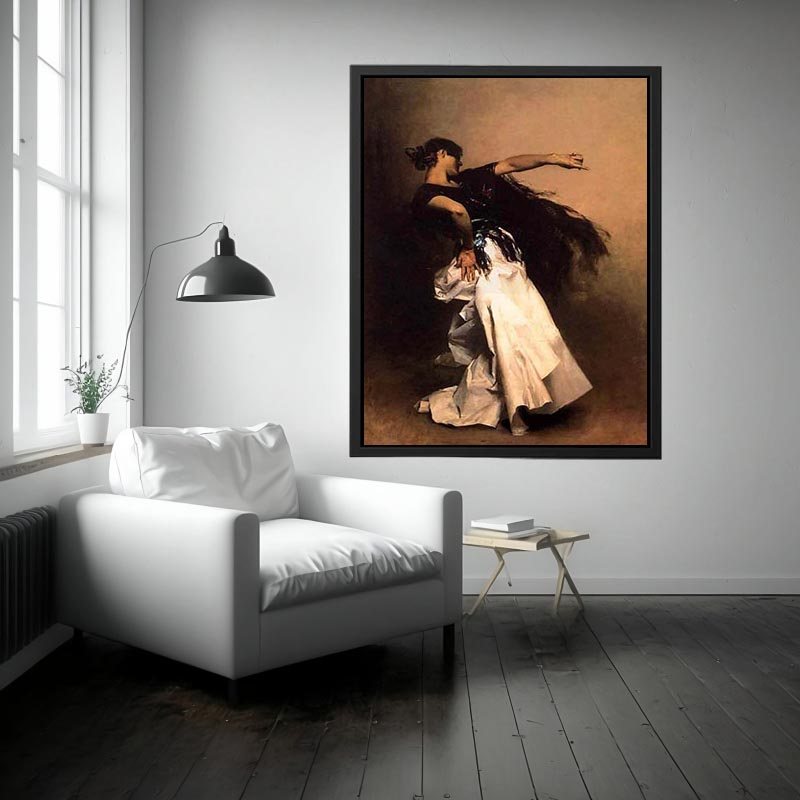
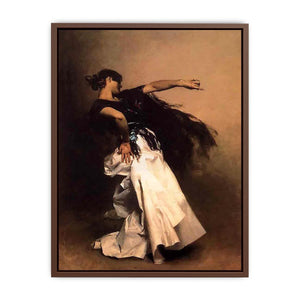
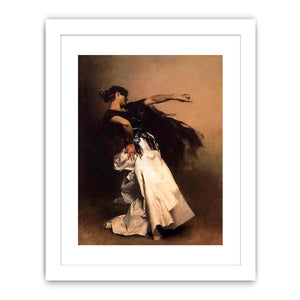
Spanish Dancer Painting by John Singer Sargent is a work of intense immediacy and cultural sensitivity, capturing movement not as spectacle but as embodied presence. Painted during Sargent’s extended engagement with Spain and Spanish performance traditions, the work reflects his rare ability to translate rhythm, gesture, and physical authority into painterly form. Rather than presenting dance as decorative entertainment, Sargent treats it as a disciplined, expressive language—one rooted in the body, tradition, and momentary force. The painting stands as a study of motion held in tension, poised between control and release.
At the time of this work, John Singer Sargent was already recognized as one of the most technically accomplished painters of his generation. Yet his fascination with Spanish culture revealed a different dimension of his artistic ambition. Spain offered Sargent an alternative to the restraint of Anglo-French society painting: a visual culture grounded in physicality, contrast, and intensity. Spanish Dancer emerges from this encounter not as an ethnographic curiosity, but as a serious artistic investigation into how the human body asserts meaning through movement.
The cultural context of the painting is essential. Spanish dance traditions—particularly flamenco and related forms—are built upon rigor, repetition, and expressive restraint rather than theatrical excess. Sargent understood this distinction. He does not depict applause, musicians, or narrative setting. The dancer is isolated, commanding the pictorial space through posture and gesture alone. This focus strips the scene of anecdote and centers attention on the act itself: the disciplined articulation of movement.
Compositionally, the painting is direct and concentrated. The dancer occupies the central field with undeniable authority, her form arranged to emphasize verticality, balance, and tension. Sargent avoids elaborate backgrounds or spatial depth, allowing the figure to dominate without competition. The composition is structured to hold motion still—capturing the precise instant when energy is gathered rather than expended. This restraint heightens intensity, making the painting feel charged rather than kinetic.
Perspective reinforces this immediacy. The viewer confronts the dancer at close range, neither elevated above nor distanced from her presence. This positioning eliminates the safety of spectatorship. One does not observe the dance from afar; one stands before it. The dancer’s posture asserts independence from the viewer’s gaze. She is not performing for admiration, but executing a practiced discipline. The painting conveys authority rather than invitation.
Light is used with clarity and purpose. Illumination falls decisively across the dancer’s form, defining structure and gesture without theatrical exaggeration. Shadows remain controlled, reinforcing solidity rather than mystery. Light here does not dramatize emotion; it articulates movement. Sargent uses illumination to carve form from space, allowing the dancer’s physical presence to register with sculptural force.
The color palette is restrained yet powerful. Dark tones anchor the figure, while lighter accents articulate fabric and limb. The limited palette prevents decorative distraction and focuses attention on structure and rhythm. Color functions as reinforcement rather than embellishment, emphasizing the physical reality of the dancer’s body and attire. This chromatic discipline aligns with the painting’s broader refusal of exotic spectacle.
Sargent’s technique is confident and economical. Brushwork is fluid where movement demands it and controlled where form must assert itself. Fabric is rendered with suggestive strokes that imply weight and motion without dissolving into abstraction. The handling of the figure reveals Sargent’s profound understanding of anatomy and balance. Nothing is arbitrary. Every mark contributes to the dancer’s authority within the frame.
Psychologically, the painting is resolute. The dancer does not emote outwardly. Her expression, if visible at all, remains focused and contained. This inward concentration reinforces the idea of dance as discipline rather than display. Sargent captures not performance anxiety or theatrical flourish, but mastery. The emotional force of the painting arises from control rather than excess.
Within Sargent’s broader oeuvre, Spanish Dancer aligns closely with works such as El Jaleo, yet it is more restrained, more introspective. Where El Jaleo confronts the viewer with collective energy and spectacle, Spanish Dancer isolates the individual act. It reveals Sargent’s capacity to move fluidly between monumentality and intimacy, between dramatic assertion and concentrated study.
Culturally, the painting stands apart from much nineteenth-century imagery of Spain, which often veered into romanticized exoticism. Sargent resists caricature. He presents the dancer not as symbol, but as practitioner—someone engaged in a rigorous cultural form with its own internal logic. This approach grants the work enduring ethical and artistic credibility.
In contemporary interiors across the United States, the United Kingdom, Canada, Australia, and Europe, Spanish Dancer commands presence through restraint rather than scale. In living rooms, it introduces rhythm, focus, and visual authority. In studies and offices, it conveys discipline, cultural seriousness, and embodied intelligence. In galleries and refined private residences, it anchors space with quiet intensity, integrating seamlessly into traditional, modern, minimalist, and eclectic décor.
The painting remains meaningful today because it honors physical intelligence in an era often dominated by abstraction and speed. Spanish Dancer reminds the viewer that mastery is visible, that discipline carries its own beauty, and that movement can be held—briefly—without losing force. The work does not narrate. It concentrates.
Spanish Dancer Painting by John Singer Sargent endures as a powerful meditation on movement, control, and cultural expression. Through compositional restraint, disciplined light, and extraordinary technical fluency, Sargent transformed a moment of dance into a timeless assertion of presence. The painting does not celebrate motion loudly. It holds it—firmly, deliberately, and with enduring authority.
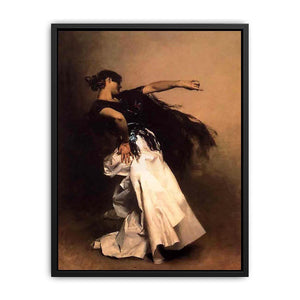
Buy museum qulaity 400- 450 canvas prints, framed prints, and 100% oil paintings of Spanish Dancer by John Singer Sargent at Alpha Art Gallery, where world-famous masterpieces are recreated with museum-quality detail, refined craftsmanship, and premium materials.
FAQs
What does Spanish Dancer depict?
It depicts a single dancer captured in a moment of poised movement, emphasizing discipline and presence rather than spectacle.
Is this painting connected to Spanish dance traditions?
Yes, it reflects Sargent’s deep engagement with Spanish performance culture and its emphasis on control and expression.
How does this differ from El Jaleo?
Unlike El Jaleo, which is theatrical and collective, Spanish Dancer is focused, restrained, and individual.
Why is the background so minimal?
The minimal setting isolates the dancer, directing full attention to movement and form.
How does Sargent convey motion without blur?
By capturing a moment of tension and balance rather than action at its peak.
Is this painting considered exoticizing?
No, it avoids romantic caricature and treats the subject with seriousness and respect.
Why does the painting remain relevant today?
Its focus on discipline, embodiment, and cultural integrity resonates strongly in contemporary art discourse.
Where does this artwork work best in interiors?
It is ideal for living rooms, studies, offices, galleries, and spaces that support focused visual engagement.