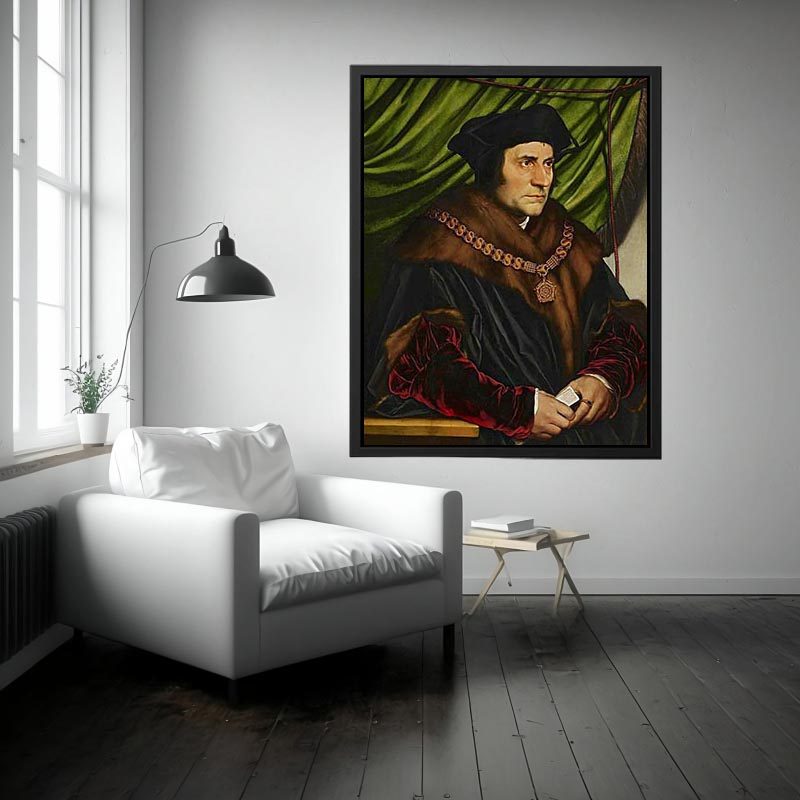
Sir Thomas More 1527 Painting by Hans the Younger Holbein
Sir Thomas More 1527 Painting by Hans the Younger Holbein stands as one of the most penetrating portraits of intellect and conscience in Renaissance art, a work in which humanist learning, political responsibility, and moral gravity are fused into a single, unforgettable image. Painted in 1527 during Holbein’s first stay in England, the portrait captures More at the height of his power and reputation, before his eventual fall from royal favor and execution. Holbein does not present a symbolic abstraction or an idealized statesman. He presents a thinking mind made visible—composed, alert, and burdened with ethical seriousness.
The painter responsible for this achievement, Hans Holbein the Younger, was among the most acute observers of character in European art. Trained in Basel and shaped by Northern Renaissance precision, Holbein brought to portraiture an unrivaled capacity for psychological insight and material exactitude. His arrival in England introduced a new standard of realism, one that combined minute surface detail with profound interior presence. The portrait of Sir Thomas More remains one of the clearest demonstrations of this synthesis.
The sitter, Thomas More, was one of the most influential thinkers of his age—lawyer, scholar, diplomat, and author of Utopia. In 1527, More was deeply embedded in the political life of Henry VIII’s court, serving as a trusted counselor and public intellectual. Holbein portrays him not in the act of governance but in the condition of contemplation, suggesting that authority, in its highest form, derives from thought rather than display.
Compositionally, the portrait is compact and deliberate. More is shown half-length, enclosed within a shallow space that draws attention inward rather than outward. His body is turned slightly, his gaze directed off to the side, creating a sense of interior engagement rather than theatrical address. Holbein avoids overt gesture. Authority here is expressed through stillness. The portrait’s structural restraint mirrors the sitter’s intellectual discipline.
Perspective reinforces intimacy without familiarity. The viewer stands close enough to observe detail yet remains at a respectful distance. More does not invite emotional access; he commands attention through presence. This controlled proximity reflects Holbein’s understanding of portraiture as a balance between revelation and reserve. The sitter is fully present, yet not exposed.
Light is soft, even, and clarifying. Holbein uses illumination to articulate form rather than to dramatize mood. The face is rendered with exceptional clarity, revealing lines of thought rather than signs of age alone. Flesh tones are natural, neither idealized nor harsh. Light serves cognition here, making the face legible as an instrument of reason.
The color palette is rich and disciplined. Deep greens, blacks, and warm browns dominate the composition, offset by the luminous texture of fur and the subtle sheen of fabric. These colors convey dignity and seriousness without austerity. Holbein’s control of tone reinforces hierarchy: the face and hands emerge with quiet emphasis, while garments frame rather than compete with them.
Holbein’s technique is extraordinary in its precision. Textures—fur, velvet, skin, and metal—are rendered with microscopic care, yet never become mere displays of virtuosity. Each material contributes to the portrait’s meaning. The heavy fur-lined robe signifies office and responsibility, while its weight seems to press inward, suggesting the burdens of public life. Holbein’s brushwork is invisible, suppressing artistic ego in service of truth.
Symbolically, the portrait operates through restraint rather than overt allegory. There are no books, no inscriptions, no classical references to announce learning or virtue. Instead, intellect is conveyed through posture, gaze, and composure. Holbein trusts the human face to carry meaning. This confidence is central to the portrait’s power. More’s authority is moral and intellectual, not performative.
Psychologically, the painting is remarkably complex. More appears alert yet inward, resolute yet reflective. There is no smile, no theatrical gravity. The expression suggests a man accustomed to weighing consequences, conscious of duty, and aware of moral limits. With historical hindsight, viewers often read the portrait as foreshadowing More’s eventual martyrdom. Yet Holbein does not impose tragedy. He presents presence—thought in equilibrium.
Within Holbein’s broader oeuvre, Sir Thomas More occupies a foundational position in his English portraits. It established his reputation among the Tudor elite and demonstrated a new model of portraiture grounded in psychological realism rather than emblematic display. Holbein’s later portraits of statesmen and courtiers would refine this approach, but none surpass the intellectual density achieved here.
Culturally, the painting stands at the intersection of Renaissance humanism and emerging modern statecraft. More embodies a moment when scholarship, conscience, and political service were understood as mutually reinforcing. Holbein’s portrait preserves that ideal at a moment just before it fractured under the pressures of absolutism and religious upheaval. The work thus carries historical poignancy without sentimentality.
In contemporary interiors across the United States, the United Kingdom, Canada, Australia, and Europe, Sir Thomas More 1527 conveys exceptional gravitas and refinement. In studies, libraries, and offices, it communicates intellectual seriousness, ethical reflection, and leadership grounded in principle. In galleries and luxury residences, it anchors space with quiet authority, integrating seamlessly into traditional, modern, minimalist, and eclectic décor through its restrained palette and compositional clarity.
The portrait remains meaningful today because it presents a vision of authority rooted in conscience rather than spectacle. In an age still negotiating the relationship between power and ethics, Holbein’s image of More offers a compelling alternative model—one in which thought precedes action and integrity defines status. The painting does not persuade. It endures.
Sir Thomas More 1527 Painting by Hans the Younger Holbein endures as one of the greatest portraits of moral and intellectual presence in Western art. Through compositional restraint, technical mastery, and psychological insight, Holbein transformed a statesman into a timeless image of conscience and reason. The painting does not assert power. It embodies it.
Buy museum qulaity 400- 450 canvas prints, framed prints, and 100% oil paintings of Sir Thomas More by Hans the Younger Holbein at Alpha Art Gallery, where world-famous masterpieces are recreated with museum-quality detail, refined craftsmanship, and premium materials.
FAQs
What does the portrait of Sir Thomas More emphasize?
It emphasizes intellect, conscience, and moral authority rather than outward power or display.
Why is this portrait historically important?
It captures a leading humanist at the height of influence before his political and personal downfall.
How does Holbein convey psychological depth?
Through restrained composition, controlled gaze, and subtle facial modeling.
Is the portrait symbolic or realistic?
It is profoundly realistic, relying on presence rather than overt symbolism.
What role does clothing play in the painting?
The garments signify office and responsibility while framing the sitter’s intellectual presence.
How does this work fit into Holbein’s career?
It established his reputation in England and defined his approach to portraiture.
Why does the painting remain relevant today?
Its vision of ethical leadership and thoughtful authority remains timeless.
Where does this artwork work best in interiors?
It is ideal for studies, libraries, offices, galleries, and spaces emphasizing intellect and integrity.