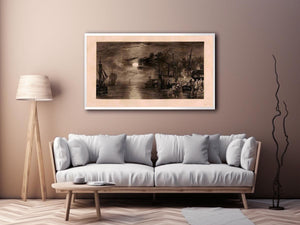
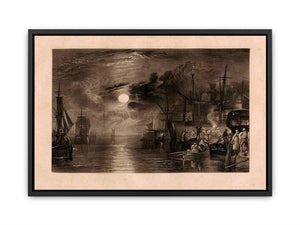
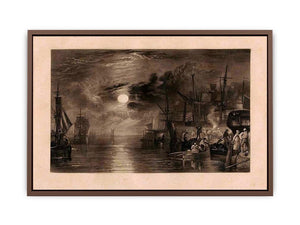
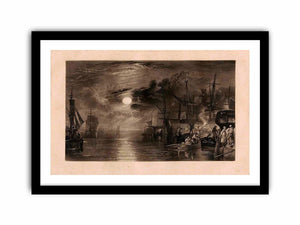
Shields, on the River Tyne Painting by Joseph Mallord William Turner
Shields, on the River Tyne Painting by Joseph Mallord William Turner is a work of quiet power and transitional significance, capturing a moment when Britain’s landscape, economy, and visual identity were being irreversibly reshaped by industry. Painted in the early nineteenth century, the work reflects Turner’s deep engagement with the working rivers of Britain—spaces where commerce, labor, light, and water intersect. Unlike his later, more overtly symbolic works, Shields, on the River Tyne speaks through observation and atmosphere, revealing Turner’s ability to extract poetry and meaning from places defined by function rather than spectacle.
At the time this painting was produced, Joseph Mallord William Turner was still closely associated with topographical and architectural subjects, yet already pushing beyond them. Turner had traveled extensively across Britain, recording ports, rivers, and industrial towns not simply as geographic records, but as living systems shaped by human ambition and natural forces. The River Tyne, with its dense traffic of coal ships and its role as a backbone of northern industry, offered Turner a subject perfectly aligned with his growing interest in the relationship between landscape and modern life.
The historical context of Shields, on the River Tyne is inseparable from Britain’s industrial transformation. North and South Shields were critical maritime centers, integral to coal export, shipbuilding, and trade. By choosing this location, Turner situates his painting within the realities of economic power and labor. Yet he resists reducing the scene to documentary illustration. Instead, he frames the river as a site of movement and atmosphere, where industry coexists with natural rhythms and visual harmony.
Compositionally, the painting is measured and expansive. Turner structures the scene along the horizontal sweep of the river, allowing the eye to travel calmly across water, shoreline, and sky. Vessels populate the river not as isolated objects, but as part of a continuous flow of activity. Their placement creates a rhythm of vertical accents against the horizontal plane of water, reinforcing the sense of sustained, purposeful movement. The composition conveys order without rigidity, suggesting a working environment governed by routine rather than drama.
Perspective is handled with clarity and restraint. Turner establishes a stable viewpoint that allows the viewer to observe the river’s breadth and activity without being overwhelmed. Depth is suggested through diminishing scale and atmospheric modulation rather than strict linear precision. Distant forms soften into haze, while nearer vessels retain greater solidity. This controlled recession mirrors the lived experience of standing at a river’s edge, watching commerce unfold over time rather than in a single decisive moment.
Light plays a subtle but essential role in shaping the painting’s character. Turner employs a calm, diffused illumination that bathes the scene evenly, avoiding the violent contrasts of his storm paintings or the incandescent glow of his later works. This light reinforces the sense of continuity and steadiness associated with daily labor. It neither dramatizes nor idealizes the setting; instead, it clarifies and unifies, allowing water, sky, and built environment to exist in balanced relation.
The color palette is restrained and harmonious, dominated by cool blues, soft greys, and muted earth tones. These colors reflect the northern atmosphere and the industrial character of the river without resorting to gloom. Subtle variations in tone articulate water, hulls, and shoreline, while gentle shifts in sky color introduce depth and openness. Turner’s use of color here is descriptive yet sensitive, serving atmosphere rather than emotional excess.
Turner’s brushwork in Shields, on the River Tyne is disciplined and controlled. Forms are clearly stated, with enough detail to establish structure and function, yet without the meticulous finish of purely topographical works. Water is rendered with fluid strokes that suggest movement without turbulence. Ships are articulated with confidence, their mass and purpose evident without overstatement. This balance between clarity and freedom reflects Turner’s position at a crossroads between documentation and expressive interpretation.
Human presence in the painting is largely indirect. Figures, if visible at all, are subordinate to vessels and landscape. Labor is implied through ships, masts, and cargo rather than through individual workers. This choice reinforces the painting’s focus on systems rather than personalities. Turner presents industry as a collective endeavor embedded within environment, emphasizing continuity over individual drama.
Symbolically, the painting can be read as an early meditation on modernity. The river functions as both natural element and industrial artery, carrying the products of human labor while remaining subject to tides, weather, and light. Turner does not frame this relationship as conflict. Instead, he presents coexistence, suggesting that industry, at least in this moment, remains integrated within the natural order. This perspective distinguishes the painting from Turner’s later, more ambivalent visions of industrial power.
Within Turner’s broader oeuvre, Shields, on the River Tyne occupies an important transitional position. It demonstrates his capacity to elevate working landscapes into subjects worthy of sustained artistic attention. While less overtly dramatic than works such as Rain, Steam and Speed or The Fighting Temeraire, it establishes thematic concerns that would later dominate his art: movement, change, and the visual consequences of progress. It also underscores Turner’s commitment to British subjects at a time when landscape painting was increasingly global in scope.
The cultural significance of the painting lies in its recognition of industrial Britain as a legitimate and meaningful artistic subject. At a time when many artists favored pastoral or classical themes, Turner turned his attention to rivers like the Tyne, acknowledging their central role in national life. In doing so, he expanded the scope of landscape painting to include places defined by labor and commerce, not merely leisure or antiquity.
In contemporary interiors across the United States, the United Kingdom, Canada, Australia, and Europe, Shields, on the River Tyne functions as a work of understated authority. In living rooms, it introduces calm movement and historical depth without visual aggression. In studies and offices, it conveys seriousness of thought, respect for labor, and an appreciation for the foundations of modern society. In galleries and luxury residences, it anchors space with quiet realism, harmonizing seamlessly with traditional, modern, minimalist, and eclectic décor through its balanced composition and muted palette.
The painting remains meaningful today because it offers a measured vision of progress—one that acknowledges industry without spectacle and labor without sentimentality. In an era still negotiating the relationship between environment and economy, Turner’s calm, observant approach feels instructive. He reminds viewers that transformation is often gradual, embedded in daily rhythms rather than dramatic rupture.
Shields, on the River Tyne Painting by Joseph Mallord William Turner endures as a work of thoughtful observation and enduring relevance. Through balanced composition, restrained light, and disciplined execution, Turner transformed a working river into a lasting reflection on movement, industry, and place. The painting does not seek to overwhelm. It invites recognition—of labor, of landscape, and of the quiet forces that shape history over time.