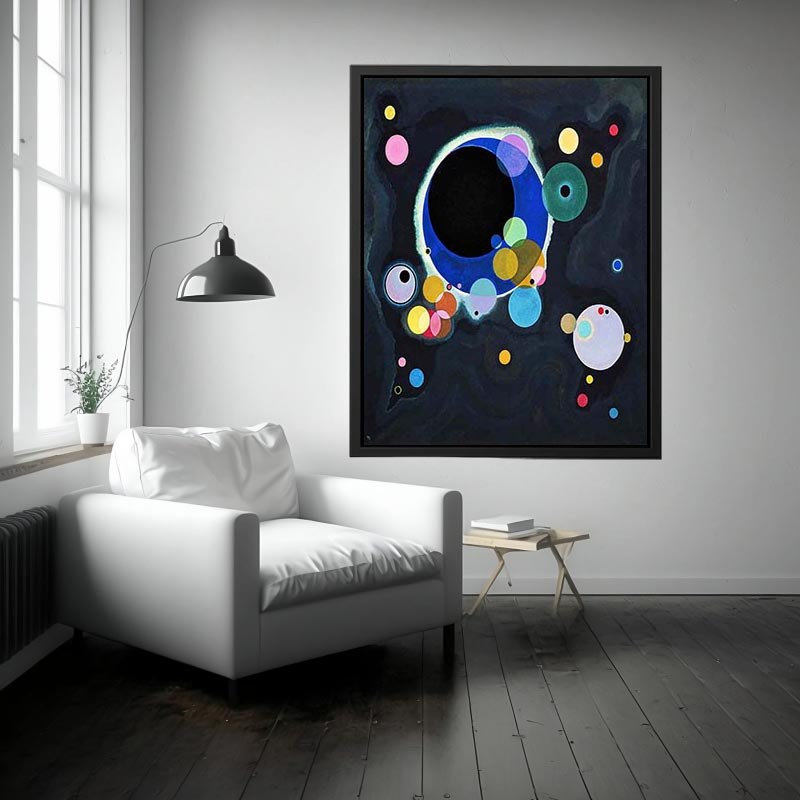
Several Circles Painting by Wassily Kandinsky
Several Circles stands as one of Wassily Kandinsky’s most refined and conceptually concentrated meditations on abstraction, a painting in which colour, geometry, and spatial tension are reduced to their essential relationships. Created in 1926, during Kandinsky’s Bauhaus period, the work reflects an artist who had reached a point of remarkable clarity in his lifelong pursuit of a universal visual language. Here, Kandinsky abandons expressive turbulence and narrative association in favour of balance, restraint, and philosophical precision. The result is a composition that appears deceptively simple yet unfolds with extraordinary depth through sustained attention.
By the mid-1920s, Kandinsky had already transformed the course of modern art. His early abstractions shattered the dependence on representation, while his theoretical writings articulated a belief in art as a spiritual and perceptual force. Several Circles belongs to a mature phase in which these ideas are no longer argued but demonstrated. The painting does not persuade through complexity or intensity. Instead, it asserts itself through order, proportion, and the quiet authority of form disciplined by thought.
The composition is anchored by a deep, dark ground upon which circles of varying size and colour appear to float, overlap, and recede. This background is not empty; it is an active field that absorbs and stabilises the chromatic events unfolding across it. Kandinsky’s decision to place the circles against a near-black ground intensifies their presence, allowing colour and geometry to emerge with heightened clarity. Space here is not illusionistic but relational, defined by contrast and interval rather than depth cues.
The circle, for Kandinsky, was never a neutral shape. He regarded it as the synthesis of opposites, combining the tension of straight lines with the continuity of curves. In Several Circles, this belief finds its most distilled expression. Each circle asserts itself as a complete entity, yet none exists in isolation. Their proximity creates dialogue. Larger forms exert gravitational pull, while smaller ones introduce rhythm and counterpoint. The painting becomes a field of interaction, where balance is continuously negotiated rather than fixed.
Colour functions with exceptional discipline. Kandinsky employs a restrained yet resonant palette: luminous blues, warm reds, muted yellows, whites, and subtle secondary tones. Each colour is calibrated in intensity and scale, ensuring harmony without uniformity. Blue circles tend to recede, creating depth and calm, while warmer hues advance, introducing energy and presence. These effects are not symbolic in a narrative sense; they are perceptual, shaping how the viewer experiences space and motion.
Light, as traditionally understood, is absent. There is no source, no shadow, no modelling. Instead, luminosity arises from colour itself. Certain circles appear to glow against the dark ground, while others seem absorbed into it. Kandinsky exploits this phenomenon with precision, demonstrating how colour alone can generate spatial sensation. The painting thus operates as a visual laboratory, revealing principles of perception while remaining fully resolved as an artwork.
Line is minimal and controlled. Circular edges are crisp, clearly defined, yet never rigid. Their clarity reinforces the painting’s intellectual tone. Kandinsky avoids expressive brushwork that might introduce subjective emphasis. Surface texture is subdued, allowing form and colour to dominate. This restraint is essential. The painting does not seek to impress through gesture; it invites understanding through structure.
Emotionally, Several Circles is composed and contemplative. It does not overwhelm the viewer, nor does it retreat into neutrality. Instead, it sustains a quiet tension, a sense of poised equilibrium. The viewer becomes aware of their own perceptual activity, of how attention shifts between forms, how relationships emerge through comparison. This self-awareness is central to Kandinsky’s intention. He believed that art should awaken inner perception, not merely depict external reality.
Symbolically, the painting resists fixed meaning. Kandinsky rejected literal symbolism, insisting that abstract form could communicate directly with the inner life. Yet the choice of circles, their measured distribution, and the cosmic suggestion of their floating arrangement have often been associated with ideas of order, unity, and infinity. These associations are not imposed by the artist but arise naturally through sustained engagement. The painting remains open, its meaning generated through experience rather than explanation.
Within Kandinsky’s artistic evolution, Several Circles represents a moment of synthesis and refinement. Earlier works explored abstraction through expressive force and chromatic intensity. Later Bauhaus compositions introduced increasing geometric clarity. Here, Kandinsky achieves a balance between these tendencies. The painting is neither emotional outpouring nor cold system. It is a measured articulation of belief: that abstraction, when guided by inner necessity and disciplined form, can communicate with lasting authority.
The cultural importance of Several Circles lies in its demonstration that modern abstraction need not rely on complexity to achieve depth. By reducing elements to circles and colour against darkness, Kandinsky reveals how much meaning can be generated through minimal means. This approach has influenced generations of artists, designers, and architects, shaping modern visual culture across the United States, the United Kingdom, Canada, Australia, and Europe.
In interior spaces, Several Circles introduces clarity and intellectual calm. In living rooms, it creates a focal point that encourages reflection rather than distraction. In studies and offices, it reinforces values of balance, focus, and disciplined creativity. In galleries and luxury residences, it signals an informed and confident engagement with one of the most significant achievements of twentieth-century abstraction.
The painting integrates seamlessly into traditional, modern, minimalist, and eclectic décor. In traditional interiors, it provides a powerful counterpoint that enlivens classical surroundings. In modern and minimalist spaces, it resonates naturally with architectural clarity and restrained palettes. Eclectic interiors find cohesion in its structured simplicity, which anchors diverse elements without competing for attention.
The enduring relevance of Several Circles lies in its refusal to separate intellect from sensation. Kandinsky demonstrates that abstraction can be both rigorous and deeply affecting, that simplicity can contain complexity, and that order can generate vitality. The painting remains meaningful because it does not belong to a specific moment or ideology. It belongs to perception itself.
To live with Several Circles is to engage daily with one of Kandinsky’s most lucid and confident expressions of abstract thought. Through its disciplined geometry, calibrated colour, and philosophical restraint, the painting continues to affirm art’s capacity to speak beyond representation, addressing the mind and senses directly. It stands as a testament to Kandinsky’s enduring belief that painting, at its highest level, functions as a universal language shaped by form, balance, and inner necessity.
Buy museum qulaity 400- 450 canvas prints, framed prints, and 100% oil paintings of Several Circles by Wassily Kandinsky at Alpha Art Gallery, where world-famous masterpieces are recreated with museum-quality detail, refined craftsmanship, and premium materials.
FAQS
What is the main idea behind Several Circles?
The painting explores how colour and circular form interact to create spatial and emotional experience without representation.
Why did Kandinsky choose circles as the sole dominant shape?
He believed the circle embodied unity and balance, making it ideal for expressing abstract harmony.
Is Several Circles connected to Kandinsky’s Bauhaus period?
Yes. It reflects the clarity, structure, and theoretical discipline of his Bauhaus years.
Does the painting represent planets or cosmic imagery?
While it may evoke cosmic associations, Kandinsky did not intend literal symbolism; meaning arises through perception.
Is Several Circles suitable for contemporary interiors?
Yes. Its restraint and clarity make it especially effective in modern, minimalist, and design-led spaces.
What emotional response does the painting tend to evoke?
It encourages calm concentration, balance, and perceptual awareness rather than dramatic emotion.
Does this artwork have lasting artistic significance?
As one of Kandinsky’s most refined abstractions, it holds enduring historical and cultural importance.
Where is the best place to display Several Circles?
It is ideally suited to living rooms, studies, offices, and gallery environments that value clarity and reflection.