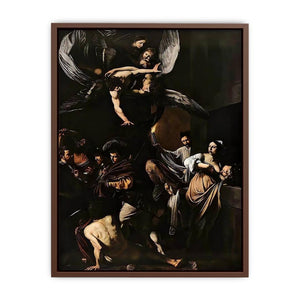
Seven Works of Mercy Painting by Caravaggio
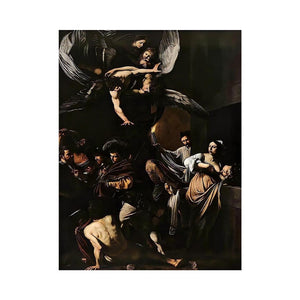
Seven Works of Mercy stands as one of Caravaggio’s most complex, urgent, and socially charged masterpieces, a painting in which charity is not idealised or allegorised but enacted through the raw immediacy of lived human experience. Executed in 1606–1607 during one of the most turbulent moments of the artist’s life, the work embodies a radical rethinking of sacred art. Here, mercy is not distant or ceremonial; it unfolds in the crowded streets of Naples, amid hunger, imprisonment, illness, death, and desperation. Caravaggio transforms theological instruction into a visceral encounter with human need.
The painting was commissioned for the Pio Monte della Misericordia, a charitable institution in Naples dedicated to the practice of corporal works of mercy. Rather than illustrating each act separately, as tradition might have suggested, Caravaggio compressed all seven works into a single nocturnal scene. This decision was revolutionary. It collapses doctrinal clarity into lived simultaneity, suggesting that mercy is not a sequence of discrete actions but a continuous condition of moral engagement. Compassion, the painting insists, is not orderly; it is chaotic, demanding, and immediate.
The composition is dense and vertical, drawing the viewer into a compressed urban space that feels both claustrophobic and alive. Figures press against one another, their bodies overlapping, gestures intersecting, stories colliding. There is no central hero, no privileged vantage point from which the scene can be comfortably surveyed. Instead, Caravaggio orchestrates a choreography of human need: a man feeding the hungry, another clothing the naked, a prisoner receiving sustenance, a corpse being prepared for burial, a thirsty man seeking drink, a pilgrim sheltered, the sick attended. These acts occur simultaneously, without hierarchy, reinforcing the painting’s moral premise that mercy is indivisible.
Perspective is deliberately destabilising. The viewer stands at street level, immersed in the scene rather than observing from above. There is no architectural order to guide the eye calmly through the narrative. Space is compressed and ambiguous, intensifying the sense of urgency. This refusal of clarity is intentional. Caravaggio denies the comfort of distance, forcing the viewer into proximity with suffering and response. One does not contemplate mercy here; one encounters it.
Light operates as the painting’s primary unifying force. Emerging from darkness, it falls selectively across faces, hands, and gestures, revealing acts of compassion while leaving the surrounding environment in shadow. This light does not glorify; it exposes. It isolates moments of mercy without transforming them into spectacle. The figures are illuminated not because they are saints, but because they are acting. Light becomes the visual equivalent of moral attention, revealing where care is being given rather than where holiness is assumed.
Colour is restrained and earthbound. Deep browns, muted reds, and heavy shadows dominate the palette, grounding the scene in material reality. Flesh tones are rendered with uncompromising honesty, emphasising hunger, age, fatigue, and vulnerability. There is no decorative richness, no chromatic excess to soften the scene’s gravity. Colour serves realism and coherence, binding disparate actions into a single moral atmosphere.
Caravaggio’s handling of paint intensifies the painting’s immediacy. Figures emerge from darkness with sculptural solidity, their forms defined by light rather than line. Wrinkled skin, strained muscles, coarse fabrics, and weary expressions are rendered without concession. The bodies in Seven Works of Mercy are not symbolic abstractions; they are physical, weighted, and mortal. This insistence on corporeality transforms charity from ideal to obligation. Mercy is shown as something enacted through bodies, not proclaimed through words.
Symbolically, the painting is radical in its refusal to separate the sacred from the profane. Angels appear above the scene, yet they do not dominate it. They hover, guiding and witnessing rather than intervening. The divine presence frames human action rather than replacing it. This compositional choice reinforces the painting’s central thesis: mercy is not a miracle bestowed from above; it is a responsibility carried out below. Salvation is enacted through action, not spectacle.
Emotionally, Seven Works of Mercy is intense without sentimentality. There is no indulgence in pity, no theatrical display of suffering for its own sake. Instead, the painting conveys urgency, exhaustion, and resolve. The figures act not because they are noble, but because need demands response. Viewers often experience discomfort alongside admiration, recognising both the painting’s technical mastery and its moral insistence. Caravaggio does not allow the viewer to remain neutral.
Within Caravaggio’s career, this work represents a profound synthesis of his artistic and ethical vision. Painted while the artist was in exile, fleeing legal and personal crisis, the painting reflects an acute awareness of vulnerability and dependence. It extends his commitment to realism beyond stylistic innovation into moral engagement. Seven Works of Mercy is not merely a religious commission fulfilled; it is a statement about what art can demand of those who look at it.
Culturally, the painting occupies a singular place in the history of Baroque art. It redefined how complex theological concepts could be visualised without didactic simplification. By embedding doctrine within contemporary urban life, Caravaggio ensured the painting’s relevance beyond its original context. The work continues to resonate in societies grappling with inequality, displacement, and moral responsibility, offering no solutions, only confrontation.
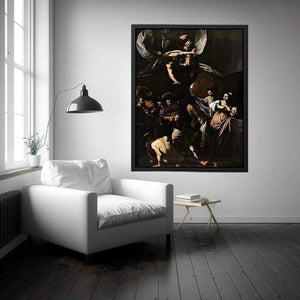
In contemporary interiors, Seven Works of Mercy commands attention through gravity and depth rather than ornament. In living rooms, it functions as a powerful focal point that invites discussion and reflection. In studies and offices, it communicates ethical seriousness, cultural literacy, and intellectual engagement. In galleries and refined residences across the United States, United Kingdom, Canada, Australia, and Europe, the painting integrates most effectively into spaces that value meaning over decoration. Its dark tonality and dynamic composition anchor space with authority, rewarding sustained contemplation.
The enduring relevance of Seven Works of Mercy lies in its uncompromising clarity about human obligation. Caravaggio presents mercy not as an abstract virtue, but as a series of concrete actions performed under pressure, in darkness, without assurance of recognition or reward. The painting insists that compassion is not optional, not orderly, and not comfortable. In confronting viewers with this reality, Seven Works of Mercy remains one of the most powerful visual arguments for ethical engagement ever made, transforming doctrine into demand and art into responsibility.
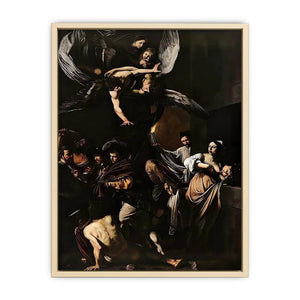
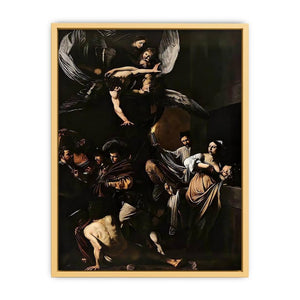
Buy museum qulaity 400- 450 canvas prints, framed prints, and 100% oil paintings of Seven Works of Mercy by Caravaggio at Alpha Art Gallery, where world-famous masterpieces are recreated with museum-quality detail, refined craftsmanship, and premium materials.
FAQS
What are the Seven Works of Mercy depicted in Caravaggio’s painting?
They are feeding the hungry, giving drink to the thirsty, clothing the naked, sheltering the homeless, visiting the sick, visiting the imprisoned, and burying the dead.
Why did Caravaggio combine all seven acts into one scene?
He wanted to show mercy as a continuous, lived reality rather than a set of isolated actions.
Where is the painting originally displayed?
It was painted for the Pio Monte della Misericordia in Naples, a charitable institution.
How does light function in Seven Works of Mercy?
Light isolates acts of compassion within darkness, directing moral attention rather than glorifying figures.
Are there saints depicted in the painting?
The figures are ordinary people; holiness is expressed through action, not status.
Why does the painting feel so crowded and intense?
The compressed space reflects the urgency and chaos of human need in urban life.
Is Seven Works of Mercy suitable for contemporary interiors?
Yes, particularly in spaces that value ethical depth, cultural significance, and serious reflection.
Why does Seven Works of Mercy remain relevant today?
Its confrontation with poverty, responsibility, and human compassion resonates strongly in the modern world.