Selling Slaves in Rome Painting by Jean Léon Gérôme
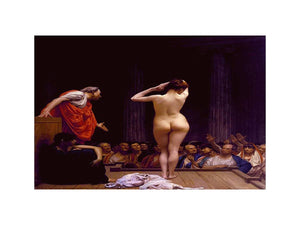
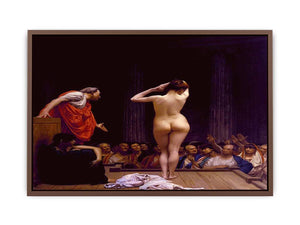
Selling Slaves in Rome Painting by Jean Léon Gérôme is one of the most severe and intellectually demanding works of nineteenth-century academic painting, a composition in which technical brilliance is harnessed to confront a system of legalized human commodification. Painted in the context of Gérôme’s sustained engagement with classical antiquity, the work does not offer moral comfort or narrative resolution. Instead, it presents slavery as an institutional fact—public, orderly, and normalized—forcing the viewer to confront the mechanisms by which cruelty becomes routine through law, ritual, and social consensus.
By the time Gérôme undertook this subject, Jean-Léon Gérôme had established himself as one of the most exacting practitioners of academic realism in Europe. His reputation rested on archaeological rigor, impeccable finish, and an uncompromising belief that clarity was a moral as well as artistic virtue. Gérôme did not soften history to accommodate sentiment. He believed that the past, when rendered precisely, revealed its own ethical weight. Selling Slaves in Rome exemplifies this conviction with unflinching discipline.
The subject is drawn from ancient Roman practice, where enslaved individuals were bought and sold openly in public markets. Gérôme situates the scene within a classical architectural setting, lending it the authority and permanence associated with Roman civilization. This choice is deliberate. The painting does not isolate slavery as aberration or excess; it embeds it within the very structures of law, culture, and urban life. Slavery here is not hidden. It is administered.
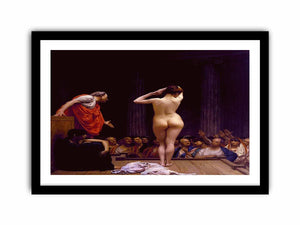
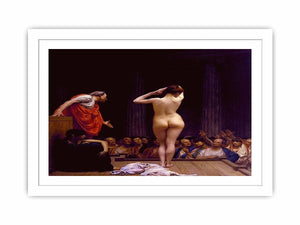
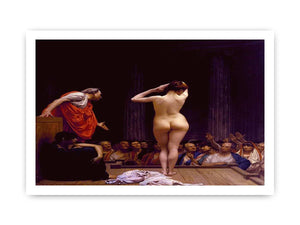
Compositionally, the painting is carefully balanced and hierarchically arranged. Enslaved figures occupy the central foreground, positioned for inspection, while prospective buyers and officials surround them with composed detachment. The spatial organization reinforces power relations. Bodies are arranged horizontally for evaluation, while clothed figures stand upright, observing and judging. Gérôme uses placement and posture to articulate dominance without exaggeration. Authority is expressed through stance and distance rather than violence.
Perspective places the viewer in a position analogous to that of the onlooker within the market. One is not elevated above the scene nor absorbed into it emotionally. Instead, the viewer is granted a clear, frontal view that mirrors the logic of inspection itself. This is a crucial ethical decision. Gérôme refuses to guide emotional response through compositional bias. He presents the system as it functions and leaves the viewer to reckon with the implications.
Light is even, controlled, and revealing. Gérôme avoids dramatic chiaroscuro or theatrical emphasis. Illumination exposes bodies, stone, and fabric with equal clarity. The enslaved figures are fully visible, their physical presence undeniable. At the same time, the calm consistency of light reinforces the unsettling normality of the scene. Nothing is hidden. Nothing is dramatized. Slavery appears not as chaos, but as procedure.
The color palette is restrained and sober. Earth tones, muted flesh colors, and stone greys dominate the composition. There is no chromatic indulgence. Gérôme avoids sensual warmth or painterly flourish, ensuring that color does not distract from structure. Flesh is rendered as material fact rather than idealized form. This chromatic discipline reinforces the painting’s ethical severity.
Gérôme’s technique is exacting and impersonal. Brushwork is smooth to the point of invisibility, eliminating expressive gesture. Surfaces appear cool, polished, and stable. This suppression of painterly emotion is central to the painting’s effect. The scene feels disturbingly orderly. Gérôme does not aestheticize suffering through expressive distortion. Instead, he renders cruelty with bureaucratic precision, allowing realism itself to indict the system.
Symbolically, Selling Slaves in Rome is a study in dehumanization through normalization. The enslaved figures are presented as objects of valuation—measured, compared, and assessed—while remaining fully human in their physical presence. Gérôme does not erase individuality, but neither does he dramatize resistance or despair. The absence of overt emotion intensifies the painting’s moral gravity. Slavery here is not cruelty driven by passion. It is cruelty sustained by structure.
Psychologically, the painting is profoundly unsettling because of its restraint. The buyers are not depicted as villains. They are composed, attentive, and lawful. The enslaved figures do not cry out or collapse theatrically. They endure. Gérôme thus confronts the viewer with a more disturbing truth: systems of oppression persist not because of monstrous individuals alone, but because ordinary people participate without reflection. The painting implicates spectatorship itself.
Within Gérôme’s broader body of work, this painting occupies a critical position alongside works such as Pollice Verso, where public spectacle and institutional violence intersect. In both, Gérôme examines how societies legitimize cruelty through ritual and consensus. Unlike Romantic depictions of suffering, his approach is analytical and unsentimental. He does not seek empathy through emotional manipulation. He demands ethical attention through clarity.
Culturally, Selling Slaves in Rome reflects nineteenth-century Europe’s complex relationship with antiquity. While classical Rome was often celebrated as a foundation of Western civilization, Gérôme insists on confronting its moral contradictions. The painting does not deny Roman achievement. It contextualizes it. In doing so, it challenges idealized visions of the past and raises enduring questions about how civilizations reconcile greatness with injustice.
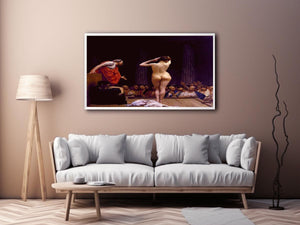
In contemporary interiors across the United States, the United Kingdom, Canada, Australia, and Europe, Selling Slaves in Rome carries exceptional intellectual weight. In studies, libraries, and offices, it communicates historical seriousness and ethical inquiry. In galleries and luxury residences, it anchors space with gravity and reflective authority. Its disciplined composition and muted palette allow it to integrate seamlessly into traditional, neoclassical, and modern interiors, where it functions not as decoration but as provocation.
The painting remains meaningful today because it addresses the mechanics of exploitation rather than its spectacle. In a world still confronting histories of slavery and systems of inequality, Gérôme’s work offers no reassurance. It offers clarity. Selling Slaves in Rome reminds the viewer that injustice often operates most efficiently when it appears orderly, lawful, and culturally sanctioned.
Selling Slaves in Rome Painting by Jean Léon Gérôme endures as one of the most ethically challenging works of academic art. Through compositional rigor, technical restraint, and uncompromising realism, Gérôme transformed a historical practice into a timeless examination of power, commodification, and moral responsibility. The painting does not accuse loudly. It exposes quietly.
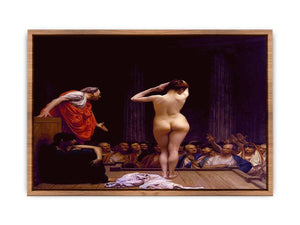
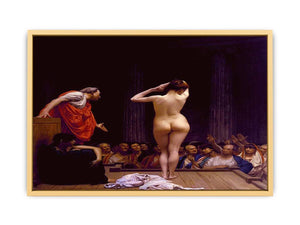
Buy museum qulaity 400- 450 canvas prints, framed prints, and 100% oil paintings of Selling Slaves in Rome by Jean Léon Gérôme at Alpha Art Gallery, where world-famous masterpieces are recreated with museum-quality detail, refined craftsmanship, and premium materials.
FAQs
What does Selling Slaves in Rome depict?
It depicts a public Roman slave market, presenting slavery as an institutionalized social practice.
Is the painting meant to condemn slavery?
Gérôme avoids overt moralizing, allowing realism and clarity to reveal the system’s cruelty.
Why is the scene so emotionally restrained?
Restraint emphasizes normalization and bureaucratic order rather than individual outrage.
How does Gérôme use composition to show power dynamics?
Standing figures observe while enslaved figures are positioned for inspection, reinforcing hierarchy.
What makes this painting unsettling to modern viewers?
Its calm precision presents injustice as routine rather than chaotic.
How does this work relate to Gérôme’s Pollice Verso?
Both examine institutional violence upheld by public consensus.
Why does the painting remain relevant today?
It prompts reflection on how systems legitimize exploitation.
Where does this artwork work best in interiors?
It is ideal for studies, libraries, galleries, and spaces devoted to history and ethical reflection.