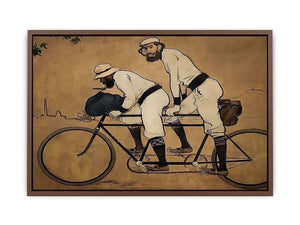
Self Portrait of Casas with Pere Romeu on a Tandem Painting by Ramon Casas
Self Portrait of Casas with Pere Romeu on a Tandem Painting by Ramon Casas is one of the most incisive and modern self-representations in European art at the turn of the twentieth century, a work that fuses personal identity, cultural ambition, and social commentary into a single, unforgettable image. Painted in 1897, the canvas captures not merely two figures in motion, but an entire moment in the intellectual life of Barcelona, when modernity, speed, and artistic self-consciousness redefined how artists positioned themselves within society. Casas transforms the self-portrait from introspective mirror into public statement, asserting the artist as participant in, rather than observer of, modern life.
Ramon Casas was a central figure of Catalan Modernisme, a movement that sought to align Barcelona with the cultural and artistic innovations of Paris while retaining a distinct local identity. Educated in France and deeply engaged with contemporary European currents, Casas developed a visual language characterized by economy, clarity, and psychological intelligence. In this painting, he achieves one of his most original syntheses, combining portraiture, genre, and symbolism with striking conceptual simplicity.
The subject depicts Casas himself riding a tandem bicycle with Pere Romeu, the flamboyant impresario and co-founder of the legendary café Els Quatre Gats, a hub of avant-garde culture in Barcelona. The choice of a tandem bicycle is central to the painting’s meaning. It is not merely a novelty or anecdote, but a symbol of shared direction, coordinated effort, and modern momentum. Casas positions himself at the front, steering, while Romeu rides behind, pedaling with exaggerated enthusiasm. The image suggests collaboration without equality, leadership without domination.
Compositionally, the painting is radical in its reduction. The background is stripped of detail, rendered as an abstracted, neutral ground that denies narrative distraction. This emptiness is deliberate. By removing environmental specificity, Casas universalizes the action, allowing movement and relationship to become the sole focus. The figures and the bicycle cut sharply across the canvas, their diagonal thrust conveying speed and purpose with remarkable economy.
Perspective reinforces this sense of forward motion. The tandem advances toward the viewer at an angle, creating immediacy without aggression. The viewer is not placed in the path of collision, but in the position of witness to progress. Casas’s control of spatial ambiguity—neither fully shallow nor conventionally deep—keeps attention fixed on the figures themselves, emphasizing identity and intent over setting.
Line and contour are among the painting’s most distinctive features. Casas employs clean, confident outlines to define figures and machine alike, reflecting his background in poster design and graphic art. The clarity of line contributes to the painting’s modern character, aligning it with the emerging visual language of advertising and illustration. Yet this graphic precision is never cold. It serves psychological insight, allowing posture and silhouette to communicate character with immediacy.
Color is restrained and purposeful. Casas limits his palette, favoring muted tones that reinforce unity and clarity. Clothing is rendered without ornamental flourish, emphasizing function over decoration. The tandem bicycle itself becomes a compositional spine, its mechanical geometry contrasting with the organic forms of the riders. Color here supports structure and meaning rather than sensory pleasure.
The contrast between the two figures is essential. Casas presents himself as composed, focused, and controlled, his posture upright and assured. Pere Romeu, by contrast, appears animated and slightly unruly, his expression and movement suggesting exuberance and theatricality. This duality is affectionate rather than critical. Casas acknowledges Romeu’s role as catalyst and promoter while asserting his own position as guiding intelligence. The painting thus becomes a nuanced study of partnership, where different temperaments contribute to shared cultural movement.
Emotionally, the work is cool, confident, and subtly ironic. There is humor in the exaggerated pedaling of Romeu and in the very choice of a tandem as subject. Yet the humor is restrained, never descending into caricature. Casas maintains a tone of self-awareness, presenting himself not as romantic genius, but as modern professional—mobile, public, and engaged with contemporary life.
Symbolically, the bicycle represents modernity itself: speed, technology, and the collapse of traditional hierarchies. By placing himself on a bicycle rather than on a pedestal or in a studio, Casas rejects the notion of the artist as isolated creator. Instead, he aligns artistic identity with movement, collaboration, and public visibility. The tandem suggests that cultural progress is collective, even when guided by individual vision.
Within Casas’s artistic career, this painting stands as one of his most iconic statements. While he was celebrated for portraits of Barcelona’s elite and for elegant depictions of social life, Self Portrait of Casas with Pere Romeu on a Tandem reveals his conceptual daring. It demonstrates his ability to condense personal biography, social observation, and symbolic meaning into a single, lucid image.
Culturally, the painting has become emblematic of Barcelona’s fin-de-siècle modernism. It captures a city in transition, eager to define itself as progressive, cosmopolitan, and artistically ambitious. The work resonates beyond its local context, speaking to broader European concerns with speed, identity, and the role of the artist in a rapidly changing world.
In contemporary interiors across the United States, the United Kingdom, Canada, Australia, and Europe, Self Portrait of Casas with Pere Romeu on a Tandem integrates with striking sophistication. In living rooms, it introduces wit, confidence, and cultural intelligence. In studies and offices, it reflects leadership, collaboration, and forward-thinking identity. In galleries and luxury residences, it signals deep engagement with modern art history and the origins of visual modernity.
The painting works seamlessly in modern and minimalist interiors, where its graphic clarity and conceptual strength resonate powerfully. It also complements eclectic spaces, where its historical significance and playful symbolism enrich layered environments. Even in traditional settings, the work functions as a dynamic counterpoint, introducing movement and modern sensibility without visual discord.
The long-term artistic importance of Self Portrait of Casas with Pere Romeu on a Tandem lies in its redefinition of self-portraiture. Casas demonstrates that to depict oneself is not merely to record appearance, but to declare position within culture and time. The painting endures because it captures the artist not as solitary figure, but as agent of movement, collaboration, and change.
Today, the work remains remarkably contemporary. Its themes of partnership, direction, and modern identity continue to resonate in a world defined by speed and collective endeavor. Through compositional economy, psychological insight, and symbolic clarity, Ramon Casas created an image that transcends biography to become a lasting statement on what it means to move forward together, guided by vision and intent.
Buy museum qulaity 400- 450 canvas prints, framed prints, and 100% oil paintings of Self Portrait of Casas with Pere Romeu on a Tandem by Ramon Casas at Alpha Art Gallery, where world-famous masterpieces are recreated with museum-quality detail, refined craftsmanship, and premium materials.
FAQS
Who is depicted alongside Ramon Casas in this painting?
The second figure is Pere Romeu, a cultural impresario and co-founder of the influential Barcelona café Els Quatre Gats.
What does the tandem bicycle symbolize?
It symbolizes modernity, collaboration, and shared direction, with Casas asserting leadership through position and posture.
Why is the background so minimal?
The abstract background removes distraction, focusing attention on movement, identity, and symbolic meaning.
Is this painting meant to be humorous?
It contains subtle humor, but remains intellectually controlled and conceptually serious.
How does this work redefine self-portraiture?
It presents the artist as a public, modern figure engaged in collective cultural progress rather than private introspection.
Where does this artwork work best in interior spaces?
It is ideal for living rooms, studies, offices, galleries, and refined contemporary interiors.
Does the painting have lasting artistic significance?
Yes, it is considered a landmark of Catalan Modernisme and an early expression of modern artistic identity.