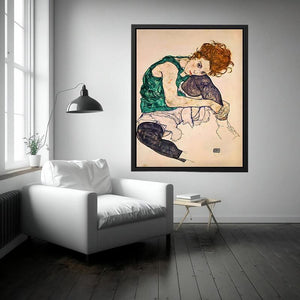
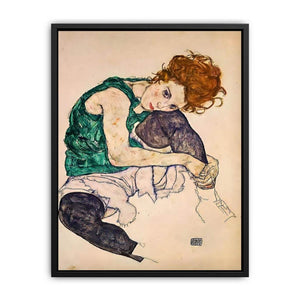
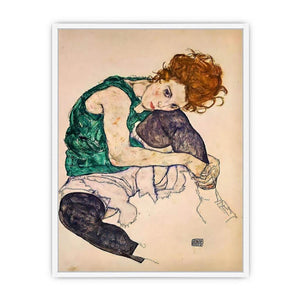
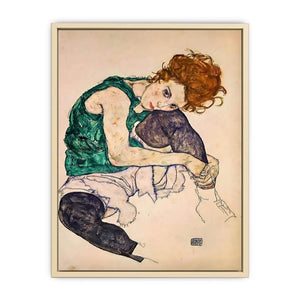
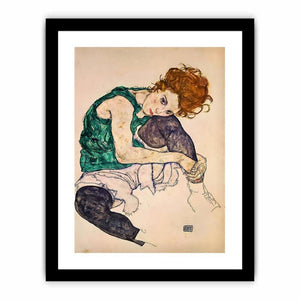
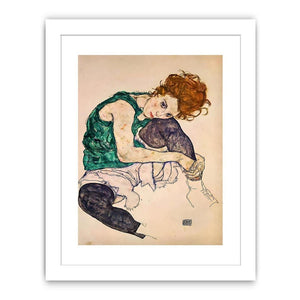
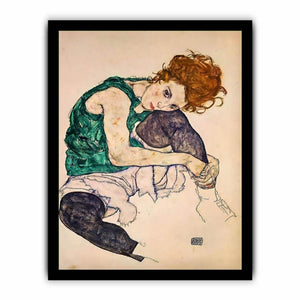
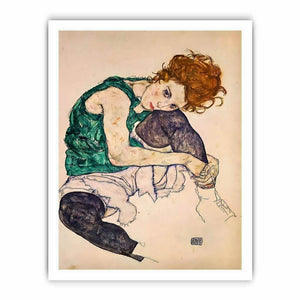
Seated Woman with Bent Knee Painting by Egon Schiele
Seated Woman with Bent Knee stands as one of Egon Schiele’s most psychologically charged and uncompromising studies of the human figure, a work in which the body becomes a site of tension, vulnerability, and existential exposure. Created during Schiele’s mature period in the early twentieth century, the painting embodies his radical break from academic idealisation and his insistence on confronting the viewer with the raw conditions of being. In this work, the female figure is not offered as an object of beauty or narrative interest; she is presented as presence—self-contained, alert, and unavoidably real.
Egon Schiele emerged within the charged cultural atmosphere of Vienna at a moment when traditional structures—moral, aesthetic, and psychological—were undergoing profound upheaval. Influenced by, yet ultimately diverging from, the decorative sensuality of the Vienna Secession, Schiele developed a language of line and form that was deliberately abrasive. His figures do not soothe; they unsettle. Seated Woman with Bent Knee reflects this ethos with particular clarity. It is not an image designed to please, but one that insists on confrontation between subject and viewer.
The composition is stark and immediate. The woman occupies the pictorial field with little contextual distraction, her body turned inward, one knee raised and bent, compressing the figure into a tense, angular configuration. This posture denies classical balance and repose. Instead of open gesture or relaxed symmetry, Schiele presents contraction and alertness. The figure seems both exposed and guarded, asserting presence while resisting access. The absence of a detailed environment intensifies this effect, isolating the body as the sole bearer of meaning.
Perspective in Seated Woman with Bent Knee is intimate yet unsettling. The viewer is placed close to the figure, close enough to register the sharpness of limbs and the immediacy of flesh, yet denied any reciprocal engagement. The woman’s posture turns inward, creating a psychological barrier that prevents easy identification or empathy. Schiele does not offer a comfortable vantage point. The proximity forces awareness of physicality without the reassurance of narrative or ideal form.
Line is the painting’s most decisive expressive element. Schiele’s contour lines are sharp, broken, and deliberately uneven, tracing the body with nervous intensity. These lines do not smooth or idealise; they expose tension. Limbs appear elongated and angular, joints accentuated rather than concealed. The line functions not merely as outline, but as psychological register, recording the strain and fragility of embodied existence. In Schiele’s hands, drawing becomes an act of excavation rather than description.
Colour is applied with restraint and intention. Flesh tones are pale, sometimes sallow, interrupted by areas of heightened pigmentation that suggest vulnerability rather than warmth. Schiele avoids the luminous modelling of academic nudes, opting instead for flattened planes and abrupt transitions. Surrounding colour is minimal, often neutral, allowing the body to dominate the visual field without atmospheric mediation. Colour here does not beautify; it exposes.
The handling of paint reinforces this exposure. Surfaces are not blended into illusionistic smoothness. Instead, paint is allowed to remain present, reinforcing the materiality of both body and medium. The figure feels constructed rather than idealised, as though assembled through observation rather than imagined perfection. Schiele’s technique underscores his belief that truth lies in tension and incompleteness rather than harmony.
Psychologically, Seated Woman with Bent Knee is marked by an intense inwardness. The figure does not perform, pose, or invite the viewer’s gaze. She appears absorbed within her own physical and mental state, neither passive nor confrontational, but alert. This self-containment grants the figure a form of autonomy that resists objectification, even as her exposure creates discomfort. Schiele’s nudes often exist within this paradox: they are vulnerable yet defiant, exposed yet self-possessed.
Symbolically, the painting resists conventional allegory. The woman does not represent myth, morality, or narrative type. Instead, she embodies a modern understanding of the self as fractured, tense, and acutely aware. Schiele’s work reflects a broader cultural shift toward psychological introspection and existential anxiety. The bent knee, compressed posture, and sharpened contours suggest a body responding to inner pressure rather than external action. Meaning arises through physical state rather than symbolic reference.
Emotionally, the painting is confrontational without being theatrical. There is no drama of gesture or expression, yet the figure radiates intensity. Viewers often experience unease, not because of explicit content, but because Schiele denies the comforts traditionally associated with the nude. There is no ideal beauty to admire, no narrative to follow. Instead, one encounters a body rendered with uncompromising honesty, demanding recognition rather than desire.
Within Schiele’s artistic development, Seated Woman with Bent Knee exemplifies his mature approach to figuration. It reflects his rejection of decorative surface in favour of psychological depth and structural tension. While influenced by Gustav Klimt’s early mentorship, Schiele moved decisively toward a harsher, more introspective vision. This painting demonstrates his belief that art’s task was not to console, but to reveal—to strip away illusion and confront the viewer with the conditions of existence.
Culturally, the work occupies a crucial place in the evolution of modern art. Schiele’s treatment of the body challenged prevailing norms of representation and morality, provoking both scandal and admiration. His figures anticipated later developments in Expressionism and existential art, where the body becomes a vehicle for psychological truth rather than aesthetic pleasure. Seated Woman with Bent Knee stands as a testament to this shift, marking a decisive break from idealised humanism.
In contemporary interiors, Seated Woman with Bent Knee integrates with striking intellectual presence and emotional gravity. In studies, galleries, and private collections, it communicates seriousness, psychological depth, and cultural awareness. In modern and minimalist spaces across the United States, United Kingdom, Canada, Australia, and Europe, the painting functions as a powerful focal work, its stark composition and restrained palette resonating with contemporary architectural clarity. It does not decorate a space; it defines it.
The enduring relevance of Seated Woman with Bent Knee lies in its refusal to soften reality. Schiele presents the human body not as symbol or ornament, but as lived condition—tense, vulnerable, and alert. The painting endures because it confronts viewers with a truth that remains unsettling and necessary: that identity is inseparable from physical presence, and that self-awareness often manifests through tension rather than ease. In this uncompromising vision, Egon Schiele offers not comfort, but clarity, ensuring the work’s continued resonance in any age willing to face itself without illusion.
Buy museum qulaity 400- 450 canvas prints, framed prints, and 100% oil paintings of Seated Woman with Bent Knee by Egon Schiele at Alpha Art Gallery, where world-famous masterpieces are recreated with museum-quality detail, refined craftsmanship, and premium materials.
FAQS
What does Seated Woman with Bent Knee by Egon Schiele depict?
It depicts a seated female figure in a tense, inward posture, emphasising psychological intensity and physical presence rather than idealised beauty.
Why does the figure appear angular and distorted?
Schiele intentionally exaggerates line and proportion to express inner tension and emotional truth.
Is the painting meant to be erotic?
No, it resists eroticisation, presenting the body as vulnerable and self-contained rather than inviting.
What role does line play in this artwork?
Line is central, functioning as a psychological and expressive force rather than a descriptive outline.
How does this work reflect Schiele’s artistic philosophy?
It reflects his rejection of idealisation and his focus on exposing the human condition through tension and introspection.
Is there symbolic meaning in the bent knee posture?
The posture suggests contraction and alertness, conveying inner pressure rather than symbolic narrative.
Is Seated Woman with Bent Knee suitable for contemporary interiors?
Yes, its stark composition and emotional depth resonate strongly within modern and minimalist spaces.
Why does Seated Woman with Bent Knee remain relevant today?
Its honest exploration of vulnerability, identity, and physical presence continues to speak powerfully to modern audiences.